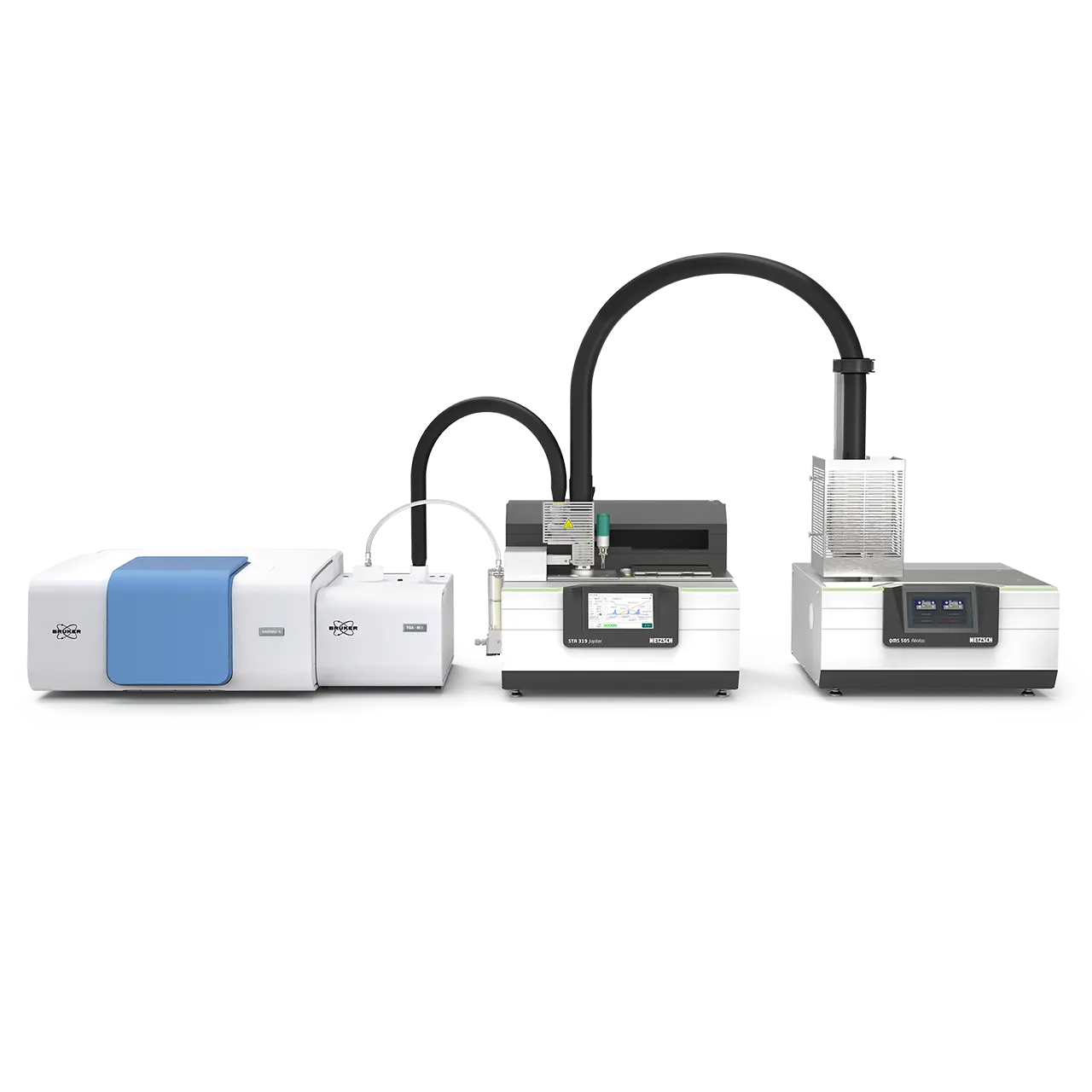
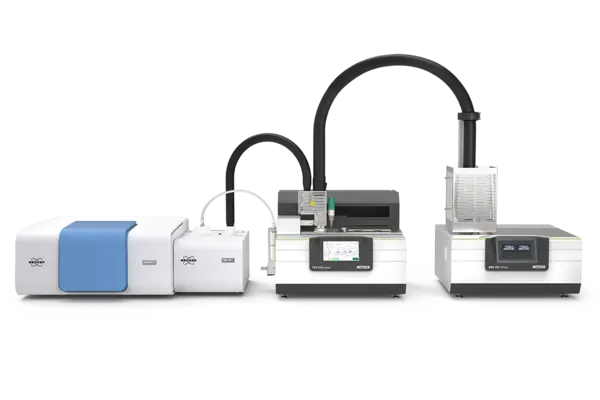
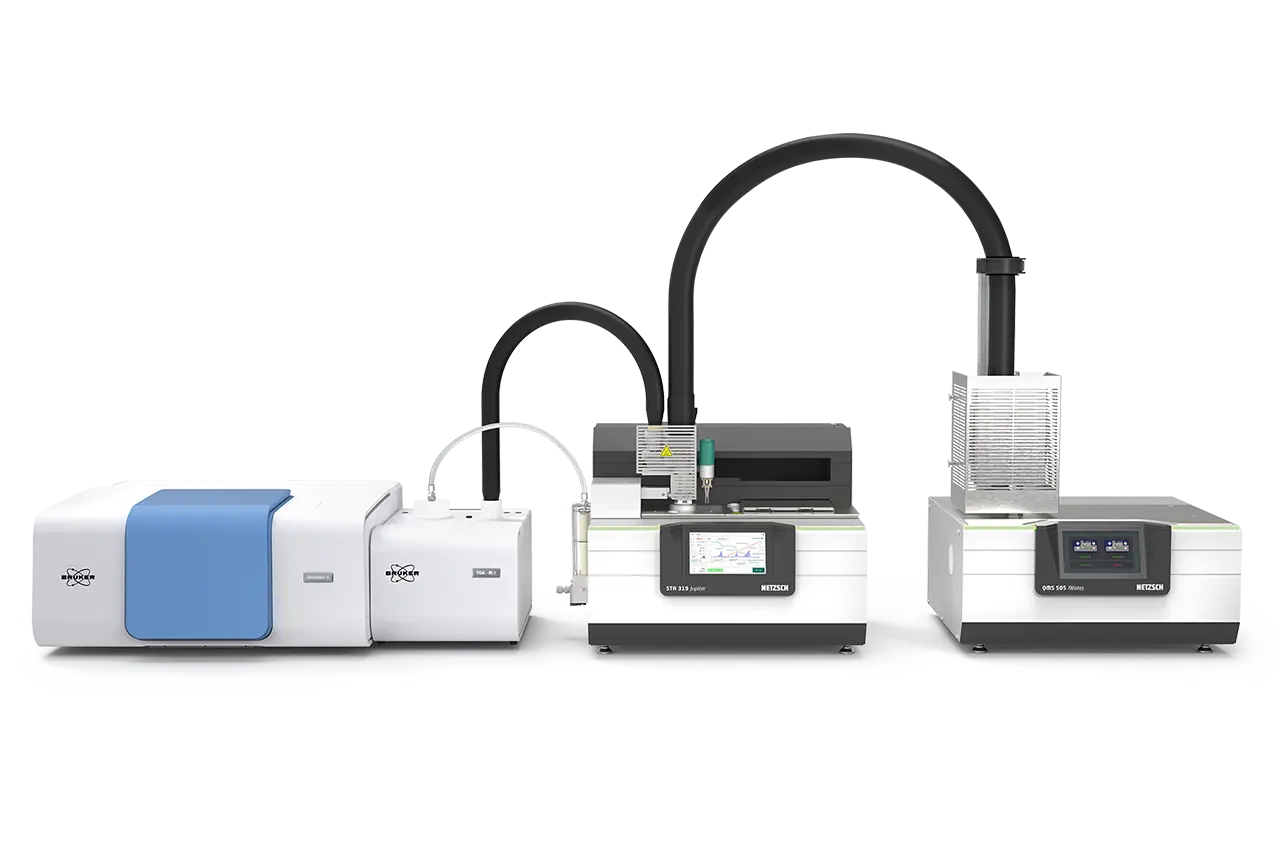
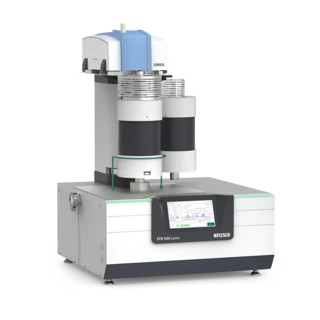
STA 319 Jupiter® Coupled to Bruker's INVENIO via Transfer Line
The Perfect STA-FT-IR Coupling Solution
Highlights
Thermal Analysis Plus FT-IR - More Than Just the Sum of Its Parts
The NETZSCH STA 319 Jupiter® with FT-IR coupling combines simultaneous thermal analysis — TGA and DSC signals from one and the same sample — with advanced gas phase detection via FT-IR spectroscopy. This powerful setup enables a deeper understanding of decomposition, oxidation, phase transitions, and other thermal processes by correlating mass changes and thermal effects with the identification of gases evolved upon heating.
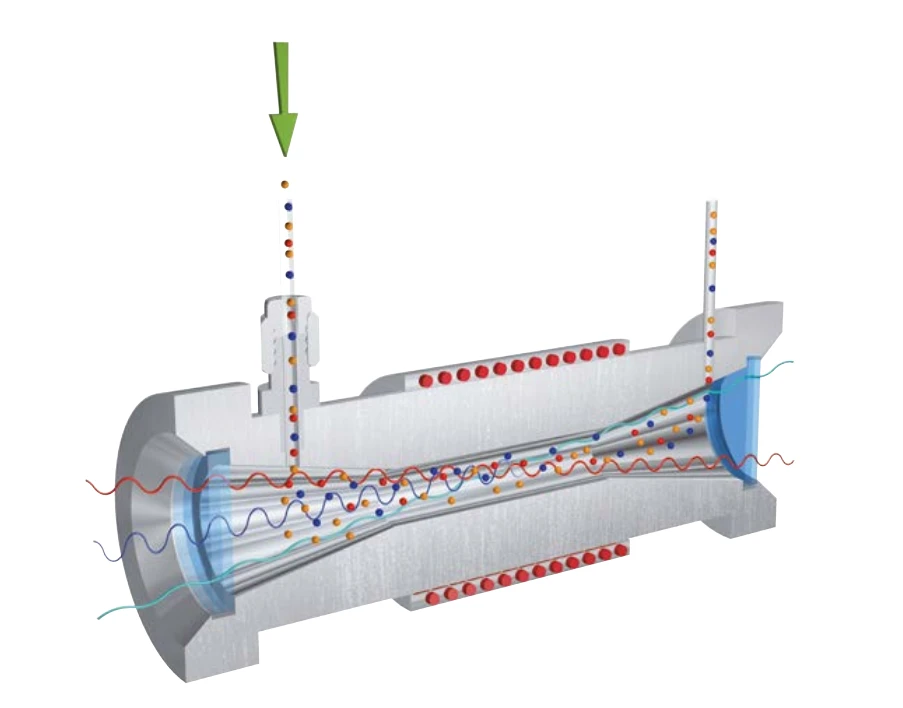
With its robust, water-cooled ceramic furnace, advanced top-loading microbalance, and vacuum-tight design, the STA 319 Jupiter® provides reliable measurements under defined atmospheric conditions. When combined with a heated transfer line, evolved gases can be transferred safely and efficiently from the furnace outlet to the FT-IR gas cell, supporting accurate and condensation-free gas analysis, even for reactive or condensable species.
Coupled with the Bruker INVENIO FT-IR platform, the system delivers high spectral resolution and sensitivity across a broad range of applications, including polymers, chemicals, pharmaceuticals, life science materials, and inorganics. The seamless integration of NETZSCH Proteus® and Bruker OPUS software ensures synchronized data acquisition, allowing users to directly correlate TGA and DSC events with specific gas species and reaction mechanisms.
This modular STA solution opens new possibilities in simultaneous thermal analysis and hyphenated techniques. By combining thermal effects, mass changes, and evolved gas analysis in one workflow, the STA 319 Jupiter® provides comprehensive insights into material behavior — from routine quality control to advanced R&D applications.
Method
Fourier Transform Infrared (FT-IR) Spectrometers Coupled to Thermal Analysis
Thermal analysis provides ideal tools for the characterization of a variety of organic and inorganic solids and liquids. Thermodynamic transitions, thermal stability, decomposition, and chemical reactions can be detected and quantified with high accuracy over a broad temperature range.
In some cases, however, information about the type of evolved gases is needed to gain a clearer understanding of the chemistry behind the processes. Coupling thermal analysis with powerful infrared spectroscopy for gas analysis bridges this gap. It allows for a deeper insight into the material’s behavior and provides a spectral fingerprint of the gases evolved from the sample when heated..
The Proteus® software for thermal analysis and the OPUS software for FT-IR measurements are seamlessly integrated to enable efficient Thermal Analysis-to-FT-IR coupling. The temperature and time correlations of all experimental data are carefully preserved throughout the process.
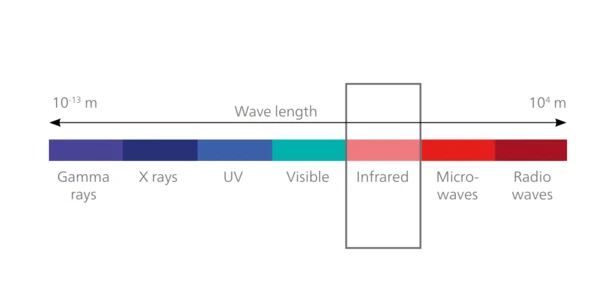
Infrared spectroscopy
A espectroscopia infravermelha é uma técnica clássica baseada na absorção da radiação infravermelha pelas vibrações das ligações moleculares. Essa absorção ocorre quando as ligações vibram de maneiras específicas. No entanto, apenas as vibrações que causam uma alteração no momento dipolar podem interagir com a luz infravermelha. É por isso que a maioria das substâncias produz um espectro característico, enquanto moléculas homonucleares — como O₂ e N₂ — ou gases nobres não apresentam bandas fundamentais de absorção no infravermelho, devido à ausência de alterações no momento dipolar durante as vibrações.
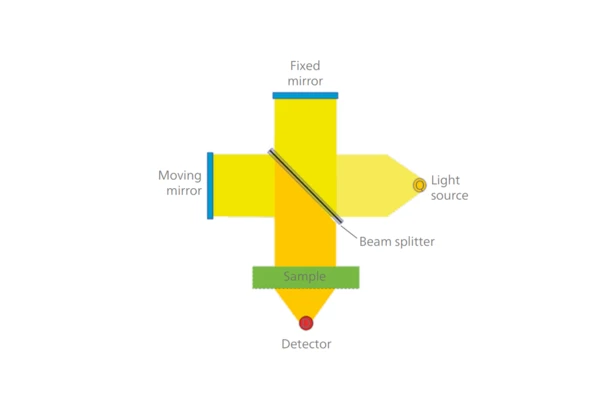
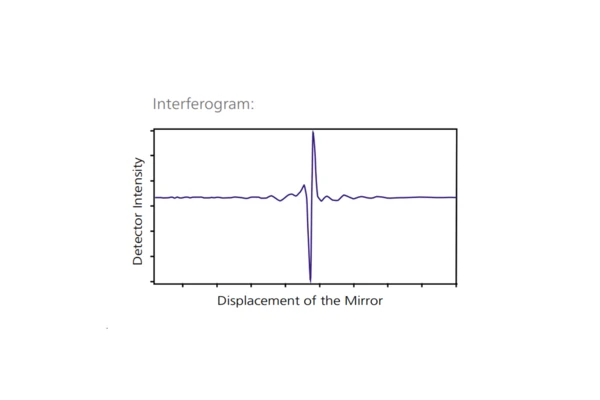
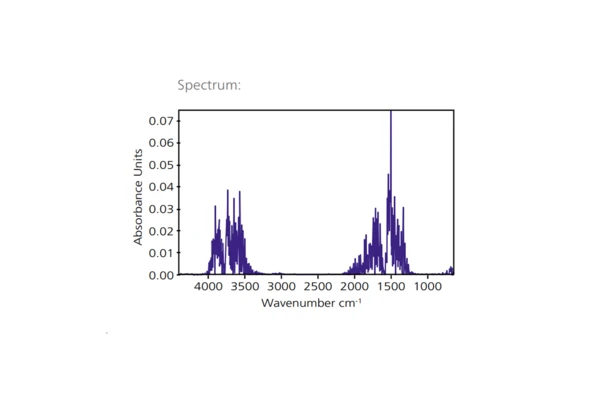
Working principle of a FT-IR spectrometer
An infrared light beam, depicted in the diagram as coming from the source on the right, is split into two paths by a beam splitter. One path is directed toward a fixed mirror and reflected, while the other is reflected by a moving mirror.
After reflection, the two beams are recombined and interfere with each other. The resulting interference pattern depends on the distance between the two mirrors — which changes as the moving mirror shifts position — and the frequencies present in the beam.
This process generates an interferogram, a signal typically characterized by a central burst and flat wings. The central burst occurs when both mirrors are equidistant from the beam splitter, allowing all frequencies to interfere constructively.
Finally, the interferogram is mathematically transformed into a spectrum using a Fourier Transform, revealing the sample’s infrared absorption characteristics.

Over 30 Years of Successful Cooperation
For over 30 years, NETZSCH and Bruker have collaborated to provide integrated solutions for thermal analysis and gas analysis. This longstanding partnership combines NETZSCH's expertise in thermal analysis with Bruker's leadership in FT-IR technology, offering customers reliable, high-quality systems tailored to their needs. Together, we deliver innovative, user-friendly solutions from a single source, ensuring seamless operation and exceptional support.
Advantages of our Cooperation at a Glance:
- Seamless integration: Optimized coupling of NETZSCH thermal analyzers with Bruker FT-IR spectrometers for reliable and efficient evolved gas analysis.
- Proven expertise: Decades of joint experience ensure high-quality, innovative solutions tailored to customer needs.
- Single-source convenience: Fully compatible systems with comprehensive support from both partners.
- Enhanced performance: Precise coordination of instruments delivers accurate and reproducible results.
- Continuous innovation: Collaboration fosters the development of cutting-edge technologies and features for advanced analysis.
- Effortless Compatibility with Bruker's OPUS Software: At NETZSCH, we offer seamless compatibility with Bruker’s OPUS software, allowing for a smooth workflow between both systems. This ensures an integrated and efficient experience, making the most out of both instruments.
Specifications
Gas cell volume and length
Temperature of transfer line
Detector
Wave number range:
FT-IR: 8000 cm-1 to 340 cm-1
Coupling: 4400 cm-1 to 600 cm-1
Resolution:
better than 0.4 cm-1
Furnace adaptor:
max. 400°C
Transfer line material:
Stainless steel (exchangeable)
Window material gas cell:
KBr
Acessories
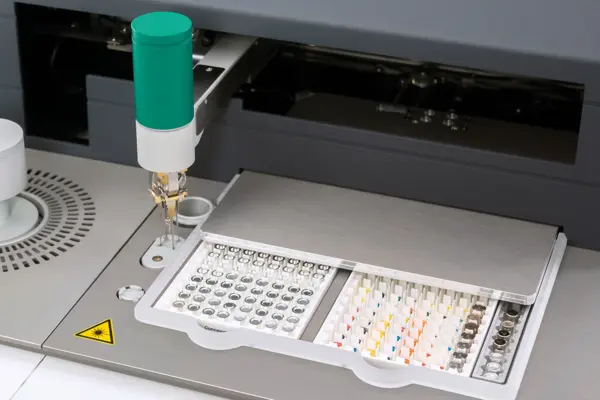
The automatic sample changer (ASC) similarly handles routine measurements in quality control as well as requirements for research and development. It works around the clock to free your time for other challenges and allows you to make optimal use of the coupling even during the weekend. Of course, each sample can be assigned a different measurement and evaluation program. Easy-to-understand input fields lead you through the programming of a series of measurements. Unplanned analyses can also be inserted into a pre-programmed series of measurements already in progress.
Find out even more about the Transfer Line Coupling



Excelência comprovada em serviços
Na NETZSCH Analyzing & Testing, oferecemos uma ampla gama de serviços em todo o mundo para garantir o desempenho ideal e a longevidade de seu equipamento termoanalítico. Com um histórico de excelência comprovada, nossos serviços são projetados para maximizar a eficácia de seus dispositivos, estender sua vida útil e minimizar o tempo de inatividade.
Libere todo o potencial de seu equipamento com nossas soluções personalizadas, respaldadas por anos de experiência e inovação no setor.
Software
Bruker OPUS and NETZSCH Proteus® – Unrivaled Combination for Maximum Ease of Use


The alliance between the NETZSCH Proteus® software and the OPUS FT-IR software is based on synchronized data exchange, enabling coordinated operation of the coupled systems. Measurements are started via the NETZSCH Proteus® software, which simultaneously triggers data acquisition in OPUS. Users only need to input the command for measurement start and data acquisition once; both OPUS and Proteus® will then operate with the predefined parameters. Online data collection is fully synchronized, ensuring precise time and temperature correlation between all signals from the two coupled instruments during evaluation. The two software packages can be operated from a single computer, giving users access to the full range of data evaluation and results display options in either environment at any time.
Find out even more about the software:
- Full software integration – online data exchange between the two instrument software packages during the running experiment
- Seamless instrument control and measurement definition for STA and FT-IR, with thermal analysis parameters controlled by Proteus® software
- Segmental activation or deactivation of the FT-IR coupling with one mouse click
- Automatic saving of data sets for both measurements (STA and FT-IR) with identical file names, but different extensions, in the same directories
- Conjoint presentation of the Gram-Schmidt plot plus up to 30 pre-selected traces together with TGA and DSC curves in Proteus®® software during the experiment
- Online evaluation of STA measurements, including TGA, DSC and FT-IR data, already during the running measurement
- Trace calculations with evaluation of characteristic temperatures and peak areas together with TGA and DSC curves
- Combined analysis graphics of thermal analysis and FT-IR signals
- Multi-component search in OPUS
- Identification by various gas phase libraries, e.g., the TGA-FT-IR library of polymers by NETZSCH
Related Devices


Consultancy & Sales
Do you have further questions about the instrument or the method and would like to speak to a sales representative?
Service & Support
Do you already have an instrument and need technical support or spare parts?