Introduction
With the growing demand for sustainable materials and rising legislative pressure, accurate identification and quantification of the recycled content are essential for enabling reliable reuse and ensuring quality assurance. Multilayer packaging, such as commercial beverage cartons, poses a unique challenge due to their complex structure — typically combining paperboard, polymer films (e.g., polyethylene), and thin layers of aluminum foil.
These layered materials are designed for durability, moisture resistance, and barrier protection, but this very complexity makes them difficult to recycle using conventional sorting and separation techniques.
In many recycling streams, separation of these components is incomplete, leading to residual mixtures of organic and inorganic phases. Knowledge of the exact composition of such recyclates is critical for determining their suitability for reuse, guiding reprocessing steps, and complying with regulatory requirements related to recycled content. This is particularly important for manufacturers aiming to meet food contact regulations or circular economy targets.
Simultaneous Thermal Analysis
Thermal analysis techniques, especially Simultaneous Thermal Analysis (STA), provide valuable insights into these heterogeneous materials. By combining Thermogravimetric Analysis (TGA) and Differential Scanning Calorimetry (DSC) in one and the same measurement, STA enables not only qualitative but also quantitative characterization of recyclate composition — including moisture, polymers, paper fibers, carbon residues, fillers, and even metals such as aluminum.
While STA may not be suited for routine, high-throughput quality control due to its small sample sizes and higher instrumentation cost, it plays a valuable role in research, development, and failure analysis. For complex multi-layer materials like beverage cartons, STA helps identify individual material components, verify claimed compositions, and assess the thermal behavior of recyclates under realistic processing conditions.
This makes STA particularly useful for
- Recyclers developing new separation or purification methods,
- Compounders exploring the behavior of recycled blends,
- Material scientists investigating contamination or variability issues.
By delivering quantitative insights into material composition, STA supports informed decision-making during product development, supplier qualification, or regulatory documentation — especially when conventional techniques fall short in resolving multi-layer or highly filled systems.
Measurement Conditions, Results and Discussion
The measurement conditions are detailed in table 1. Figure 1 depicts the TGA-DSC results of a commercial beverage carton made of laminated film heated to 850°C in an inert atmosphere and from 850°C to 1000°C in an mgoxidizing atmosphere. Under an inert atmosphere, four mass-loss steps of 4.2%, 50.2%, 23.1% and 3.7% were detected with peaks in the mass-loss rate (DTG) at 86°C, 365°C, 479°C and 691°C. The residual mass amounted to 7.95 %, which can be related to the ash content.
Table 1:
| Instrument | STA Jupiter® |
|---|---|
| Furnace | Rhodium |
| Sample carrier | TG-DSC Type S |
| Crucible | Pt with pierced lid |
| Temperature program | RT - 850°C, 10 K/min, nitrogen; then 850 - 1000°C, 10 K/min air |
| Sample mass | 10.24 mg |
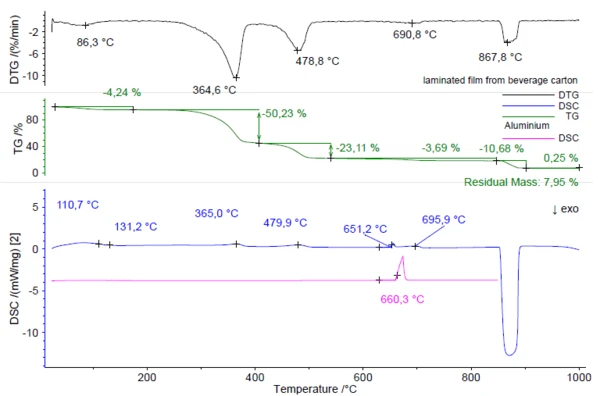
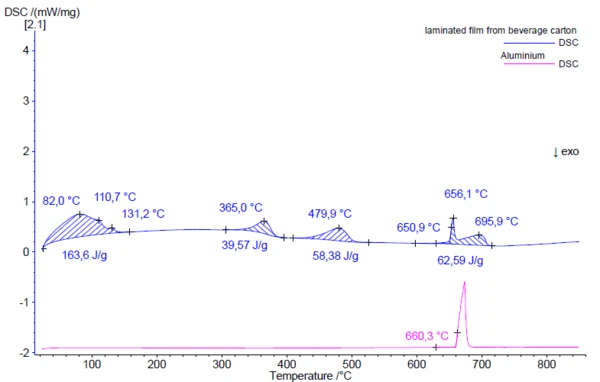
The mass-loss steps were accompanied by endothermic effects. The details of the DSC curve can be seen in figure 2.
The first mass-loss step (86°C) was probably caused by the release of moisture. The next mass-loss step was due to the thermal decomposition of the paper content. The polymer decomposition took place between 400°C and 500°C during the third mass-loss step. The mass-loss step at 691°C indicated the decomposition of a carbonate filler. Under oxidizing conditions, another mass loss of 10.7% was detected which was caused by the combustion of the residual carbon, either generated by pyrolysis or added as filler.
This was followed by a mass increase of 0.25%, which is probably due to the oxidation of the metallic components.
For detailed analyses of the DSC signal, an enlarged plot is shown in figure 2. The four mass-loss steps under an inert atmosphere were accompanied by endothermic effects at 82°C, 365°C, 480°C and 696°C. In addition, endothermic effects at 111°C and 131°C were found, which indicate the melting of the polymer content. The common enthalpy of water evaporation and polymer melting was 164 J/g.
Another endothermic effect was detected with a peak temperature of 656°C and an extrapolated onset temperature of 651°C. Comparison to literature data yielded high similarity to the melting of pure aluminum, see pink curve of in figures 1 and 2.
Aluminum alloys, commonly used in commercial beverage carton (e.g., AA 1145 or AA 1235), contain between 99.35% and 99.45% aluminum and have a reported solidus temperature of 643°C (onset temperature) and a liquidus temperature of 657°C.
Conclusion
This study demonstrates how Simultaneous Thermal Analysis (STA) can be effectively used to characterize and quantify the individual components of complex multi-layer recyclates like beverage cartons. The combination of TGA and DSC allows the identification of:
- Water content (moisture evaporation in the paper fraction)
- Cellulose or paper fraction (thermal decomposition)
- Polymer content (melting and decomposition)
- Inorganic fillers (carbonate decomposition)
- Aluminum foil layers (melting point)
Especially the detection of aluminum via its characteristic melting behavior highlight the analytical power of STA in recycling contexts.
For the recycling industry, these capabilities offer significant advantages:
- Accurate assessment of material composition
- Support for sorting, purification, and reuse decisions
- Improved quality control of recycled input streams
- Basis for product development using recycled multilayer materials
STA thus represents a powerful analytical tool for turning complex waste streams into valuable, well-understood raw materials — supporting circular economy goals with scientific precision.
If no components components with high melting points, such as aluminum, are present, these analyses can also be carried out using a TGA with c-DTA® signal, or just a DSC for the polymer fractions.