Introduction
Ohjelmistomallit, joissa otetaan huomioon näytteiden muodon ja pinnan vaikutus, ovat yhä tärkeämpiä lämpöfysikaalisten ominaisuuksien (TPP), kuten lämpödiffuusiokyvyn (a), lämmönjohtavuuden (λ) ja ominaislämpökapasiteetin (Ominaislämpökapasiteetti (cp)Lämpökapasiteetti on materiaalikohtainen fysikaalinen suure, joka määräytyy näytteeseen syötetyn lämmön määrän ja siitä aiheutuvan lämpötilan nousun perusteella. Ominaislämpökapasiteetti suhteutetaan näytteen massayksikköön.cp), tarkassa määrittämisessä. Tästä syystä NETZSCH on viime vuosina pyrkinyt jatkuvasti parantamaan nykyisiä LFA-malleja (laser flash analysis) ja kehittämään uusia laskentamalleja, korjauksia ja matemaattisia operaatioita, joissa otetaan huomioon lämpöhäviö yhdessä pulssikorjauksen, säteilyn, monikerroksisten järjestelmien, tasokokeiden, perusviivakorjausten jne. kanssa.
Tässä sovellusmuistiossa esitellään McMastersin [1] pohjalta laadittu tunkeutumismalli. Se soveltuu mittauksiin materiaaleissa, joissa on karhea pinta, ja erittäin huokoisissa materiaaleissa.
Huokoiset materiaalit ovat haaste - mutta eivät tunkeutumismallille
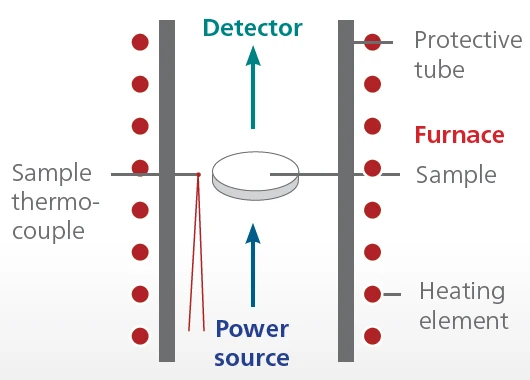
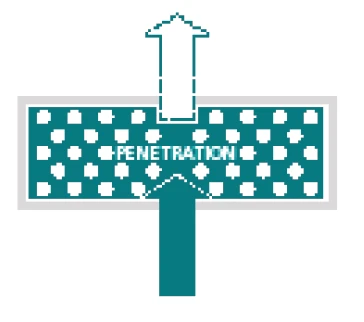
Tavanomaisissa salamamittauksissa näytteen etupinta absorboi kokonaisenergian. Tämän jälkeen lämpöaalto kulkee näytteen paksuuden läpi ennen kuin se saavuttaa takapinnan (kuva 1). Huokoisten materiaalien osalta NETZSCH on nyt ottanut käyttöön tunkeutumismallin (kuva 2), joka sisältää seuraavat näkökohdat:
- Pulssienergian absorptio ei enää rajoitu etupintaan.
- Absorptio ulottuu ohuen kerroksen yli näytteen paksuuteen.
- Absorptiokerroksia voidaan käsitellä keskimääräisenä vapaana tienä materiaalissa
Näiden näkökohtien huomioon ottaminen johtaa eksponentiaalisesti laskevaan alkulämpötilajakaumaan näytteessä. Tämän lähestymistavan soveltaminen, jossa otetaan huomioon materiaalin huokoisuus, johtaa parempaan tarkkuuteen ja täsmällisyyteen määritettyjen lämpödiffuusiokyvyn, lämmönjohtavuuden ja ominaislämpökapasiteetin arvojen osalta.
Measurement Conditions
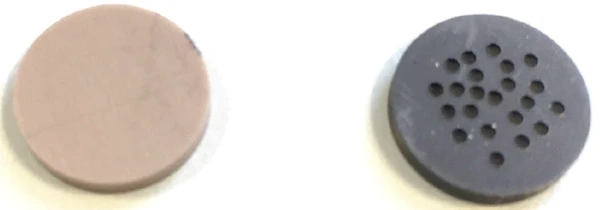
For testing the suitability of the Penetration model, two filled polymers made of the same type but of different shapes were measured. One measurement was carried out on a specimen with a surface, which was covered with boreholes of 0.5 mm in diameter. For comparison reasons, a second measurement was carried out on the original specimen with a smooth surface (figure 3). The thermal diffusivity was determined on specimen dimensions of 12.7 mm in thickness and 1.96 mm in diameter at room temperature.
Measurement Results
Figures 4 and 5 depict the measurement on the sample with boreholes. In figure 4, the model fit of the detector rise signal (red curve) is obtained by using the standard model by Cowan [2]. The green circle indicates the area of deviations between the fit and the measurement curve (blue). With this – obviously insufficient – model fit, the thermal diffusivity is calculated at 0.753 mm2/s. The calculation based on the Penetration model yields a thermal diffusivity of 0.626 mm2/s, which is nearly 17% lower in value (figure 5).
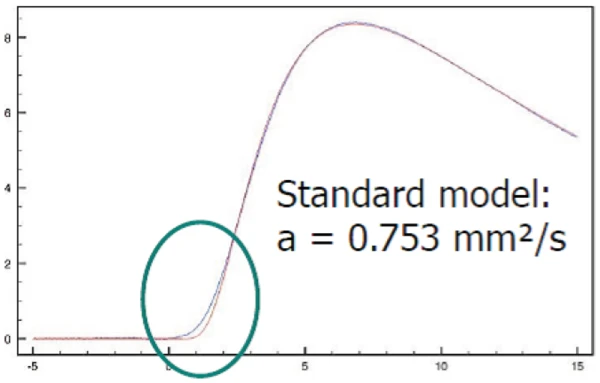
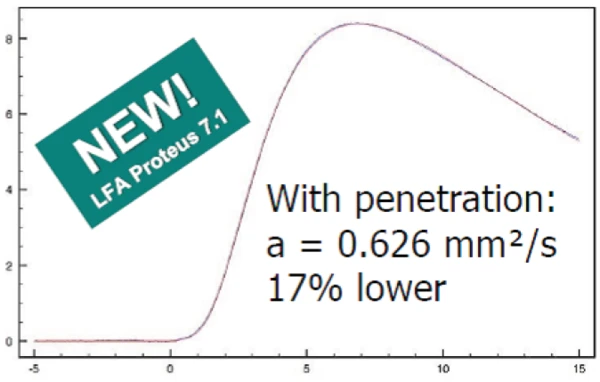
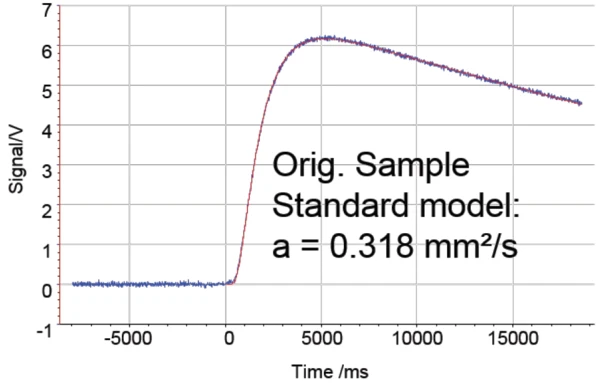
Figure 6 shows the rise of the detector signal from the measurement on the original filled polymer disc with smooth surface. Using the standard Cowan model here for determination of the thermal diffusivity yields nearly the same measurement results as were obtained with the Penetration model for the specimen with boreholes (figure 5). The deviation amounts to approximately 3%. This proves that the calculation of the thermal diffusivity based on the Penetration model yields correct results.
Conclusion
Along with the various classical models (e.g., Cowan 5 /10, Parker, improved Cape-Lehman, etc.), the NETZSCH LFA Proteus® software includes many different calculation models, corrections and mathematical operations. The Penetration model is specifically suitable for porous materials and materials with a rough surface. This special feature of the LFA Proteus® software involves the penetration of the light flash into the specimen beyond the actual heated surface. It accounts for the specimen’s porosity, which causes much of the light flash energy to be deposited inside the specimen. This means the Penetration model considers for absorption of the pulse energy over a thin layer into the specimen thickness. Measurements on samples of the same specimen but with very different surface structures (smooth vs. porous), confirm the correctness of the Penetration model.