Pendahuluan
Diamond powder combines exceptional hardness and wear resistance with outstanding thermal transport properties. It is therefore widely used for grinding and polishing hard materials such as cemented carbides, ceramics, gemstones and optical glass. In thermal interface materials, including thermal greases and pastes, diamond powder can also serve as a highly conductive filler, to help transfer heat from electronic components to heat sinks and thereby reduce operating temperatures. Reliable characterization of its thermal transport behaviour is thus essential for material development and quality control.
Tantangan Pengukuran
The thermal diffusivity and conductivity of a powder are not only dominated by the intrinsic properties of the material, but also by the particle size, packing density or the degree of compaction. Contact resistance between adjacent particles and air-filled voids within the powder bed can significantly reduce the effective thermal conductivity compared to that of bulk diamond.
Reproducible sample preparation and a measurement configuration suited to powders are therefore critical for meaningful comparative results.
Measurement with the LFA 717 HyperFlash®
The LFA results enables the temperature-dependent thermal diffusivity of diamond powder to be determined using either a sapphire sample holder or a pressure sample holder (see https://analyzing-testing.NETZSCH.com/en/products/thermal-diffusivity-and-conductivity).
The thermal conductivity can subsequently be calculated from the thermal diffusivity, density and specific heat capacity, with the latter determined by Differential Scanning Calorimetry (DSC). The pressure sample holder additionally allows the influence of different compaction pressures on thermal transport to be investigated.
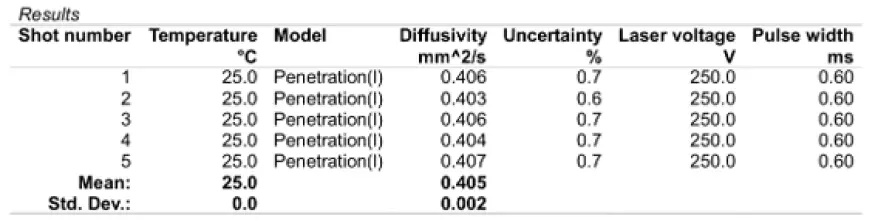
In measurement 1, the diamond powder was analyzed in a sapphire sample holder. As can be seen, when the sample is placed naturally (without additional pressure) in the holder, its thermal diffusivity is approximately 0.4 mm²/s (Table 1).
Thermal diffusivity results for the diamond powder sample, measured in a sapphire sample holder. Table 1
Tabel 1: Hasil Difusivitas TermalDifusivitas termal (a dengan satuan mm2 /s) adalah properti khusus material untuk mengkarakterisasi konduksi panas yang tidak stabil. Nilai ini menggambarkan seberapa cepat suatu bahan bereaksi terhadap perubahan suhu.difusivitas termal untuk sampel bubuk berlian, yang diukur dalam wadah sampel safir.
Karena permukaan bubuk tetap kasar setelah wadah sampel diisi, model penetrasi* memberikan gambaran yang lebih tepat mengenai kurva kenaikan suhu yang diukur (Gambar 1).
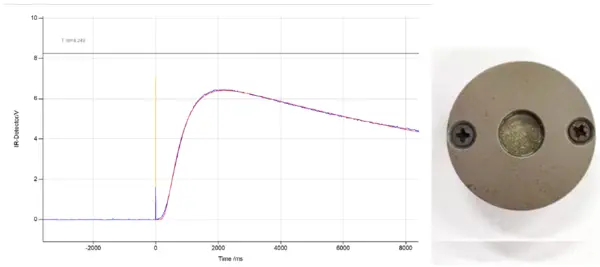
* Model standar mengasumsikan bahwa energi pulsa diserap sepenuhnya pada permukaan depan spesimen. Namun, pada bahan yang sedikit berpori, Proses PenyerapanPenyerapan adalah proses fisika dan kimia di mana suatu zat (biasanya gas atau cairan) terakumulasi di dalam fase lain atau pada batas fase dua fase. Tergantung pada tempat akumulasi, ada perbedaan antara absorpsi (akumulasi dalam fase) dan adsorpsi (akumulasi pada batas fase).penyerapan tidak terbatas pada permukaan depan saja, melainkan meluas ke lapisan tipis di dalam spesimen. Ketebalan lapisan Proses PenyerapanPenyerapan adalah proses fisika dan kimia di mana suatu zat (biasanya gas atau cairan) terakumulasi di dalam fase lain atau pada batas fase dua fase. Tergantung pada tempat akumulasi, ada perbedaan antara absorpsi (akumulasi dalam fase) dan adsorpsi (akumulasi pada batas fase).penyerapan ini dapat dianggap mewakili jarak bebas rata-rata foton dalam bahan tersebut, sehingga menghasilkan distribusi suhu awal yang meluruh secara eksponensial ke dalam spesimen. Model ini mengadopsi dan menyempurnakan pendekatan yang diperkenalkan oleh McMasters dkk. pada tahun 1999 [1].
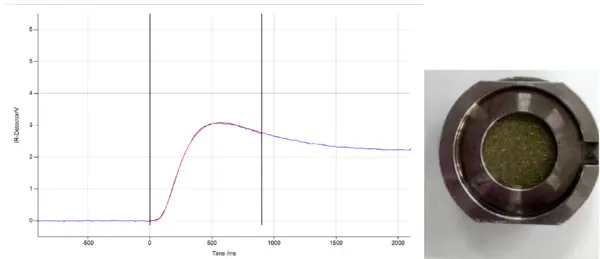
Untuk pengukuran ke-2, bubuk berlian dianalisis dalam wadah sampel bertekanan (Gambar 2). Karena pelat penyangga atas dan bawah terbuat dari safir, digunakan model satu lapisan. Torsi diatur sebesar 40 cN·m, yang setara dengan tekanan sekitar 0,5 MPa.
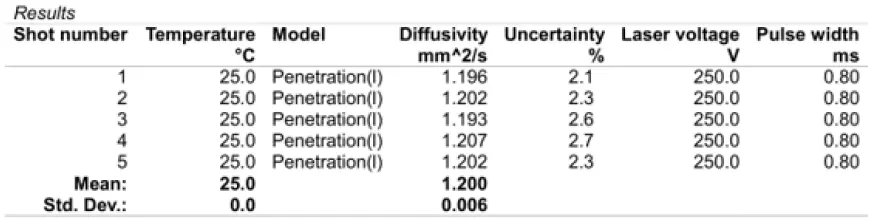
Ketika tekanan tertentu diberikan pada sampel bubuk, Difusivitas TermalDifusivitas termal (a dengan satuan mm2 /s) adalah properti khusus material untuk mengkarakterisasi konduksi panas yang tidak stabil. Nilai ini menggambarkan seberapa cepat suatu bahan bereaksi terhadap perubahan suhu.difusivitas termal meningkat akibat KepadatanDensitas massa didefinisikan sebagai rasio antara massa dan volume. kepadatan bubuk yang lebih padat, hingga mencapai sekitar 1,2 mm²/s (Tabel 2). Model penetrasi juga diterapkan untuk menentukan Difusivitas TermalDifusivitas termal (a dengan satuan mm2 /s) adalah properti khusus material untuk mengkarakterisasi konduksi panas yang tidak stabil. Nilai ini menggambarkan seberapa cepat suatu bahan bereaksi terhadap perubahan suhu.difusivitas termal.
Tabel 2: Hasil Difusivitas TermalDifusivitas termal (a dengan satuan mm2 /s) adalah properti khusus material untuk mengkarakterisasi konduksi panas yang tidak stabil. Nilai ini menggambarkan seberapa cepat suatu bahan bereaksi terhadap perubahan suhu.difusivitas termal untuk sampel bubuk berlian, yang diukur dalam wadah sampel bertekanan
Results and Discussion
Thermal diffusivity results for the diamond powder sample, measured in a pressure sample holder. Table 2
When a defined pressure was applied to the powder sample, the thermal diffusivity increased due to the more compact packing of the powder, reaching approximately 1.2 mm²/s (Table 2). The penetration model was also applied to determine the thermal diffusivity.
The measured thermal diffusivity of the diamond powder is significantly lower than the values typically observed for bulk diamond (see Application Notes 438 and 476). This difference can be attributed to the pronounced thermal contact resistance between the individual particles and the insulating effect of air voids within the powder bed. Compared with compact solids, measurements on powder samples are generally expected to exhibit greater scatter. This is because the heat transfer in powders is strongly influenced by the structure and morphology of the powder bed. Relevant factors include particle size, particle shape, particle size distribution, and packing density. Together, these parameters determine the particle-to-particle contact and thus affect the effective heat transport through the powder bed. Consequently, variations in powder morphology and packing can have a significant impact on the measured thermal diffusivity. These results highlight the importance of considering powder morphology and compaction conditions when evaluating diamond-filled thermal interface materials.
Conclusion
The LFA 717 HyperFlash® offers a flexible approach for characterizing the thermal diffusivity of diamond powders. Dedicated sample holders accommodate loose or compacted powders, while suitable evaluation models account for sample-specific effects such as a rough surface. Combined with density and DSC-derived specific heat capacity, the measurement delivers the data required to determine thermal conductivity and assess diamond powders for demanding thermal-management applications.