Giriş
Diamond powder combines exceptional hardness and wear resistance with outstanding thermal transport properties. It is therefore widely used for grinding and polishing hard materials such as cemented carbides, ceramics, gemstones and optical glass. In thermal interface materials, including thermal greases and pastes, diamond powder can also serve as a highly conductive filler, to help transfer heat from electronic components to heat sinks and thereby reduce operating temperatures. Reliable characterization of its thermal transport behaviour is thus essential for material development and quality control.
Ölçüm Zorluğu
The thermal diffusivity and conductivity of a powder are not only dominated by the intrinsic properties of the material, but also by the particle size, packing density or the degree of compaction. Contact resistance between adjacent particles and air-filled voids within the powder bed can significantly reduce the effective thermal conductivity compared to that of bulk diamond.
Reproducible sample preparation and a measurement configuration suited to powders are therefore critical for meaningful comparative results.
Measurement with the LFA 717 HyperFlash®
The LFA results enables the temperature-dependent thermal diffusivity of diamond powder to be determined using either a sapphire sample holder or a pressure sample holder (see https://analyzing-testing.NETZSCH.com/en/products/thermal-diffusivity-and-conductivity).
The thermal conductivity can subsequently be calculated from the thermal diffusivity, density and specific heat capacity, with the latter determined by Differential Scanning Calorimetry (DSC). The pressure sample holder additionally allows the influence of different compaction pressures on thermal transport to be investigated.
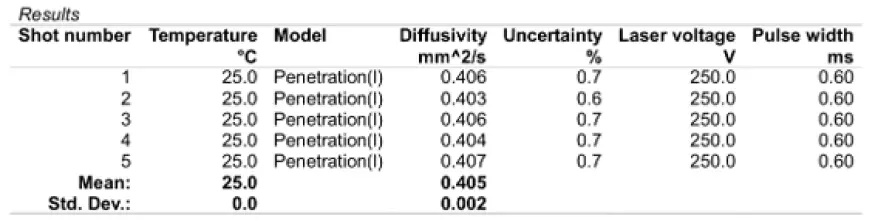
In measurement 1, the diamond powder was analyzed in a sapphire sample holder. As can be seen, when the sample is placed naturally (without additional pressure) in the holder, its thermal diffusivity is approximately 0.4 mm²/s (Table 1).
Thermal diffusivity results for the diamond powder sample, measured in a sapphire sample holder. Table 1
Tablo 1: Safir numune tutucusunda ölçülen elmas tozu numunesine ait Termal DifüziviteTermal difüzivite (mm2/s birimiyle a), kararsız ısı iletimini karakterize etmek için malzemeye özgü bir özelliktir. Bu değer, bir malzemenin sıcaklıktaki bir değişikliğe ne kadar hızlı tepki verdiğini açıklar.termal difüzivite sonuçları.
Numune tutucusu doldurulduktan sonra toz yüzeyi pürüzlü kaldığı için, penetrasyon modeli* ölçülen sıcaklık artış eğrisini daha uygun bir şekilde açıklamıştır (Şekil 1).
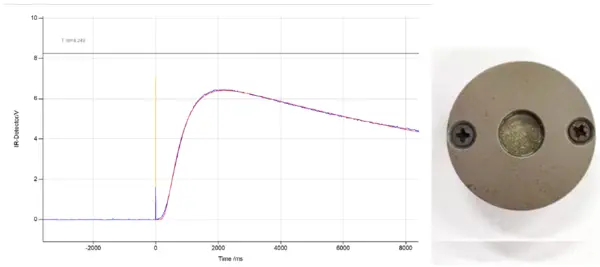
* Standart model, darbe enerjisinin numunenin ön yüzünde tamamen emildiğini varsayar. Ancak, hafif gözenekli malzemelerde emilim sadece ön yüzle sınırlı kalmaz, numunenin içindeki ince bir tabakaya kadar uzanır. Bu emilim tabakasının kalınlığı, malzeme içindeki fotonların ortalama serbest yolunu temsil ettiği kabul edilebilir; bu da numune içinde üstel olarak azalan bir başlangıç sıcaklık dağılımına yol açar. Bu model, 1999 yılında McMasters ve ark. tarafından ortaya konulan yaklaşımı içermekte ve daha da geliştirmiştir [1].
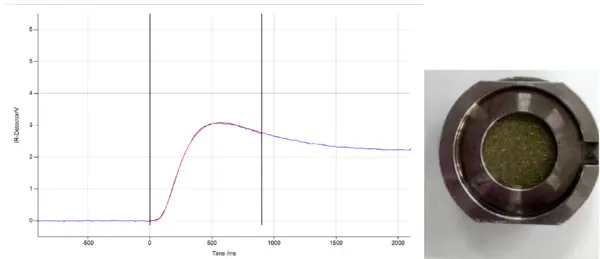
2. ölçüm için, elmas tozu bir basınçlı numune tutucusunda analiz edildi (Şekil 2). Üst ve alt destek plakaları safirden yapıldığından, tek katmanlı bir model kullanıldı. Tork, yaklaşık 0,5 MPa’lık bir basınca karşılık gelen 40 cN·m olarak ayarlandı.
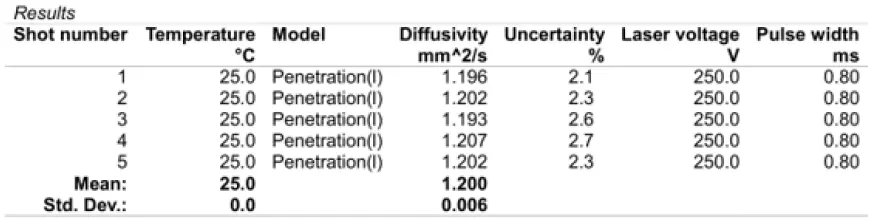
Toz numunesine belirli bir basınç uygulandığında, tozun daha sıkı bir şekilde sıkışması nedeniyle Termal DifüziviteTermal difüzivite (mm2/s birimiyle a), kararsız ısı iletimini karakterize etmek için malzemeye özgü bir özelliktir. Bu değer, bir malzemenin sıcaklıktaki bir değişikliğe ne kadar hızlı tepki verdiğini açıklar.termal difüzivite artarak yaklaşık 1,2 mm²/s değerine ulaştı (Tablo 2). Termal difüziviteyi belirlemek için penetrasyon modeli de kullanıldı.
Tablo 2: Basınçlı numune tutucusunda ölçülen elmas tozu numunesine ait Termal DifüziviteTermal difüzivite (mm2/s birimiyle a), kararsız ısı iletimini karakterize etmek için malzemeye özgü bir özelliktir. Bu değer, bir malzemenin sıcaklıktaki bir değişikliğe ne kadar hızlı tepki verdiğini açıklar.termal difüzivite sonuçları
Results and Discussion
Thermal diffusivity results for the diamond powder sample, measured in a pressure sample holder. Table 2
When a defined pressure was applied to the powder sample, the thermal diffusivity increased due to the more compact packing of the powder, reaching approximately 1.2 mm²/s (Table 2). The penetration model was also applied to determine the thermal diffusivity.
The measured thermal diffusivity of the diamond powder is significantly lower than the values typically observed for bulk diamond (see Application Notes 438 and 476). This difference can be attributed to the pronounced thermal contact resistance between the individual particles and the insulating effect of air voids within the powder bed. Compared with compact solids, measurements on powder samples are generally expected to exhibit greater scatter. This is because the heat transfer in powders is strongly influenced by the structure and morphology of the powder bed. Relevant factors include particle size, particle shape, particle size distribution, and packing density. Together, these parameters determine the particle-to-particle contact and thus affect the effective heat transport through the powder bed. Consequently, variations in powder morphology and packing can have a significant impact on the measured thermal diffusivity. These results highlight the importance of considering powder morphology and compaction conditions when evaluating diamond-filled thermal interface materials.
Conclusion
The LFA 717 HyperFlash® offers a flexible approach for characterizing the thermal diffusivity of diamond powders. Dedicated sample holders accommodate loose or compacted powders, while suitable evaluation models account for sample-specific effects such as a rough surface. Combined with density and DSC-derived specific heat capacity, the measurement delivers the data required to determine thermal conductivity and assess diamond powders for demanding thermal-management applications.