Introducción
Diamond powder combines exceptional hardness and wear resistance with outstanding thermal transport properties. It is therefore widely used for grinding and polishing hard materials such as cemented carbides, ceramics, gemstones and optical glass. In thermal interface materials, including thermal greases and pastes, diamond powder can also serve as a highly conductive filler, to help transfer heat from electronic components to heat sinks and thereby reduce operating temperatures. Reliable characterization of its thermal transport behaviour is thus essential for material development and quality control.
Reto de medición
The thermal diffusivity and conductivity of a powder are not only dominated by the intrinsic properties of the material, but also by the particle size, packing density or the degree of compaction. Contact resistance between adjacent particles and air-filled voids within the powder bed can significantly reduce the effective thermal conductivity compared to that of bulk diamond.
Reproducible sample preparation and a measurement configuration suited to powders are therefore critical for meaningful comparative results.
Measurement with the LFA 717 HyperFlash®
The LFA results enables the temperature-dependent thermal diffusivity of diamond powder to be determined using either a sapphire sample holder or a pressure sample holder (see https://analyzing-testing.NETZSCH.com/en/products/thermal-diffusivity-and-conductivity).
The thermal conductivity can subsequently be calculated from the thermal diffusivity, density and specific heat capacity, with the latter determined by Differential Scanning Calorimetry (DSC). The pressure sample holder additionally allows the influence of different compaction pressures on thermal transport to be investigated.
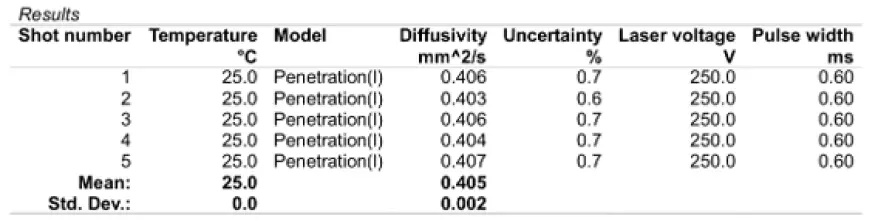
In measurement 1, the diamond powder was analyzed in a sapphire sample holder. As can be seen, when the sample is placed naturally (without additional pressure) in the holder, its thermal diffusivity is approximately 0.4 mm²/s (Table 1).
Thermal diffusivity results for the diamond powder sample, measured in a sapphire sample holder. Table 1
Tabla 1: Resultados de la Difusividad térmicaLa difusividad térmica (a con la unidad mm2/s) es una propiedad específica de los materiales para caracterizar la conducción de calor inestable. Este valor describe la rapidez con la que un material reacciona a un cambio de temperatura.difusividad térmica de la muestra de polvo de diamante, medidos en un portamuestras de zafiro.
Dado que la superficie del polvo seguía siendo rugosa tras llenar el portamuestras, el modelo de penetración* ofrecía una descripción más adecuada de la curva de aumento de temperatura medida (figura 1).
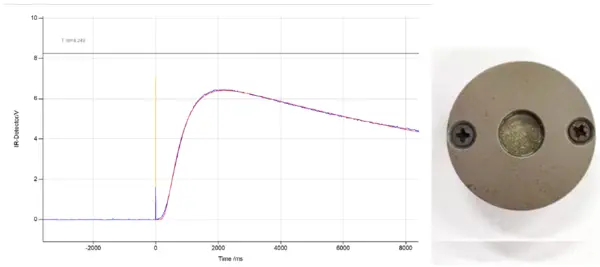
* The standard model assumes that the pulse energy is fully absorbed at the front face of the specimen. In slightly porous materials, however, absorption is not confined to the front face, but extends into a thin layer within the specimen. The thickness of this absorption layer can be taken to represent the mean free path of photons in the material, resulting in an initial temperature distribution that decays exponentially into the specimen. This model incorporates and further refines the approach introduced by McMasters et al. in 1999 [1].
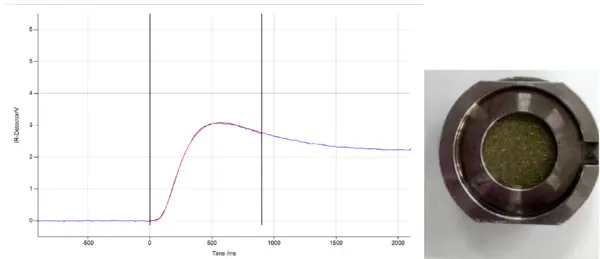
Para la medición n.º 2, se analizó el polvo de diamante en un portamuestras a presión (figura 2). Dado que las placas de soporte superior e inferior estaban fabricadas en zafiro, se utilizó un modelo de una sola capa. El par se fijó en 40 cN·m, lo que corresponde a una presión de aproximadamente 0,5 MPa.
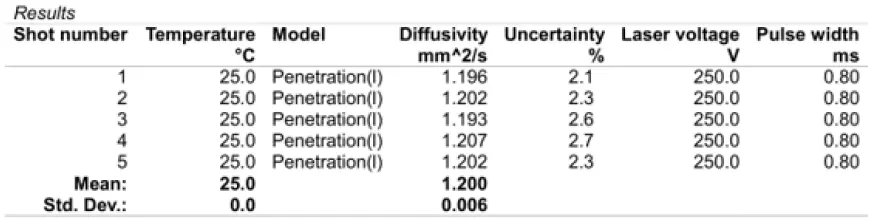
Al aplicar una presión definida a la muestra de polvo, la Difusividad térmicaLa difusividad térmica (a con la unidad mm2/s) es una propiedad específica de los materiales para caracterizar la conducción de calor inestable. Este valor describe la rapidez con la que un material reacciona a un cambio de temperatura.difusividad térmica aumentó debido a que el polvo quedó más compactado, alcanzando aproximadamente 1,2 mm²/s (Tabla 2). También se aplicó el modelo de penetración para determinar la Difusividad térmicaLa difusividad térmica (a con la unidad mm2/s) es una propiedad específica de los materiales para caracterizar la conducción de calor inestable. Este valor describe la rapidez con la que un material reacciona a un cambio de temperatura.difusividad térmica.
Tabla 2: Resultados de la Difusividad térmicaLa difusividad térmica (a con la unidad mm2/s) es una propiedad específica de los materiales para caracterizar la conducción de calor inestable. Este valor describe la rapidez con la que un material reacciona a un cambio de temperatura.difusividad térmica de la muestra de polvo de diamante, medidos en un portamuestras a presión
Results and Discussion
Thermal diffusivity results for the diamond powder sample, measured in a pressure sample holder. Table 2
When a defined pressure was applied to the powder sample, the thermal diffusivity increased due to the more compact packing of the powder, reaching approximately 1.2 mm²/s (Table 2). The penetration model was also applied to determine the thermal diffusivity.
The measured thermal diffusivity of the diamond powder is significantly lower than the values typically observed for bulk diamond (see Application Notes 438 and 476). This difference can be attributed to the pronounced thermal contact resistance between the individual particles and the insulating effect of air voids within the powder bed. Compared with compact solids, measurements on powder samples are generally expected to exhibit greater scatter. This is because the heat transfer in powders is strongly influenced by the structure and morphology of the powder bed. Relevant factors include particle size, particle shape, particle size distribution, and packing density. Together, these parameters determine the particle-to-particle contact and thus affect the effective heat transport through the powder bed. Consequently, variations in powder morphology and packing can have a significant impact on the measured thermal diffusivity. These results highlight the importance of considering powder morphology and compaction conditions when evaluating diamond-filled thermal interface materials.
Conclusion
The LFA 717 HyperFlash® offers a flexible approach for characterizing the thermal diffusivity of diamond powders. Dedicated sample holders accommodate loose or compacted powders, while suitable evaluation models account for sample-specific effects such as a rough surface. Combined with density and DSC-derived specific heat capacity, the measurement delivers the data required to determine thermal conductivity and assess diamond powders for demanding thermal-management applications.