Введение
Diamond powder combines exceptional hardness and wear resistance with outstanding thermal transport properties. It is therefore widely used for grinding and polishing hard materials such as cemented carbides, ceramics, gemstones and optical glass. In thermal interface materials, including thermal greases and pastes, diamond powder can also serve as a highly conductive filler, to help transfer heat from electronic components to heat sinks and thereby reduce operating temperatures. Reliable characterization of its thermal transport behaviour is thus essential for material development and quality control.
Задача по измерению
The thermal diffusivity and conductivity of a powder are not only dominated by the intrinsic properties of the material, but also by the particle size, packing density or the degree of compaction. Contact resistance between adjacent particles and air-filled voids within the powder bed can significantly reduce the effective thermal conductivity compared to that of bulk diamond.
Reproducible sample preparation and a measurement configuration suited to powders are therefore critical for meaningful comparative results.
Measurement with the LFA 717 HyperFlash®
The LFA results enables the temperature-dependent thermal diffusivity of diamond powder to be determined using either a sapphire sample holder or a pressure sample holder (see https://analyzing-testing.NETZSCH.com/en/products/thermal-diffusivity-and-conductivity).
The thermal conductivity can subsequently be calculated from the thermal diffusivity, density and specific heat capacity, with the latter determined by Differential Scanning Calorimetry (DSC). The pressure sample holder additionally allows the influence of different compaction pressures on thermal transport to be investigated.
In measurement 1, the diamond powder was analyzed in a sapphire sample holder. As can be seen, when the sample is placed naturally (without additional pressure) in the holder, its thermal diffusivity is approximately 0.4 mm²/s (Table 1).
Thermal diffusivity results for the diamond powder sample, measured in a sapphire sample holder. Table 1
Таблица 1: Результаты измерений теплопроводности образца алмазного порошка, проведенных в сапфировом держателе для образцов.
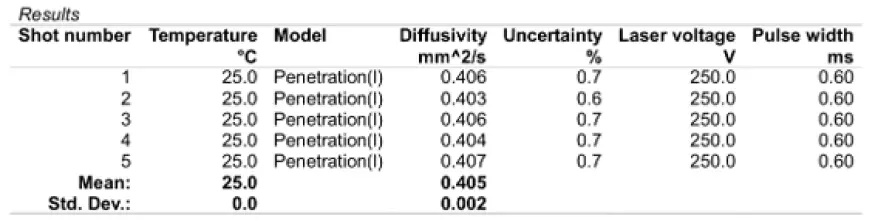
Поскольку поверхность порошка оставалась шероховатой после заполнения держателя для образца, модель проникновения* обеспечила более адекватное описание измеренной кривой повышения температуры (рис. 1).
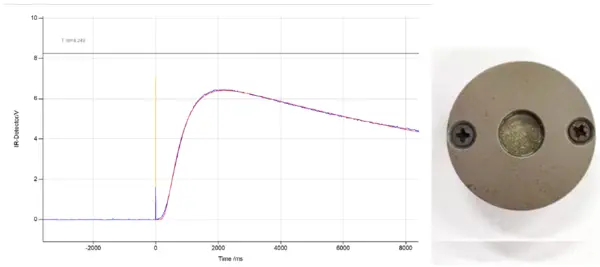
* Стандартная модель предполагает, что энергия импульса полностью поглощается на передней поверхности образца. Однако в слегка пористых материалах поглощение не ограничивается передней поверхностью, а распространяется на тонкий слой внутри образца. Толщину этого поглощающего слоя можно принять за среднюю длину свободного пробега фотонов в материале, что приводит к распределению начальной температуры, экспоненциально затухающему вглубь образца. Данная модель включает в себя и дополнительно уточняет подход, предложенный Макмастерсом и др. в 1999 году [1].
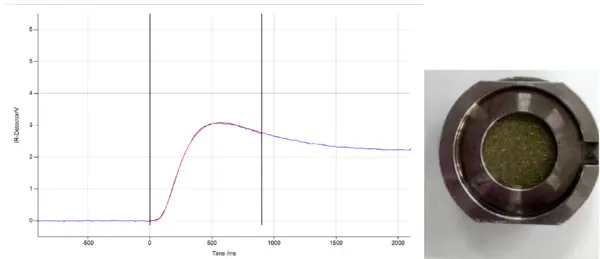
В ходе второго измерения алмазный порошок анализировался в держателе образца под давлением (рис. 2). Поскольку верхняя и нижняя опорные пластины были изготовлены из сапфира, использовалась однослойная модель. Крутящий момент был установлен на уровне 40 сН·м, что соответствует давлению примерно 0,5 МПа.
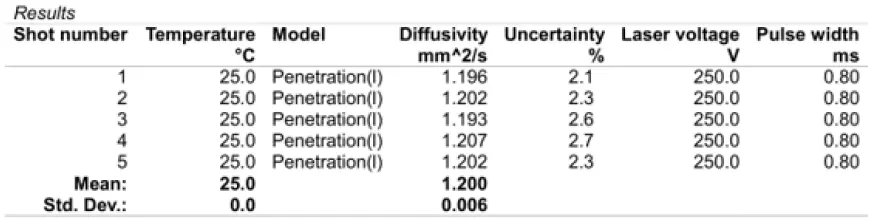
При воздействии заданного давления на порошковый образец теплопроводность увеличилась вследствие более плотного уплотнения порошка, достигнув значения примерно 1,2 мм²/с (табл. 2). Для определения теплопроводности также была применена модель проникновения.
Таблица 2: Результаты измерения теплопроводности образца алмазного порошка, полученные в держателе для образцов под давлением
Results and Discussion
Thermal diffusivity results for the diamond powder sample, measured in a pressure sample holder. Table 2
When a defined pressure was applied to the powder sample, the thermal diffusivity increased due to the more compact packing of the powder, reaching approximately 1.2 mm²/s (Table 2). The penetration model was also applied to determine the thermal diffusivity.
The measured thermal diffusivity of the diamond powder is significantly lower than the values typically observed for bulk diamond (see Application Notes 438 and 476). This difference can be attributed to the pronounced thermal contact resistance between the individual particles and the insulating effect of air voids within the powder bed. Compared with compact solids, measurements on powder samples are generally expected to exhibit greater scatter. This is because the heat transfer in powders is strongly influenced by the structure and morphology of the powder bed. Relevant factors include particle size, particle shape, particle size distribution, and packing density. Together, these parameters determine the particle-to-particle contact and thus affect the effective heat transport through the powder bed. Consequently, variations in powder morphology and packing can have a significant impact on the measured thermal diffusivity. These results highlight the importance of considering powder morphology and compaction conditions when evaluating diamond-filled thermal interface materials.
Conclusion
The LFA 717 HyperFlash® offers a flexible approach for characterizing the thermal diffusivity of diamond powders. Dedicated sample holders accommodate loose or compacted powders, while suitable evaluation models account for sample-specific effects such as a rough surface. Combined with density and DSC-derived specific heat capacity, the measurement delivers the data required to determine thermal conductivity and assess diamond powders for demanding thermal-management applications.