Introdução
Diamond powder combines exceptional hardness and wear resistance with outstanding thermal transport properties. It is therefore widely used for grinding and polishing hard materials such as cemented carbides, ceramics, gemstones and optical glass. In thermal interface materials, including thermal greases and pastes, diamond powder can also serve as a highly conductive filler, to help transfer heat from electronic components to heat sinks and thereby reduce operating temperatures. Reliable characterization of its thermal transport behaviour is thus essential for material development and quality control.
Desafio de medição
The thermal diffusivity and conductivity of a powder are not only dominated by the intrinsic properties of the material, but also by the particle size, packing density or the degree of compaction. Contact resistance between adjacent particles and air-filled voids within the powder bed can significantly reduce the effective thermal conductivity compared to that of bulk diamond.
Reproducible sample preparation and a measurement configuration suited to powders are therefore critical for meaningful comparative results.
Measurement with the LFA 717 HyperFlash®
The LFA results enables the temperature-dependent thermal diffusivity of diamond powder to be determined using either a sapphire sample holder or a pressure sample holder (see https://analyzing-testing.NETZSCH.com/en/products/thermal-diffusivity-and-conductivity).
The thermal conductivity can subsequently be calculated from the thermal diffusivity, density and specific heat capacity, with the latter determined by Differential Scanning Calorimetry (DSC). The pressure sample holder additionally allows the influence of different compaction pressures on thermal transport to be investigated.
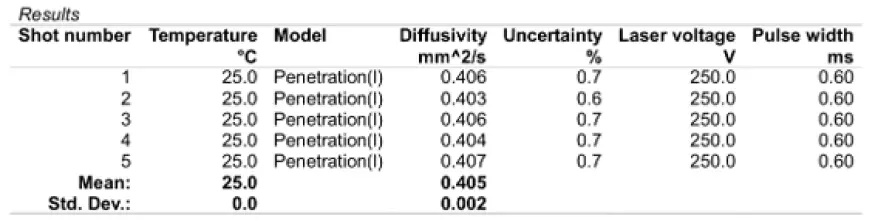
In measurement 1, the diamond powder was analyzed in a sapphire sample holder. As can be seen, when the sample is placed naturally (without additional pressure) in the holder, its thermal diffusivity is approximately 0.4 mm²/s (Table 1).
Thermal diffusivity results for the diamond powder sample, measured in a sapphire sample holder. Table 1
Tabela 1: Resultados da Difusividade térmicaA difusividade térmica (a com a unidade mm2/s) é uma propriedade específica do material para caracterizar a condução de calor instável. Esse valor descreve a rapidez com que um material reage a uma mudança de temperatura.difusividade térmica da amostra de pó de diamante, medidos em um suporte de amostra de safira.
Como a superfície do pó permaneceu irregular após o preenchimento do porta-amostra, o modelo de penetração* forneceu uma descrição mais adequada da curva de aumento de temperatura medida (Figura 1).
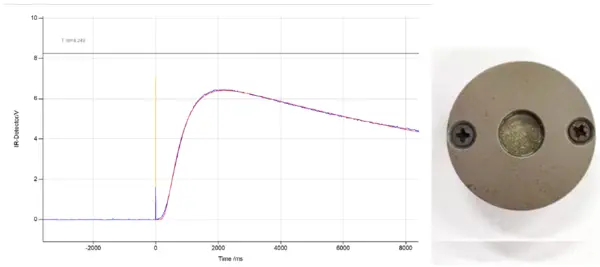
* O modelo padrão pressupõe que a energia do pulso seja totalmente absorvida na face frontal da amostra. Em materiais levemente porosos, no entanto, a absorção não se limita à face frontal, mas se estende por uma camada fina no interior da amostra. A espessura dessa camada de absorção pode ser considerada como representativa do caminho livre médio dos fótons no material, resultando em uma distribuição de temperatura inicial que decai exponencialmente no interior da amostra. Este modelo incorpora e aprimora ainda mais a abordagem introduzida por McMasters et al. em 1999 [1].
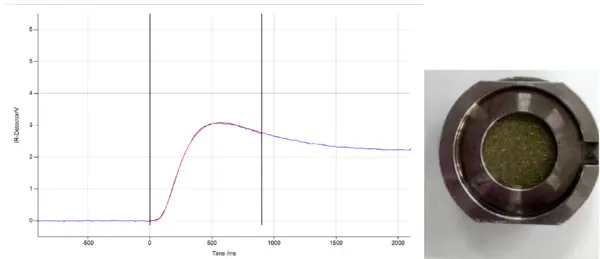
Para a medição 2, o pó de diamante foi analisado em um suporte de amostra sob pressão (Figura 2). Como as placas de suporte superior e inferior eram feitas de safira, utilizou-se um modelo de camada única. O torque foi definido em 40 cN·m, o que corresponde a uma pressão de aproximadamente 0,5 MPa.
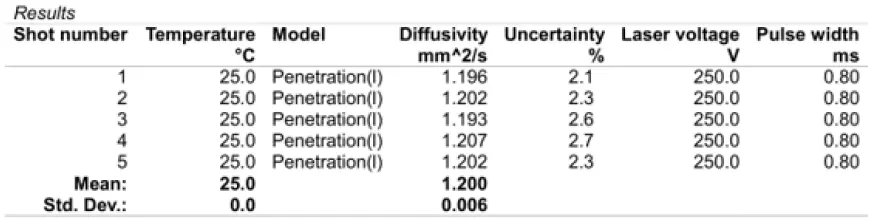
Quando uma pressão definida foi aplicada à amostra de pó, a Difusividade térmicaA difusividade térmica (a com a unidade mm2/s) é uma propriedade específica do material para caracterizar a condução de calor instável. Esse valor descreve a rapidez com que um material reage a uma mudança de temperatura.difusividade térmica aumentou devido ao compactamento do pó, atingindo aproximadamente 1,2 mm²/s (Tabela 2). O modelo de penetração também foi aplicado para determinar a Difusividade térmicaA difusividade térmica (a com a unidade mm2/s) é uma propriedade específica do material para caracterizar a condução de calor instável. Esse valor descreve a rapidez com que um material reage a uma mudança de temperatura.difusividade térmica.
Tabela 2: Resultados da Difusividade térmicaA difusividade térmica (a com a unidade mm2/s) é uma propriedade específica do material para caracterizar a condução de calor instável. Esse valor descreve a rapidez com que um material reage a uma mudança de temperatura.difusividade térmica da amostra de pó de diamante, medidos em um suporte de amostra pressurizado
Results and Discussion
Thermal diffusivity results for the diamond powder sample, measured in a pressure sample holder. Table 2
When a defined pressure was applied to the powder sample, the thermal diffusivity increased due to the more compact packing of the powder, reaching approximately 1.2 mm²/s (Table 2). The penetration model was also applied to determine the thermal diffusivity.
The measured thermal diffusivity of the diamond powder is significantly lower than the values typically observed for bulk diamond (see Application Notes 438 and 476). This difference can be attributed to the pronounced thermal contact resistance between the individual particles and the insulating effect of air voids within the powder bed. Compared with compact solids, measurements on powder samples are generally expected to exhibit greater scatter. This is because the heat transfer in powders is strongly influenced by the structure and morphology of the powder bed. Relevant factors include particle size, particle shape, particle size distribution, and packing density. Together, these parameters determine the particle-to-particle contact and thus affect the effective heat transport through the powder bed. Consequently, variations in powder morphology and packing can have a significant impact on the measured thermal diffusivity. These results highlight the importance of considering powder morphology and compaction conditions when evaluating diamond-filled thermal interface materials.
Conclusion
The LFA 717 HyperFlash® offers a flexible approach for characterizing the thermal diffusivity of diamond powders. Dedicated sample holders accommodate loose or compacted powders, while suitable evaluation models account for sample-specific effects such as a rough surface. Combined with density and DSC-derived specific heat capacity, the measurement delivers the data required to determine thermal conductivity and assess diamond powders for demanding thermal-management applications.