서론
Diamond powder combines exceptional hardness and wear resistance with outstanding thermal transport properties. It is therefore widely used for grinding and polishing hard materials such as cemented carbides, ceramics, gemstones and optical glass. In thermal interface materials, including thermal greases and pastes, diamond powder can also serve as a highly conductive filler, to help transfer heat from electronic components to heat sinks and thereby reduce operating temperatures. Reliable characterization of its thermal transport behaviour is thus essential for material development and quality control.
측정 과제
The thermal diffusivity and conductivity of a powder are not only dominated by the intrinsic properties of the material, but also by the particle size, packing density or the degree of compaction. Contact resistance between adjacent particles and air-filled voids within the powder bed can significantly reduce the effective thermal conductivity compared to that of bulk diamond.
Reproducible sample preparation and a measurement configuration suited to powders are therefore critical for meaningful comparative results.
Measurement with the LFA 717 HyperFlash®
The LFA results enables the temperature-dependent thermal diffusivity of diamond powder to be determined using either a sapphire sample holder or a pressure sample holder (see https://analyzing-testing.NETZSCH.com/en/products/thermal-diffusivity-and-conductivity).
The thermal conductivity can subsequently be calculated from the thermal diffusivity, density and specific heat capacity, with the latter determined by Differential Scanning Calorimetry (DSC). The pressure sample holder additionally allows the influence of different compaction pressures on thermal transport to be investigated.
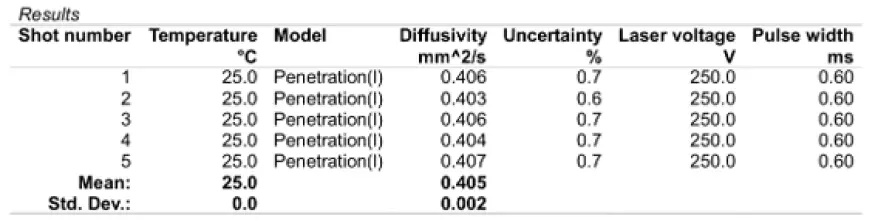
In measurement 1, the diamond powder was analyzed in a sapphire sample holder. As can be seen, when the sample is placed naturally (without additional pressure) in the holder, its thermal diffusivity is approximately 0.4 mm²/s (Table 1).
Thermal diffusivity results for the diamond powder sample, measured in a sapphire sample holder. Table 1
표 1: 사파이어 시료 홀더에서 측정된 다이아몬드 분말 시료의 열확산율 측정 결과.
시료 홀더에 시료를 채운 후에도 분말 표면이 거친 상태를 유지했기 때문에, 침투 모델*이 측정된 온도 상승 곡선을 더 적절하게 설명해 주었다(그림 1).
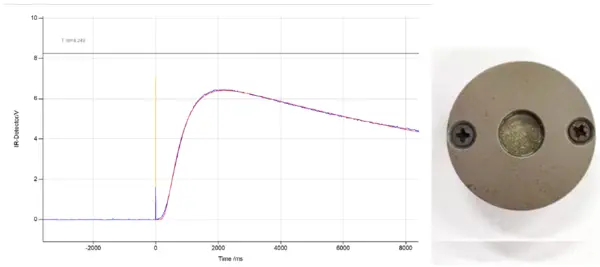
* 표준 모델은 펄스 에너지가 시편의 전면에서 완전히 흡수된다고 가정한다. 그러나 다공성이 약간 있는 재료의 경우, 흡수는 전면에만 국한되지 않고 시편 내부의 얇은 층으로까지 확장된다. 이 흡수층의 두께는 재료 내 광자의 평균 자유 행로를 나타내는 것으로 간주할 수 있으며, 그 결과 시편 내부로 지수적으로 감쇠하는 초기 온도 분포가 도출된다. 이 모델은 1999년 McMasters 등이 제시한 접근법을 반영하고 이를 더욱 정교화한 것이다 [1].
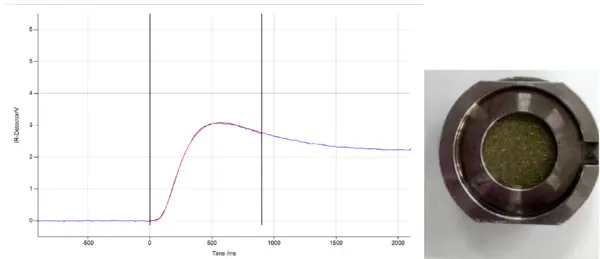
측정 2에서는 다이아몬드 분말을 압력 시료 홀더에서 분석하였다(그림 2). 상부 및 하부 지지판이 사파이어로 제작되었으므로 단층 모델을 사용하였다. 토크는 약 0.5 MPa의 압력에 해당하는 40 cN·m으로 설정하였다.
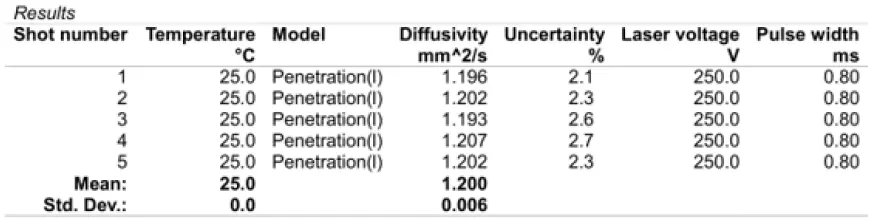
분말 시료에 정해진 압력을 가했을 때, 분말이 더 촘촘하게 압축되면서 열확산율이 증가하여 약 1.2 mm²/s에 도달했다(표 2). 또한 열확산율을 구하기 위해 침투 모델을 적용하였다.
표 2: 압력 시료 홀더에서 측정된 다이아몬드 분말 시료의 열확산율 측정 결과
Results and Discussion
Thermal diffusivity results for the diamond powder sample, measured in a pressure sample holder. Table 2
When a defined pressure was applied to the powder sample, the thermal diffusivity increased due to the more compact packing of the powder, reaching approximately 1.2 mm²/s (Table 2). The penetration model was also applied to determine the thermal diffusivity.
The measured thermal diffusivity of the diamond powder is significantly lower than the values typically observed for bulk diamond (see Application Notes 438 and 476). This difference can be attributed to the pronounced thermal contact resistance between the individual particles and the insulating effect of air voids within the powder bed. Compared with compact solids, measurements on powder samples are generally expected to exhibit greater scatter. This is because the heat transfer in powders is strongly influenced by the structure and morphology of the powder bed. Relevant factors include particle size, particle shape, particle size distribution, and packing density. Together, these parameters determine the particle-to-particle contact and thus affect the effective heat transport through the powder bed. Consequently, variations in powder morphology and packing can have a significant impact on the measured thermal diffusivity. These results highlight the importance of considering powder morphology and compaction conditions when evaluating diamond-filled thermal interface materials.
Conclusion
The LFA 717 HyperFlash® offers a flexible approach for characterizing the thermal diffusivity of diamond powders. Dedicated sample holders accommodate loose or compacted powders, while suitable evaluation models account for sample-specific effects such as a rough surface. Combined with density and DSC-derived specific heat capacity, the measurement delivers the data required to determine thermal conductivity and assess diamond powders for demanding thermal-management applications.