Customer SUCCESS STORY
Enabling Breakthroughs in Thermal Transistor Research
Enabling Breakthroughs in Thermal Transistor Research: Learn how the Hokkaido University Uses the NETZSCH PicoTR to Push the Limits of Thin-Film Measurement
At Hokkaido University, Prof. Hiromichi Ohta and his team are at the forefront of research on solid-state electrochemical thermal transistors. Using the NETZSCH PicoTR analyzer, they can precisely measure the thermophysical properties of ultra-thin films — a key step towards realizing next-generation thermal management technologies.
In this customer success story, we interview our long-term customer, Prof. Hiromichi Ohta, Director of the Research Institute for Electronic Science, Hokkaido University, in Japan. He uses the NETZSCH PicoTR instrument to measure thin films applied in thermal transistors. His research lab at Hokkaido University was the first to develop solid-state electrochemical thermal transistors.
The interview was conducted by Narumi Fukuda and Kazuko Ishikawa (NETZSCH Japan)
About the interviewee, Prof. Hiromichi Ohta
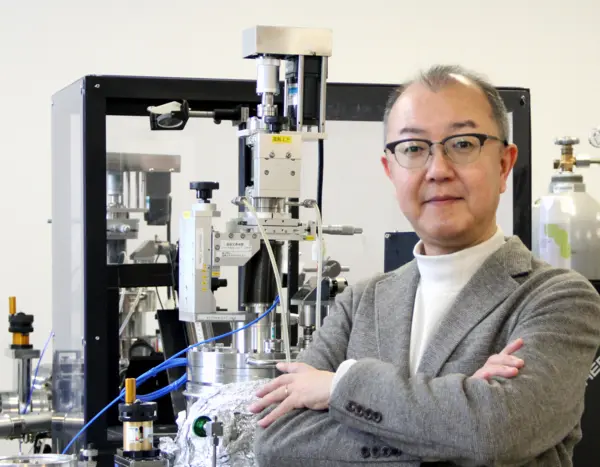
Hiromichi Ohta (figure 1) was born in 1971. He graduated from the Faculty of Engineering at Saitama University in March 1994. After completing his master’s degree in applied chemistry at Nagoya University's Graduate School of Engineering in March 1996, he worked as a researcher at Sanyo Electric Co., Ltd.'s Soft Energy Technology Development Laboratory, as well as a researcher at HOYA Corporation's R&D Center for Advanced Technology. He also served as group leader of the ERATO Hosono Transparent ElectroActive Materials Project.
In 2003, he became an associate professor at Nagoya University's Graduate School of Engineering. In 2012, he became a professor at Hokkaido University's Research Institute for Electronic Science, a position he still holds today. Since 2025, he has served as Director of the Research Institute for Electronic Science. He holds a Ph.D. in Engineering from the Tokyo Institute of Technology (2001).
His main research fields include thermal transistors (thermal switches), thermoelectric conversion materials, and oxide thin-film transistors. He has authored over 280 peer-reviewed journal papers, which have been cited more than 24,800 times, with an H-index of 61.
About the Research Institute for Electronic Science (RIES)
The Research Institute for Electronic Science (RIES) at Hokkaido University (figure 2) was originally established in 1943 as the Ultra Shortwave Research Institute. Later, it became the Institute of Applied Electricity before adopting its current name in 1993. Through cutting-edge research and education, RIES continues to contribute to the advancement of electronic science.
RIES consists of three main research divisions: the Division of Photonics and Optical Science, the Division of Material and Molecular Sciences, and the Division of Life Science. Additionally, it houses the Green Nanotechnology Research Center and the Research Center of Mathematics for Social Creativity.

Why the NETZSCH PicoTR?
NETZSCH: Prof. Ohta, why did you choose a NETZSCH instrument for your research? Please tell us a little more about your analysis objectives and the key factors that influenced your decision.
Prof. Ohta:
"I have been researching thin films for a long time. When it comes to thermoelectric conversion technology, measuring Thermal ConductivityThermal conductivity (λ with the unit W/(m•K)) describes the transport of energy – in the form of heat – through a body of mass as the result of a temperature gradient (see fig. 1). According to the second law of thermodynamics, heat always flows in the direction of the lower temperature.thermal conductivity is essential. Before the development of the PicoTR, I thought, "Measuring thin films was difficult," "Only specialized people could measure them," and "There were no devices available to measure thin films."
PeopIe often advised me: "Why not measure using the 3-omega method?" But there was the strong perception that this would be impossible without metal fine-line patterning technology.
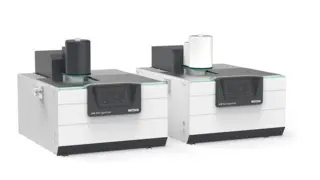
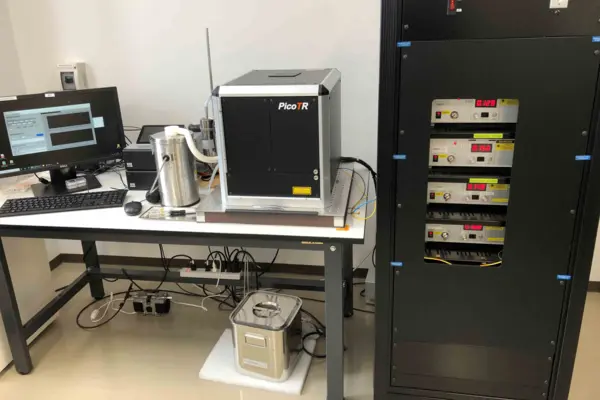
However, when the PicoTR was released, I quickly heard about it, and there were rumors saying, "This device seems to be able to measure thin films." At that time, I happened to secure a research grant that I had applied for, so I decided to try using the PicoTR (figure 3) and introduced it at our institute. With success!
Today, I'm researching thin films to develop solid-state electrochemical thermal transistors. I believe the PicoTR is perfectly suited to measuring them."
Unique Features that Make a Difference
NETZSCH: Are there any features of the PicoTR system you use that are particularly useful for your specific application?
Prof. OHTA:
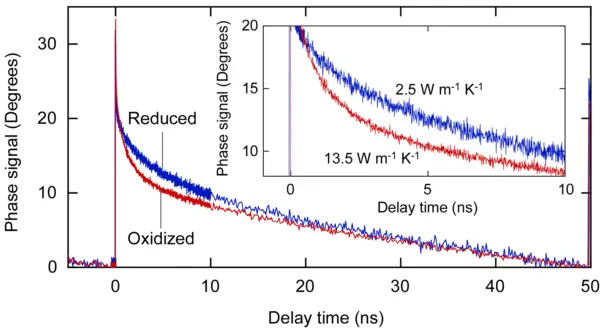
"One of the unique features of the PicoTR is its delay time of 50 nanoseconds. When I presented this data at an international conference, I was often asked, "Wasn't that a mistake? Shouldn’t it be 5 nanoseconds?" Researchers at other institutes seem to only have devices with a delay time of around 5 nanoseconds.
When measuring in FF mode and taking the delay time on the horizontal axis, the decay of the ThermoreflectanceThermoreflectance is a method for determining the thermal diffusivity and thermal conductivity of thin films with thicknesses in the nanometer range.thermoreflectance signal can be observed (figure 4). However, there was data that could be observed for the first time when measuring up to 50 nanoseconds. Therefore, I felt that it was a little inconvenient to make measurements with a device that can only see down to 5 nanoseconds."
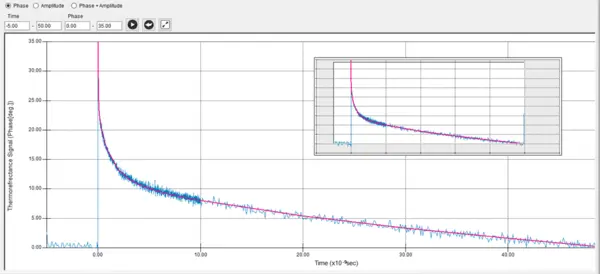
In the figure below, the blue line shows the data measured by the PicoTR, and the red line shows the data fitted for analysis (figure 5). If the actual measurement and fitting match up to 50 nanoseconds, it is obvious that the value of the analysis result is correct. If it could only measure down to 5 nanoseconds, then there would be some uncertainty in the results. Therefore, I think the ability to measure up to 50 nanoseconds is one of the great strengths of the PicoTR.
Prof. Ohta:
"Whenever I give lectures overseas, there are always students in the audience who are using similar systems and who are active as teachers and professors in various places, including Hong Kong, China, and Korea. When they see my data, they’re always surprised and say, “50 nanoseconds!? Isn’t there an extra zero?”. I think it’s great that the PicoTR can observe the ThermoreflectanceThermoreflectance is a method for determining the thermal diffusivity and thermal conductivity of thin films with thicknesses in the nanometer range.thermoreflectance signal up to 50 nanoseconds.
Another advantage is that you can operate the NETZSCH system even without in-depth knowledge. I don’t have much knowledge about thermal analysis, so even if someone told me to build a thermal analysis instrument for thin films and gave me the parts, I’d never be able to do it. (He laughs)
Researchers and engineers who specialize in thermal analysis often collect parts, build instruments, and carry out measurements by themselves. So, those TDTR (Time-Domain Thermoreflectance) devices are usually much bulkier and only measure up to 5 nanoseconds. However, PicoTR, with its compact design, allows you to obtain data just with a click."
Comment by NETZSCH: As you mentioned, those who work with TDTR optical delay often struggle to align laser beams in space, which can be very challenging. We think one of the reasons the PicoTR with electric delay can be commercialized is because its alignment is much easier.
From Laboratory Data to Real-World Impact
NETZSCH: How did the analysis results affect your research? Have you been able to gain new insights, or did a completely new development emerge?
Prof. Ohta:
"I don’t think we could have marketed solid-state electrochemical thermal transistors without THE PicoTR.
In thermal transistor research, it is necessary to repeatedly turn the thermal transistor on and off and measure how its Thermal ConductivityThermal conductivity (λ with the unit W/(m•K)) describes the transport of energy – in the form of heat – through a body of mass as the result of a temperature gradient (see fig. 1). According to the second law of thermodynamics, heat always flows in the direction of the lower temperature.thermal conductivity changes. When I first submitted my paper, I performed 10 repetitive runs and was able to get 10 measurements, so I submitted the paper with that data.
However, during the review process of a more recent paper, I was asked, "Please measure 10 to the power of 6 (1 million) times." Obviously, that’s unreasonable, so I had to reduce it to 100 times. Even 100 times was quite challenging. Ultimately, I decided to make a measurement with the PicoTR once every 10 trials. Based on this experience, I realized that it would be great if the PicoTR could predict changes in Thermal ConductivityThermal conductivity (λ with the unit W/(m•K)) describes the transport of energy – in the form of heat – through a body of mass as the result of a temperature gradient (see fig. 1). According to the second law of thermodynamics, heat always flows in the direction of the lower temperature.thermal conductivity while maintaining its excellent performance."

A Vision for the Future: The “Thermal Display”
NETZSCH: Let´s take a look into the future: Are there other challenges that you would like to address?
Prof. Ohta:
"While I plan to continue my current research, personally, I want to develop a "thermal display." When I talk to people about this, they often say, "I don’t quite understand." But this is my vision for a "thermal display.”:
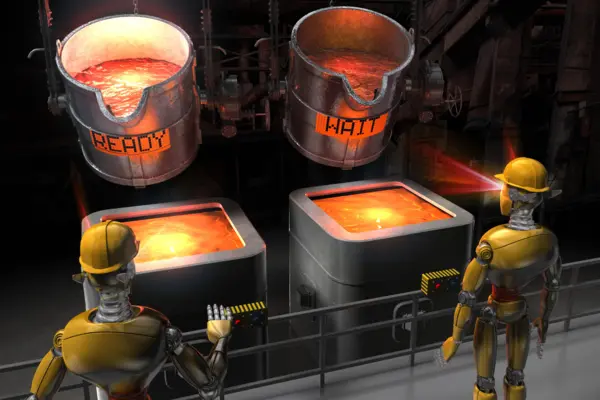
I want to develop a switch that can change thermal transmissivity. Imagine each pixel of the text (figure 7) as a thermal switch. The orange part represents a switch that allows heat to pass through easily, while the black part represents an area where heat does not pass through. Inside this container is molten hot iron. This molten iron is the heat source, and the display uses an infrared technique.
I want to develop a technology that can use the heat emitted to be displayed on a screen. The temperature in this (illustrated) room is assumed to be 100°C. I think that typically, you wouldn’t be able to place a TV or display in such an environment. LCDs and OLEDs wouldn’t work, and I’m imagining a scenario where humans cannot work in that setting.
In this environment, only robots can operate. These robots would capture infrared signals and move according to the instructions displayed on the screen. I’m not sure if this will ever be realized, but I hope to develop this kind of "thermal display." However, when I talk to experts about it, they don't understand, so I asked a graphic designer to create this image. (laughs) I also tried using AI (like ChatGPT) to create an image, but it didn’t quite match my vision."
Advice for Future PicoTR Users
NETZSCH: If you could give advice or points of caution to someone considering introducting PicoTR, what would it be?
Prof. Ohta:
"Regarding the selection of samples for PicoTR, the thin samples we use are perfect. However, I don’t think PicoTR would work well with thicker samples or those with prominent surface roughness. Sometimes we get requests to measure samples using PicoTR, and when I look at the samples they send, they often have significant surface roughness. So, if you decide to introduce PicoTR, I recommend using thin samples with smooth surfaces."
NETZSCH: Thank you very much for these interesting insights, Prof. Ohta! We are proud to support your research with our PicoTR analyzer. Moreover, for measuring thicker samples, we can recommend our Laser-Flash Analyzer. 😉
Learn more about NETZSCH products for Testing Thermophysical Properties