Capillary Rheometers
Capillary Rheology Technique by NETZSCH
High-pressure capillary rheometers (the NETZSCH Rosand series) are designed to measure material behavior under extreme shear conditions, closely mimicking high-speed processing operations. In a capillary rheometer, the material (often a viscous melt or thick fluid) is confined in a temperature-controlled barrel and forced through a narrow capillary (die) by a powerful piston.
NETZSCH Rosand rheometers are built on a decades-long tradition of excellence. Originally developed by Bohlin Instruments, then advanced by Malvern Instruments, the technology was brought under NETZSCH Analyzing & Testing’s full portfolio in 2020.
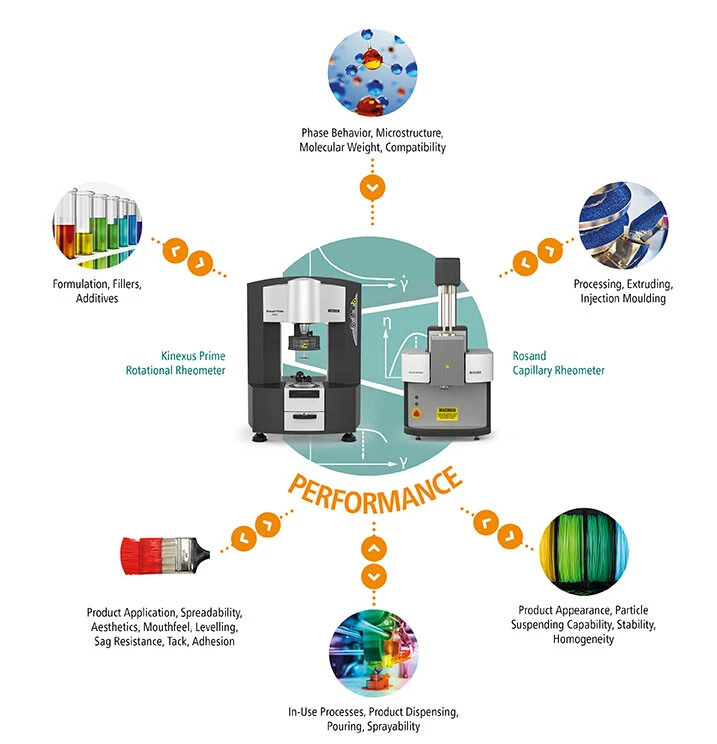
Today, NETZSCH is the only company on the market that offers both rotational and capillary rheometers and, in combination with other thermal analysis instruments such as Differential Scanning Calorimetry (DSC), provides extensive analysis capabilities from a single source.
Our Capillary Rheometers
Explore the range of NETZSCH Rosand Instruments
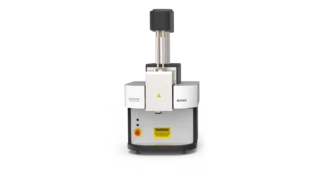
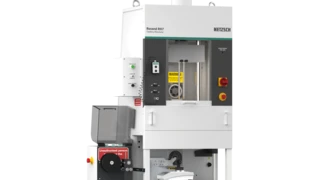
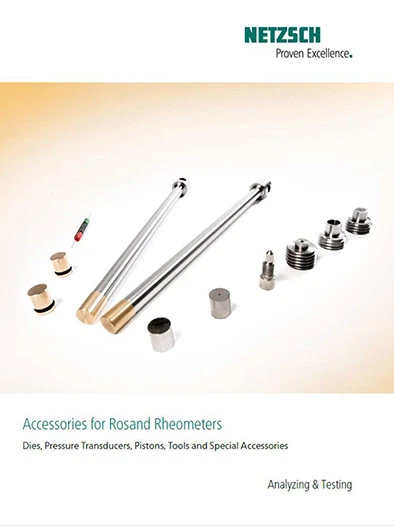
Accessories for NETZSCH Capillary Rheometers
Take advantage of our extensive range of dies, transducers, pistons, and special accessories for NETZSCH Rosand capillary rheometers.
The Rosand series of high pressure capillary rheometers are class-leading instruments, providing robust research for high-force conditions. The wide range of shear rates these instruments can apply enables correlation with material processing conditions, from research through to quality control applications.
The large selection of dies and accessories is optimized for the rheological characterization of complex fluids and soft solids, including dispersions, emulsions, polymer and surfactant solutions, pastes, adhesives and inks.
About the Method
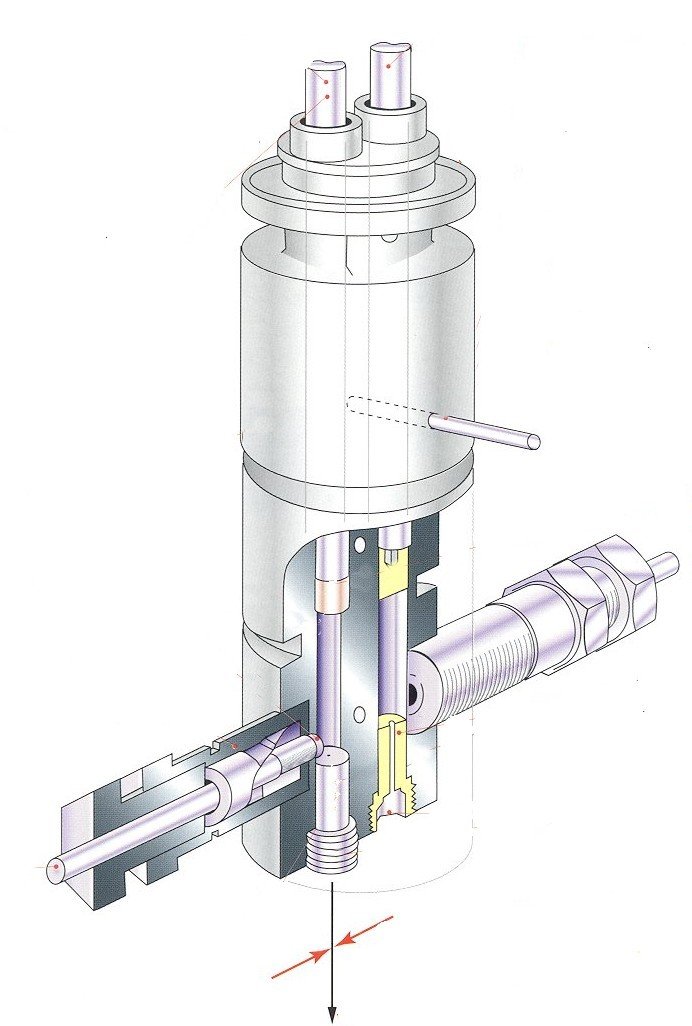
Capillary Methodology
With the Rosand capillary rheometer, a sample is loaded into a cylindrical barrel that is pre-set at the required test temperature. A servo-drive-controlled piston is then used to extrude the sample material through a cylindrical or rectangular slot die in place at the end of the barrel at a very controlled series of speeds (volumetric flow rate). The pressure drop across the die is continuously monitored and measured with a pressure transducer placed just above the die. A cut away is shown in the figure on the left.
Capillary rheometers can be used to execute shear viscosity, extensional viscosity and elasticity measurements. Also, there are modules for thermal degradation tests, flow – no flow testing, pressure volume temperature (PVT) tests, haul-off (fiber spinning), StressStress is defined as a level of force applied on a sample with a well-defined cross section. (Stress = force/area). Samples having a circular or rectangular cross section can be compressed or stretched. Elastic materials like rubber can be stretched up to 5 to 10 times their original length.stress RelaxationWhen a constant strain is applied to a rubber compound, the force necessary to maintain that strain is not constant but decreases with time; this behavior is known as stress relaxation. The process responsible for stress relaxation can be physical or chemical, and under normal conditions, both will occur at the same time. relaxation, wall slip analysis and others.
Generating a Viscosity Flow Curve
The constant shear test is designed to investigate the relationship between shear StressStress is defined as a level of force applied on a sample with a well-defined cross section. (Stress = force/area). Samples having a circular or rectangular cross section can be compressed or stretched. Elastic materials like rubber can be stretched up to 5 to 10 times their original length.stress and shear rate for a material, with shear viscosity being the ratio between the two parameters. The test routine involves pre-setting the test temperature, then loading the sample with periodic tamping, thus ensuring a uniform fill by reducing voids and air entrapment. Loading of the sample is followed by further pre-test compressions to ensure the sample is de-aerated as much as possible and fully compacted.
A series of discrete piston speeds (shear rates) is selected from across the shear rate range of interest and the sample is extruded until pressure equilibrium is detected at each speed. Pressure is monitored during the test and shear StressStress is defined as a level of force applied on a sample with a well-defined cross section. (Stress = force/area). Samples having a circular or rectangular cross section can be compressed or stretched. Elastic materials like rubber can be stretched up to 5 to 10 times their original length.stress calculated at each data pointed collected. To ensure accurate results regarding the true flow properties of the sample, the user has the option of applying up to two corrections associated with errors of entrance pressure and Non-NewtonianA non-Newtonian fluid is one that exhibits a viscosity that varies as a function of the applied shear rate or shear stress.non-Newtonian flow.
?How can rheology help you?
Your Benefits
> 40
> 100
50
Benefit from the Rosand FreeFlow Dies
Extensional viscosity (?ₑ) is a rheological property that significantly affects the processability of polymer melts and the mechanical properties of the final product.
Planar extensional viscosity measures a fluid’s resistance to deformation when stretched in two dimensions, unlike uniaxial extensional viscosity, which involves stretching in a single direction. It is crucial in processes like polymer film production and coating applications for predicting material behavior and ensuring consistent product quality.
𝜂ₑ can be readily determined by inlet pressure drop (𝘗ₑₙ) measurements using high-pressure capillary rheometers, orifice dies, and the Cogswell method. However, during 𝘗ₑₙ measurements, polymer can adhere to the underside of the orifice die, leading to an overestimation of 𝘗ₑₙ.
To overcome this challenge, NETZSCH offers the FreeFlow dies: Thanks to their design, they completely eliminate wall sticking and thus allow for accurate measurement of the entrance pressure drop. Uniaxial and planar 𝜂ₑ can be easily obtained for different materials under controlled conditions.
Watch our video to see for yourself:
Why Choose a NETZSCH Rosand Capillary Rheometer?
- Unmatched Speed Control
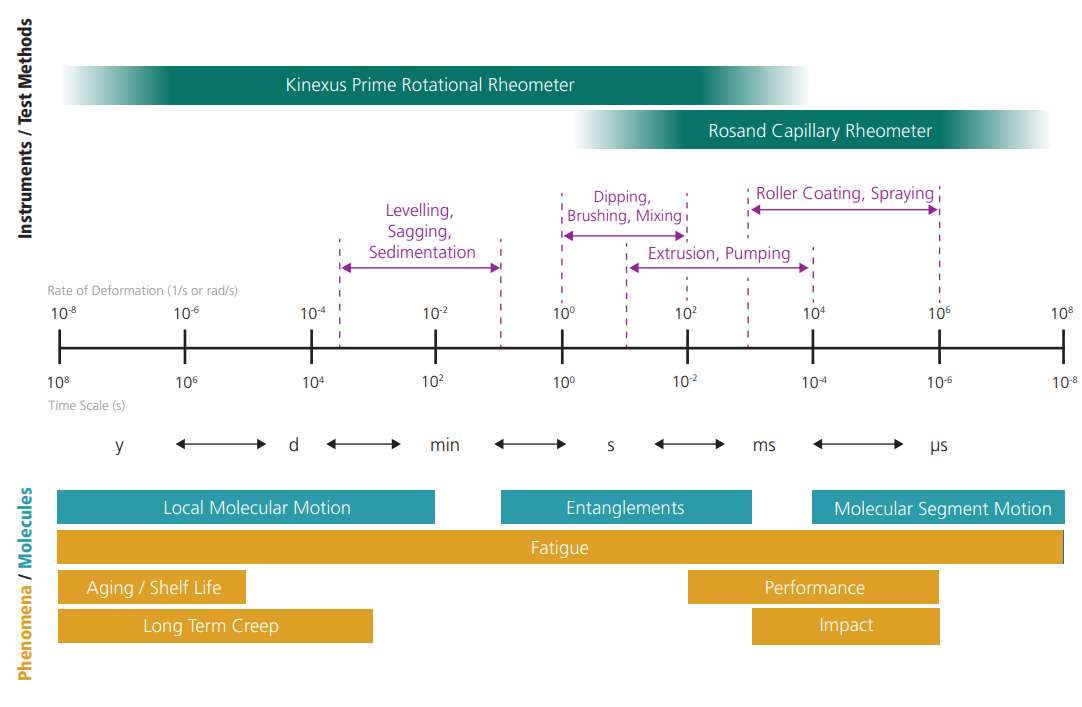
The bi-modal digital drive with up to 400,000:1 dynamic range and <0.1% uncertainty allows for precision from ultra-low to ultra-high speeds. Achieve up to 10⁸ s⁻¹, covering everything from slow extrusion to high-speed spraying.
- Intuitive Operation
Benefit from our comprehensive analysis software for shear, extensional, wall slip, melt fracture, degradation, StressStress is defined as a level of force applied on a sample with a well-defined cross section. (Stress = force/area). Samples having a circular or rectangular cross section can be compressed or stretched. Elastic materials like rubber can be stretched up to 5 to 10 times their original length.stress, RelaxationWhen a constant strain is applied to a rubber compound, the force necessary to maintain that strain is not constant but decreases with time; this behavior is known as stress relaxation. The process responsible for stress relaxation can be physical or chemical, and under normal conditions, both will occur at the same time. relaxation, and more — with visualization of the set-up (temperature, pressure), easy export, multi-language support and online data view during the tests, along with the ability to merge previous test runs for comparison.
- Proven Technology – Fully Configurable
The Rosand name is globally referenced in polymer melt rheology, with a heritage tracing back to the pioneering work of Bohlin and Malvern — now carried forward by NETZSCH with continuous innovation. We were the first to market with true twin-bore measurement for simultaneous shear and extensional viscosity testing, or for two-material comparison in one run. Robust H-frame (RH7/RH10) or cantilever (RH2000) constructions allow for accuracy in high-load and transient tests such as pVT.
- Accessories Ecosystem
Expand capabilities with pVT, haul-off & melt strength, die swell (with/without melt cutters), nitrogen purge, and laser measurement systems.
- Broadest Shear Rate Range
NETZSCH Analyzing & Testing is the only company on the market that offers both rotational and capillary rheometers and, in combination with other thermal analysis instruments such as those for Differential Scanning Calorimetry (DSC), provides extensive analysis capabilities from a single source.
- Worldwide Support & Expertise
Rely on decades of experience from our worldwide team. NETZSCH offers expert service, training, and application support to help you get the best results from your rheometer.
- Proven Excellence Paired with Unlimited Warranty
With a minimum spare parts availability span of 10 years, NETZSCH Kinexus rheometers promise top-tier quality, longevity and reliable performance. And to underline the quality and long-term availability of our services, we offer an unlimited warranty for the Kinexus Prime instrument series.

Our Quality Promise:
NETZSCH’s Unlimited Warranty
At NETZSCH, our commitment to quality goes beyond the instruments themselves. We understand that your investment in advanced technology is a long-term one, and and that’s why we offer something truly unique – our Unlimited Warranty.
Frequently Asked Questions
Long Instrument Life
Always There for You
Unlimited Warranty
Applications for Capillary Rheometers
NETZSCH Rosand high-pressure capillary rheometers are the go-to solution for understanding material behavior under real processing conditions. From polymer melt processing to applications in food, pharma, and coatings, they provide the insights needed to optimize product performance and allow for reliable, efficient manufacturing.
Click on the appropriate application box to learn more.





Reference Customer Studies
Rheological analysis is a fundamental part of developing many types of products. A rheometer can actually measure sample properties at extremely low shear rates, as in sedimentation, or at the high shear rates seen in pumping, mixing and application. In the correct shear range, we can adequately simulate a flow process and so differentiate good products from poor ones.
Learn how our high-quality instruments have changed the work of our customers.
Here's what our customers say about using the NETZSCH rheometer:
"Since 1994, we have reliably used the Rosand rheometer to investigate the flow behaviour of polymers, thermoplastics, rubbers and highly filled plastics."
"Choosing NETZSCH rheometers was an easy decision. The instruments have (and, more importantly, meet!) excellent specifications."
"NETZSCH Kinexus rheometers help us to understand bubble dynamics in Yield StressYield stress is defined as the stress below which no flow occurs; literally behaves like a weak solid at rest and a liquid when yielded.yield stress fluids, reducing emissions from oil sands tailings ponds."
E-Learning
Become an Expert with our Free E-Learning Courses
All NETZSCH E-Learning Basic Courses are free of charge! The content is created by our laboratory method experts, who share their personal experiences with you. Take advantage of flexible online learning, fully adapted to your training needs!
Media and Training
Brochures and Whitepapers
 Rosand Series(pdf – 2.02 MB)
 Accessories for Rosand Rheometers(pdf – 2.01 MB)
 A Basic Introduction to RheologyWhite Paper(pdf – 391 KB)
 Introduction to the Rheology of DispersionsWhite Paper(pdf – 904 KB)
 Investigation of Pharmaceuticals, Foods, Cosmetics and OrganicsBrochure(pdf – 4.43 MB)
 Advanced Materials TestingBrochure(pdf – 3.67 MB)
 Product Overview(pdf – 1.65 MB)
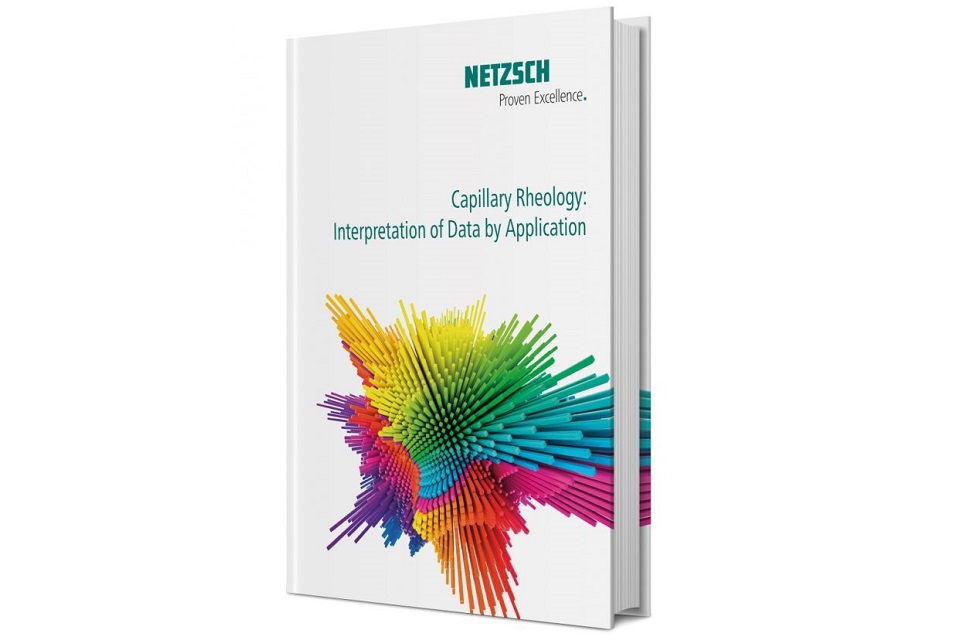
Application book: Capillary Rheology: Interpretation of Data by Application
This new booklet delivers an introduction to the technology and subject area, discusses application examples, shows how to characterize fundamental material properties, and provides examples of measurements using advanced techniques.
The booklet provides insight into how shear and extensional properties can influence behavior in application, whilst allowing processing problems to be investigated and production to continue on the factory floor. This highlights the importance to, and benefits for, the material producer, processor and researcher.
Application Literature about NETZSCH Rosand Rheometers
Our latest blog articles about capillary rheometers








Videos related to NETZSCH Capillary Rheometers

Consultancy & Sales
Do you have further questions about our instruments or the method? Would you like to speak to a sales representative?
Service & Support
Do you already have an instrument and need technical support or spare parts?
FAQs about NETZSCH Rheometer Service