Introduction
The development of drug eluting devices is a key area of biomedical research where products are created to deliver a tailored dose of a therapeutic agent at a particular site within the body. Typically, these drug eluting devices are fabricated with the therapeutic agent dispersed within a polymer matrix [1], or within a composite material partially composed of a polymeric matrix. Polymers are ideal vehicles for therapeutic agents because of their ease of manufacturability, tailorable release profiles, biocompatibility, and moldability. Examples of these kinds of products include drug eluting stents, implants, and sutures.
NETZSCH is uniquely positioned within the world of rheology because it produces both traditional rotational/ oscillatory rheometers as well as high force capillary rheometers; in tandem these instruments cover greater than six orders of magnitude of shear rates. Particularly, the capillary Rosand rheometers can be utilized to simulate polymeric manufacturing processes such as hot melt extrusion for pharmaceutical formulation [2]. In this example, low-DensityThe mass density is defined as the ratio between mass and volume. density polyethylene (LDPE) was extruded to produce thin implants or suture vehicles as a model for manufacturing.
Dynamic Mechanical Analysis (DMA) is primarily used to analyze the viscoelastic properties of polymeric materials but is also used to measure metals, ceramics, or simulate specific mechanical conditions. The NETZSCH DMA 303 Eplexor® is a versatile desktop device capable of measuring in a temperature range from -170°C to 800°C (-274°F to 1472°F), applying a force ranging from 1 mN to 50 N, and at frequencies of 0.001 to 150 Hz. In this example, it was utilized for the determination of the LDPE vehicles’ viscoelastic properties. However, the force and frequency range of the unit allow for simulation of many physiological conditions as well, meaning the LDPE extrudate can be tested as an implant, suture, or stent under model conditions.
Capillary Rheometry Extrusion and Haul-off Testing
Besides being able to simulate the polymer melt processing of techniques such as hot melt extrusion, the Rosand RH7/10 capillary units are also capable of haul-off measurement, in which the polymer extrudate is threaded around two low friction pulleys (the first located on a precision balance) and then fed through a nip roll arrangement onto a take-up drum driven by a motor attached to the side of the main rheometer unit, as shown in Figure 1). This allows for both the melt tension to be determined, as well as the draw-down effect in which the extrudate is further thinned from the die’s diameter to a particular width. This is particularly relevant for drug eluting devices as implants are often administered by a needle of a given gauge (site dependent), and sutures need to meet dimensional standards.
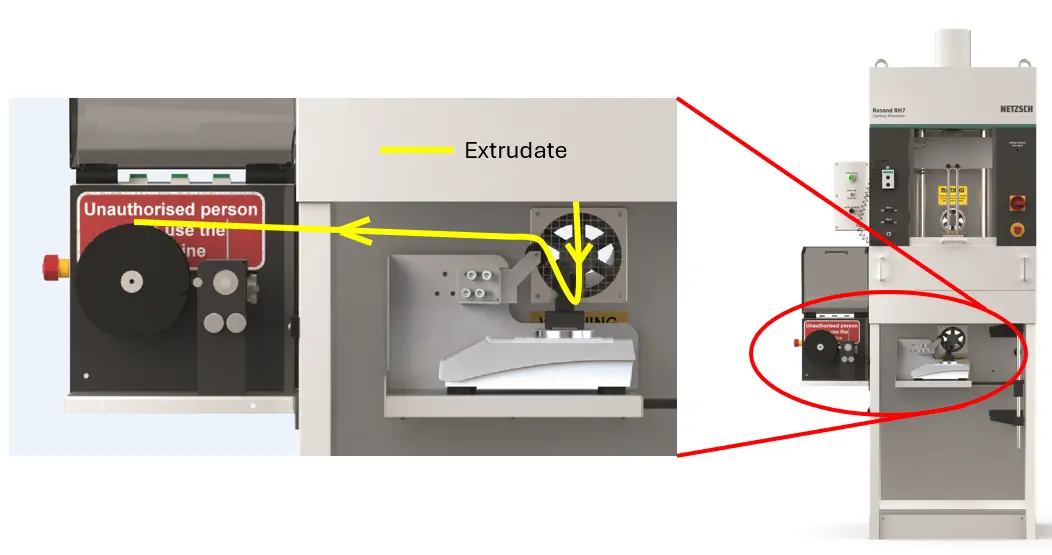
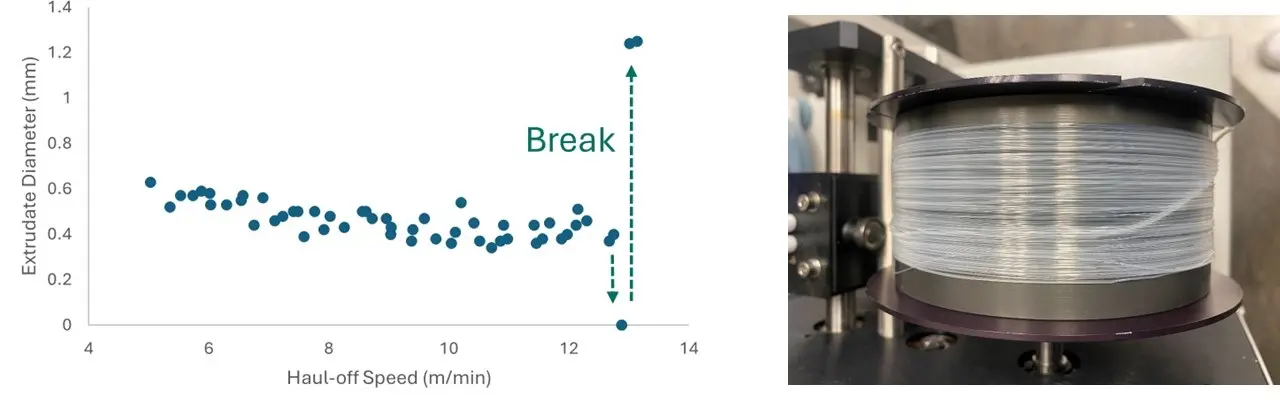
Herein, LDPE-450 pellets were processed at 180ºC using the Rosand RH10 floor standing model (Figure 1). A 16 mm long, 1.0 mm diameter, die was used to produce the polymer extrudate. A 5,000 PSI pressure transducer was used to measure the viscosity of the melt and the extrudate was fed onto the Tragethon haul-off system. The LDPE was extruded at a speed of 10 mm/min from the die and then the haul-off speed was ramped from 5 to 15 m/min. The results of the draw-down effect and collection of the LDPE extrudate are shown in Figure 2. From Figure 2a, the extrudate leaving the 1.0 mm diameter die is effectively thinned by the haul-off system and can be pulled to a consistent target diameter of 0.4 mm. From a haul-off speed of 6 to 7 m/min the extrudate diameter is 0.54 ± 0.04 mm while from 11 to 12 m/min the diameter is 0.54 ± 0.04 mm. This is very important for consistently producing drug eluting implants to be deployed by a needle (22-gauge needle) or sutures (USP size #0 or #1). Another key finding from Figure 2a is that the LDPE could be thinned with an increasing haul-off speed but that the material broke (as labeled) at a speed of 13 m/min causing the recorded diameter to read 0 (no material being measured) and then returning to 1.25 mm (extrudate diameter leaving the die). Being able to establish the degree of draw-down but also the point in which the melt strength is too weak for effective processing are important manufacturing considerations. Figure 2b shows the spooled LDPE extrudate collected from the haul-off system. A single run can produce several meters of thin material.
DMA Testing for Viscoelastic Properties and Application Simulation
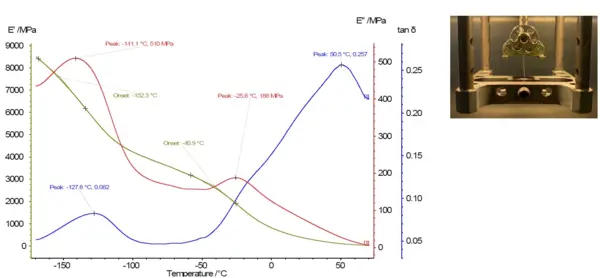
For determination of the viscoelastic properties of the thin, 0.4 mm diameter LDPE extrudate, a standard temperature sweep was performed on a single implant (taken from the 10 to 13 m/min haul-off speed section) in tension, as shown in Figure 3a, with the NETZSCH DMA 303 Eplexor® from -170 to 70°C, as shown in Figure 3b. The storage modulus (E’) describes the material's ability to store energy (and subsequently release it like a spring), the Viscous modulusThe complex modulus (viscous component), loss modulus, or G’’, is the “imaginary” part of the samples the overall complex modulus. This viscous component indicates the liquid like, or out of phase, response of the sample being measurement. loss modulus (E”) describes the material's dissipation of energy (typically through internal friction), and the damping factor (tan δ) is the ratio of E” to E’ describing how much a material will dampen an applied force.
From the labeled Figure 3b, the Glass Transition TemperatureThe glass transition is one of the most important properties of amorphous and semi-crystalline materials, e.g., inorganic glasses, amorphous metals, polymers, pharmaceuticals and food ingredients, etc., and describes the temperature region where the mechanical properties of the materials change from hard and brittle to more soft, deformable or rubbery.glass transition of LDPE occurs at approximately -130ºC with another transition at around -30°CC. The melt temperature of LDPE is typically 125ºC, however, as shown in Figure 3, the material becomes soft after 50ºC. Understanding the viscoelastic properties of a drug eluting product are important for physiological applications: how strong the suture is, how comfortable an implant may be perceived, how pliable the stent to be effectively wrapped around an artery but still provide reinforcement.
Additionally, the NETZSCH DMA 303 Eplexor® can be utilized to simulate dynamic loading conditions. This is particularly relevant for biomedical applications because the human body experiences constant small dynamic movements caused by blood flow from the pumping heart, as well as larger movements experienced throughout the day and during exercise. Stents will experience this dynamic deformation as they cover arteries/vessels, but even implants deployed in targeted locations such as the brain or back of the eye will experience constant small deformations by pulsatile blood supply and localized flow. The NETZSCH DMA 303 Eplexor® can measure materials at specific relative humidities or in fully aqueous environments by utilizing an immersion bath.
To simulate an environment which the LDPE extrudate might be exposed to as a suture, a time sweep was completed where the material was immersed in water and subjected to a 30 μm dynamic deformation at 1.3 Hz (to reflect the average 80 BPM resting heartrate) and 37ºC for 8 hours, the results are shown in Figure 4. Importantly, not only can the NETZSCH DMA 303 Eplexor® be used to model a dynamic loading at a biorelevant frequency, but by increasing the frequency of deformation, accelerated ageing can also be modeled [3].
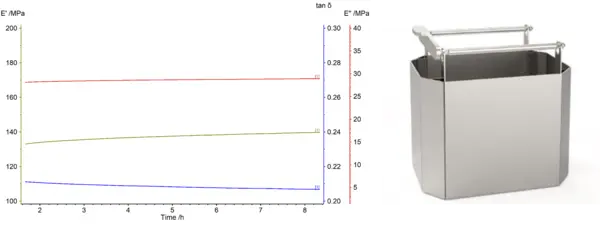
LDPE is hydrophobic so the mechanical properties are not expected to change drastically in a physiological environment as the polymer matrix will not swell. However, in this example a slight decrease (less than 1%) in the damping factor is observed, demonstrating that the implant behaves more elastically over time in the given environment, a key consideration for effective action within the human body. However, this slight magnitude in change would need to be validated to show significance. Contrasting that with an implant made of a hydrophilic polymer matrix, the swelling of the matrix over time would result in a significant reduction in stiffness.
Summary
Drug eluting devices are utilized to deliver controlled therapeutic doses within a specific location of the body. Herein, we demonstrated how various NETZSCH instruments can be utilized to not only model manufacturing and determine viscoelastic but also simulate physiological conditions which these materials may be exposed to. The Rosand RH10 was utilized to model hot melt extrusion of polymeric implants/sutures along with haul-off measurement for tensile properties and draw-down dimensional control to an extrudate diameter of 0.4 mm.
The DMA 303 Eplexor® was then utilized to measure basic viscoelastic properties (transitions at -130 and -30°C) and to simulate the dynamic physiological conditions (deformation by heartbeat) which the extrudates would be exposed to within the human body.