Hotbox Test Chambers
Determining the stationary heat transfer properties of complex components and finished products used in construction such as doors, windows and bricks
In a world increasingly focusing on sustainability, energy efficiency, and safety, accurate knowledge of the heat transfer properties of building materials is crucial. Whether it's about the insulation of buildings, the efficiency of windows and doors, or the overall energy balance of facades, precise determination of these properties is essential. This is where the innovative NETZSCH TDW Hotbox test chambers come into play – the ultimate solution for measuring and analyzing the heat transfer properties of wall elements, walls, windows and doors.

About the Hotbox Method

Hotbox Test Chamber - How does it work?
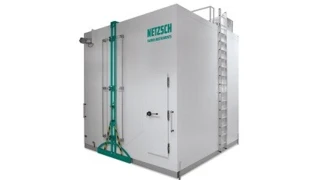
In a hotbox, real-world conditions as they would exist for a building wall are simulated: In practice, both conditions inside the building and on the outside can be simulated. This means that temperature, humidity, air speed and radiation properties on both sides of the test wall must be detectable and precisely adjustable.
There are usually two test chambers (warm and cold section). Between them is a test frame with the sample positioned. Stone walls to be tested are first bricked onto a base and then dried in drying chambers. Windows, doors or facade parts are mounted directly on the test frame. The prepared test frame is inserted between the warm and the cold section to be measured.
In NETZSCH Hotbox systems, homogenity of the flow and temperature profiles is achieved to be in accordance with international standards like DIN EN 1934, DIN EN ISO 8990, DIN EN 1946-4, DIN EN ISO 12567, DIN EN 12412-2 and ASTM C1363. This means that the same temperature and air speed must prevail on the test wall at every point of the warm and cold sections.

What Purpose Do Hotbox Tests Serve?
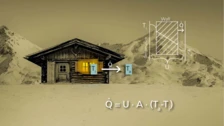
The heat transfer through a brick wall or a window part is defined by the U-value: The lower the U-value, the lower the lost heat-flow and the better the insulation properties of the building part. The U-value is therefore a measure of the energy efficiency of parts of a building envelope such as brickwork, facades, windows and doors. Manufacturers have to specify the U-value of their products.
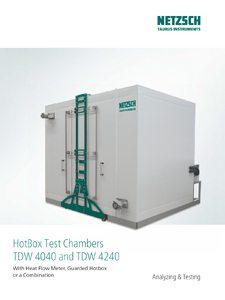
We offer two different Hotbox systems: The TDW 4040 with a Heat Flow Meter and the TDW 4240 with a controlled Hotbox.
Frequently Asked Questions
NETZSCH offers two different systems to measure and analyze the heat transfer properties of wall elements, bricks, walls, windows and doors: The TDW 4040 with a Heat Flow Meter and the TDW 4240 with a controlled Hotbox.
Key Facts for the NETZSCH TDW 4040
The TDW 4040 is the test chamber for determining the stationary heat transfer properties with a Heat Flow Meter in accordance with DIN EN 1934. It is designed for testing brickwork (such as brick, lime sand brick, concrete, or aerated concrete) and basically simulates the temperature and the natural convection inside and outside a building.
The compact test chamber for specimens up to 1500 mm x 1500 mm and 360 mm thickness consists of a cold and a warm section, the hotbox and a test frame with test mask that is positioned between the two sections of the chamber. Both sections contain heat exchangers for temperature control and air deflectors with radial fans to generate the necessary convection.
Key Facts for the NETZSCH TDW 4240
With the TDW 4240, we offer a test chamber system with a controlled hotbox in accordance with standards like DIN EN ISO 8990, DIN EN 1946-4, DIN EN ISO 12567, DIN EN 12412-2, ASTM C-1363.
The compact TDW 4240 test chamber is designed for testing elements and components used in construction, such as windows, profiles, doors, brick walls and domes handling specimen sizes up to 2180 mm x 2000 mm and 560 mm thick.
In contrast to conventional analysis methods for determining Thermal ConductivityThermal conductivity (λ with the unit W/(m•K)) describes the transport of energy – in the form of heat – through a body of mass as the result of a temperature gradient (see fig. 1). According to the second law of thermodynamics, heat always flows in the direction of the lower temperature.thermal conductivity – e.g., guarded hot plate method – these hotbox test chambers not only take the heat conduction through the material itself into consideration, but also the heat transfer conditions that are influenced by environmental factors such as material surface structures and ambient conditions. The surface structures of walls or transmission properties of window panes, for example, thus have direct influence on the effective heat transfer.
The measurement result is either the effective Thermal ConductivityThermal conductivity (λ with the unit W/(m•K)) describes the transport of energy – in the form of heat – through a body of mass as the result of a temperature gradient (see fig. 1). According to the second law of thermodynamics, heat always flows in the direction of the lower temperature.thermal conductivity of the entire test wall (heat-flow method) or the U- or k-value (heat transmission coefficient) as it relates to the heat flow between the air of the warm and cold sections (method with protected hotbox).
The TDW systems can test a wide range of materials, including brick, lime sand brick, concrete, aerated concrete, insulation panels, windows, doors, profiles, and composite materials. The TDW 4040 focuses on walls like brick and concrete walls, while the TDW 4240 accommodates larger building elements, such as windows and doors.
The TDW systems use the intuitive Hotbox Software, which simplifies for control, data logging, analysis and report generation for test chambers for determining the stationary heat transfer properties in accordance with international standards.
It enables real-time monitoring and comprehensive analysis, saving time and ensuring reproducible results.
Find out more about the software in our NETZSCH Hotbox brochure:
The cost of a NETZSCH Hotbox can vary significantly depending on the model, temperature range and additional accessories you may require.
To get an accurate and up-to-date price for your individual NETZSCH TDW instrument, please contact your local NETZSCH representative or one of our authorized distributors. We will provide a quote tailored to your specific requirements, including any necessary training, installation, or additional features.
Each NETZSCH Hotbox is a customized instrument adapted to the customers needs. According to that the delivery time can be longer in comparison to a standard device.
For the most up-to-date information, we encourage you to contact us directly with a specific request. This will ensure that we can provide you with an accurate timeline tailored to your specific needs.
Your Benefits
> 20
> 25
50
What Makes NETZSCH Hotbox Testing Chambers Unique?
- Wide Specimen Accommodation and Tailored Solutions for Various Applications:
NETZSCH systems are designed to handle diverse testing scenarios with flexibility in specimen size and thickness, making them ideal for a wide range of materials and applications.- TDW 4040: For compact brickwork and materials, accommodating specimens up to 1500 mm x 1500 mm with different thicknesses.
- TDW 4240: For larger building components like windows, doors, and profiles
- Advanced Software Integration: The Hotbox Software simplifies testing with easy parameter selection, real-time data acquisition and automated, comprehensive report generation. This allows for reproducibility and saves time compared to less intuitive systems.
- Customization Options: Optional features, like adjustable humidity levels, allow the simulation of real-world conditions, improving the accuracy of test results. Take advantage of our level of flexibility in environmental simulation.
- Market Reputation and Proven Excellence: NETZSCH is a trusted leader in thermal analysis, rheology and fire testing with decades of experience. Benefit from our durable, high-performance systems, reliable after-sales support, including maintenance, calibration and training. This ensures peace of mind for long-term use.
Hotbox Applications
The NETZSCH TDW 4040 and TDW 4240 systems are advanced HotBox testing chambers designed for precise thermal performance analysis of construction materials and components. By simulating real-world conditions, they deliver accurate evaluations of Thermal ConductivityThermal conductivity (λ with the unit W/(m•K)) describes the transport of energy – in the form of heat – through a body of mass as the result of a temperature gradient (see fig. 1). According to the second law of thermodynamics, heat always flows in the direction of the lower temperature.thermal conductivity and U-values, making them indispensable tools in the construction and building materials industry. These systems support diverse applications, including energy-efficient building designs, material optimization, and regulatory compliance, ensuring high-quality results under realistic testing environments:
- Building Insulation Materials
These systems are ideal for testing the Thermal ConductivityThermal conductivity (λ with the unit W/(m•K)) describes the transport of energy – in the form of heat – through a body of mass as the result of a temperature gradient (see fig. 1). According to the second law of thermodynamics, heat always flows in the direction of the lower temperature.thermal conductivity and insulation performance of materials such as bricks, concrete, lime sand bricks, aerated concrete, and composite materials. This helps manufacturers optimize material properties for energy-efficient construction. - Windows, Doors, and Facades
The TDW 4240 is specifically designed for analyzing the thermal behavior of larger components like windows, doors, facade systems, and structural profiles. This is critical for meeting energy efficiency regulations and enhancing sustainable building designs. - Rehabilitation and Retrofitting Projects
They are valuable tools for evaluating the thermal properties of materials and components used in retrofitting projects, including the addition of insulating layers to existing structures or testing new designs for older buildings. - Research and Development in Sustainable Materials
The systems aid in the R&D of innovative, eco-friendly materials, such as recycled composites or bio-based insulations, helping manufacturers achieve sustainability goals while maintaining high performance. - Regulatory and Standards Testing
By adhering to international standards like DIN EN ISO 8990, ASTM C1363, and DIN EN 1934, these systems support manufacturers, testing laboratories, and research institutes in certifying materials and products for market compliance.

NRG-STORAGE PROJECT*: Let’s push the boundaries of energy-efficient construction!
Our latest study presents the first systematic evaluation of NRG-Foam, a patented cementitious insulation material designed to balance thermal insulation and heat storage while maintaining mechanical integrity. We compared NRG-Foam-insulated walls with standard expanded polystyrene (EPS) panels, assessing their thermal performance under standard static conditions as well as dynamic real conditions in a NETZSCH Hotbox!
By participating in the EU-funded NRG-STORAGE project, NETZSCH is actively contributing to the EU’s target of becoming carbon-neutral by the year 2050.
Media and Training
Videos about NETZSCH TDW Hotbox Systems

FAQs about NETZSCH Service
We offer:
- Installation and Commissioning
- Relocation of your instrument
- Maintenance and inspection
- Calibration
- Repair
- Comprehensive training from basic to advanced use of the instrument on-site
Please note that our service may vary from region to region.
Yes, we offer maintenance contracts for your instruments according to the different regional and individual customer requirements. Please feel free to contact our Service Department or take a closer look at our website section Service-Level Agreement - NETZSCH Analyzing & Testing.
We offer online training via our NETZSCH Online Academy NOA, 1:1 remote training and on-site training at your location or our training centers. Simply contact your sales representative or go to Know-How - NETZSCH Analyzing & Testing