Mass Spectrometry (MS)
NETZSCH Thermal Analyzers Coupled to Mass Spectrometers
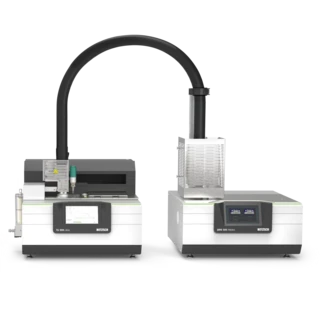
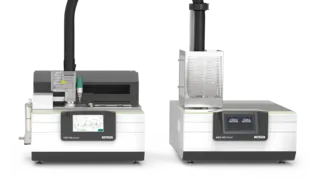
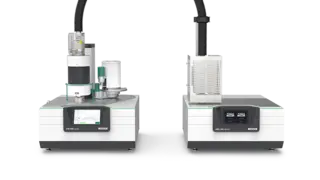
NETZSCH thermal analysis instruments coupled to mass spectrometers offer a robust solution for evolved gas analysis during thermal events. This combination allows for simultaneous measurement of mass changes and highly sensitive detection of even trace-level gaseous products. Whether analyzing polymers, pharmaceuticals, chemicals, or advanced materials, our integrated systems deliver precise, real-time insight into Decomposition reactionA decomposition reaction is a thermally induced reaction of a chemical compound forming solid and/or gaseous products. decomposition mechanisms, evolved gas composition, and reaction pathways, providing valuable clues to the original material composition.
Our Mass Spectrometry Coupling Solutions
Explore the range of our NETZSCH Coupling Solutions
About the Thermal Analysis QMS Coupling Method
Perfectly Coupled for Precise Results
What is QMS?
What is a Coupling?
Different Types of MS Couplings
When using mass spectrometry (MS) with thermal analysis, different coupling methods can be employed, depending on the specific requirements of the application. The two common approaches are direct coupling and coupling via a transfer line. Each offers distinct advantages in terms of sensitivity, detection limits, and system configuration, making it important to select the most suitable option for your laboratory setup and analytical goals.
Transfer Line Coupling via QMS 505 Aëolos®
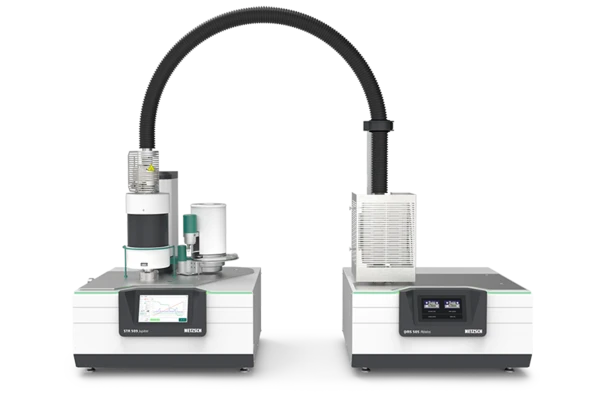
In this method, a heated transfer line connects the mass spectrometer to the thermal analyzer, enabling the transfer of evolved gases over a distance without the risk of condensation.
- Transfer temperatures of up to 350°C to prevent condensation and ensure loss-free gas transport.
- Uses fused silica or stainless steel capillaries for precise gas flow and minimal dead volume.
- Single-step pressure reduction for simple and efficient MS operation
- Flexible setup supporting simultaneous MS, FT-IR, and GC-MS measurements
- Robust and service-friendly design with ppb range sensitivity
- Suitable for measurements under humid conditions
Direct Coupling via Skimmer
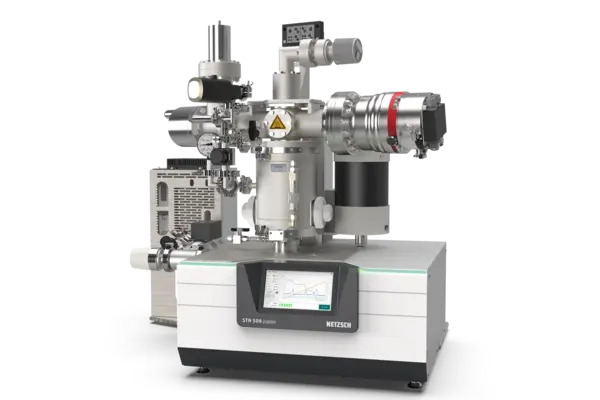
In this cofiguration, the mass spectrometer is connected directly to the thermal analysis instrument without a designated transfer line enabling significantly higher transfer temperatures.
- QMS is mounted directly above the STA furnace, minimizing the gas transfer path down to a few millimeters
- Two-stage pressure reduction for ultra-fast response
- Transfer temperatures up to 1950°C
- Enables evolved gas analysis for highly condensable vapor materials such as metals, salts and high-boiling organics
Seamless Integration of MS Coupling into the NETZSCH Proteus® Software
Measurements using NETZSCH instruments coupled to the QMS 505 Aëolos® or Skimmer can be controlled entirely via Proteus® software, which integrates the measurement and analysis software of the two coupled methods into a single software application for both control and data acquisition. Proteus® allows for the individual definition of any parameters relevant to thermal analysis (e.g., temperature program, heating rate, etc.) as well as any parameters relevant to the mass spectrometer (e.g., mass ranges, scans, etc.). For hyphenated measurements, the two systems are started and stopped simultaneously.
During the measurement, the thermoanalytical and MS data are displayed in a common plot and stored in one measurement file. This is then used in the Proteus® analysis software for joint presentation and evaluation. There is no longer any need for complex data import or switching between different applications.
3D Visualization for Deeper Insight into Evolved Gases
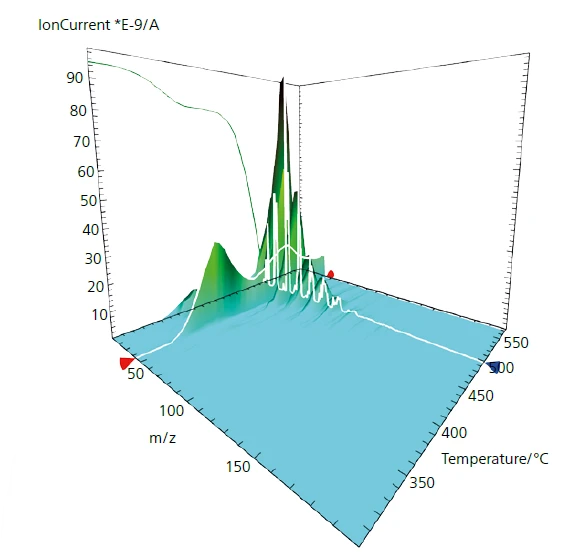
The 3D plot of temperature, m/z ratio, and ion current provides a comprehensive visualization of all MS data in a single graph. It allows users to observe the relationship between mass loss and signal intensity across individual m/z values.
Comprehensive Information via Scan-Bargraph
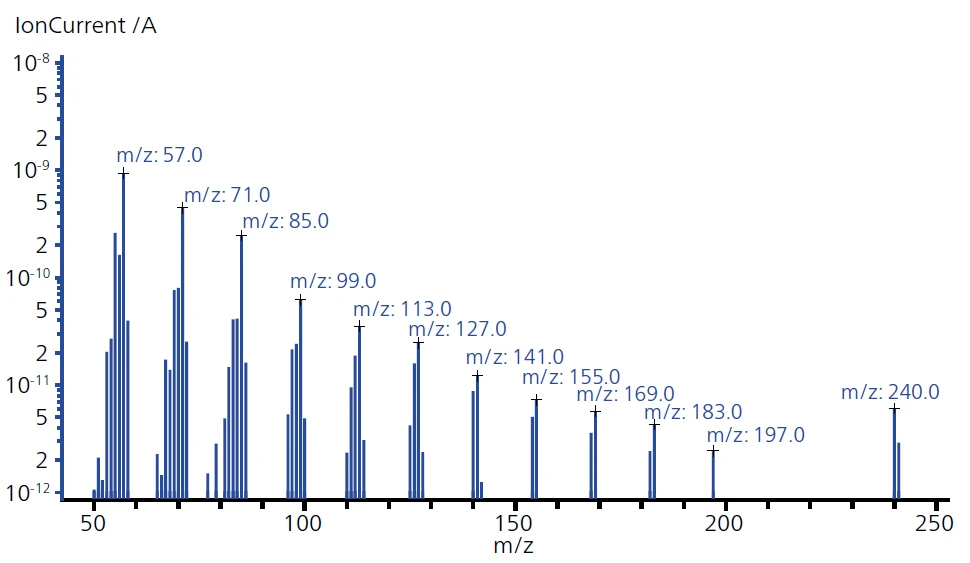
A scan bargraph is often used as the basis for visualizing comprehensive information about all species evolved from a sample. Within the Proteus® software, users can display either all mass numbers recorded or only selected ones of interest, shown as time-resolved MID curves. In the example, one of the repeated scans is shown for heptadecane measured in argon.
Key Software Features
Your Benefits
> 50
> 60
> 50
Mass Spectrometers Coupled to NETZSCH Thermal Analysis – here are the benefits to you:
- Unmatched sensitivity for trace detection:
Mass spectrometry enables the identification of even the smallest amounts of evolved gases, down to the ppb range – far beyond the sensitivity of standard thermal analysis alone. - Fast and selective analysis for complex samples:
With high selectivity and rapid detection capabilities, QMS is ideal for applications requiring continuous monitoring of fast-evolving processes during TGA or STA measurements. - Reliable performance in demanding environments:
Quadrupole MS systems are designed for continuous operation, making them a robust and dependable choice for routine lab work and advanced research. - Optimized integration with NETZSCH systems:
NETZSCH coupling solutions ensure efficient gas transfer and accurate correlation between thermal events and gas evolution, enabling comprehensive material characterization. - NETZSCH Proteus®: One Software Solution
Seemless integration of thermal analysis and mass spectrometry in a single software interface, eliminating the need for multiple tools.
Why Should you Choose a NETZSCH Thermal Analyzer for your Coupling?
We deliver tailored solutions going beyond measurement data and providing insight with smart approaches. NETZSCH Analyzing & Testing is your perfect match, offering unrivaled precision, reliability and innovation. Here’s why you should consider investing in a NETZSCH instrument for your laboratory or research facility:
- Always One Step Ahead with the Proteus® Measurement Software
The Proteus® software for thermal analysis is integrated to support the Thermal Analysis-to-MS coupling. Features like AutoEvaluation for the automatic evaluation of curves, Identify for material identification and comparison via a database and other advanced tools make your analysis seamless and insightful.
- Modular Flexibility with the AutoSampler
Our AutoSampler provides unparalleled modular flexibility, as it can be added as an accessory to any coupling setup. This allows you to expand and adapt your system according to your evolving needs, ensuring scalability and efficiency in your operations.
- Tailored Furnace Solutions for Coupling Systems
We offer a range of furnace options for STA couplings, ensuring that the solution perfectly matches your requirements. Our selection allows you to configure your system to meet your specific application needs with precision.
- Comprehensive Support Throughout the Purchase Process
We provide extensive support during the entire purchasing process. Our team of experts will guide you through the configuration of your system, ensuring a perfect fit without compromise. From consultation to installation, we're with you every step of the way.
- Expert Support and Training
Benefit from the expertise of our dedicated and continuously trained professionals across service, laboratory, training, and sales departments. Our team with decades of experience is committed to providing exceptional support and comprehensive training to ensure you get the most out of your instrument
- Proven Excellence in German Engineering
NETZSCH instruments are synonymous with German engineering excellence, offering top-tier quality and exceptional durability. With a minimum of 10 years of spare parts availability, our instruments promise longevity and reliable performance for years to come.
Long Instrument Life
Always There for You
Unlimited Warranty

Our Quality Promise:
NETZSCH’s Unlimited Warranty
At NETZSCH, our commitment to quality goes beyond the instruments themselves. We understand that your investment in advanced technology is a long-term one, and and that’s why we offer something truly unique – our Unlimited Warranty.
Applications for Mass Spectrometry (MS)
Mass spectrometry (MS) is a vital analytical technique used across numerous industries, offering qualitative identification and, where calibration and instrument configuration allow, quantitative analysis of chemical species based on their mass-to-charge ratio.
At NETZSCH Analyzing & Testing, our advanced MS coupling solutions ensure high sensitivity and accuracy for a broad spectrum of applications.

Polymers and Plastics
Thermal analysis coupled with MS enables the detection and identification of volatile degradation products and residual additives in polymers and plastics. This combination provides valuable insights into Decomposition reactionA decomposition reaction is a thermally induced reaction of a chemical compound forming solid and/or gaseous products. decomposition mechanisms, Thermal StabilityA material is thermally stable if it does not decompose under the influence of temperature. One way to determine the thermal stability of a substance is to use a TGA (thermogravimetric analyzer). thermal stability, and compound-specific behavior during heating.
- Benefit: Enhanced material characterization for quality control, product development, and recycling applications.
Composites and Advanced Materials
By analyzing gases released during thermal events, coupled MS reveals details about the Thermal StabilityA material is thermally stable if it does not decompose under the influence of temperature. One way to determine the thermal stability of a substance is to use a TGA (thermogravimetric analyzer). thermal stability and Decomposition reactionA decomposition reaction is a thermally induced reaction of a chemical compound forming solid and/or gaseous products. decomposition pathways of fiber-matrix systems and high-performance materials. This knowledge supports the development of thermally robust formulations and process optimization.
- Benefit: Improved understanding of thermal resistance and component compatibility in complex materials.


Pharmaceuticals
Coupling MS with thermal analysis allows for the detection of Decomposition reactionA decomposition reaction is a thermally induced reaction of a chemical compound forming solid and/or gaseous products. decomposition products, residual solvents, and gaseous reaction intermediates. It supports stability testing, shelf-life prediction, and purity verification of pharmaceutical substances.
- Benefit: Enhanced drug formulation control and regulatory compliance through detailed decomposition profiling.
Food and Beverages
Thermal analysis coupled with MS enables the detection and characterization of volatile compounds released during the heating of food ingredients and packaging materials. It supports the study of flavor components, spoilage indicators, and potential contamination sources under thermal StressStress is defined as a level of force applied on a sample with a well-defined cross section. (Stress = force/area). Samples having a circular or rectangular cross section can be compressed or stretched. Elastic materials like rubber can be stretched up to 5 to 10 times their original length.stress.
- Benefit: Improved quality assurance and safety assessment in food processing and packaging.

Chemicals
Thermal analysis coupled with MS provides comprehensive insight into Decomposition reactionA decomposition reaction is a thermally induced reaction of a chemical compound forming solid and/or gaseous products. decomposition reactions, reaction kinetics, and the evolution of products in chemical substances and mixtures. It supports formulation development, process optimization, and hazard assessment.
- Benefit: Better understanding of chemical behavior and reactivity under thermal conditions.
Electronics
In electronic materials and components, thermal analysis coupled with MS enables the detection and characterization of off-gassing compounds, flame-retardant degradation products, and residual solvents. This information is essential for evaluating reliability, thermal StressStress is defined as a level of force applied on a sample with a well-defined cross section. (Stress = force/area). Samples having a circular or rectangular cross section can be compressed or stretched. Elastic materials like rubber can be stretched up to 5 to 10 times their original length.stress resistance, and potential failure risks.
- Benefit: Increased product safety and performance insight for electronic systems.


Consultancy & Sales
Do you have further questions about the instrument or the method? Would you like to speak to a sales represenative?
Service & Support
Do you already have an instrument and need technical support or spare parts?
Media and Training

Become an Expert for Thermal Analyzers coupled to Evolved Gas Analyzers!
Our Training Department offers exciting training courses on various methods throughout the year.
Find out more about our courses we offer and register now!


Application Literature about Mass Spectrometry (MS)
Our latest blog articles about Mass Spectrometry (MS)



Videos about Mass Spectrometry (MS)