Introduction
While Dynamic Mechanical Analysis (DMA) is primarily used to analyze polymeric materials, the technique can also be applied to a wide range of other fields. These include diverse applications in the biomedical industry. The NETZSCH DMA 303 Eplexor® is a versatile desktop device capable of measuring in a temperature range from -170°C to 800°C (-274°F to 1472°F), applying a force ranging from 1 mN to 50 N, and at frequency of 0.001 to 150 Hz. The force and frequency range allow for simulation of many physiological conditions as well as accelerated testing of those phenomena.
Medical implants and devices are generally categorized as replaceable (bone screws, chemotherapy ports, etc.) or permanent (pacemakers, stents, dental implants, etc.). Products designed to be replaceable run the risk of infection and placement issues while permanent products need to be able to survive several decades and withstand the forces which the human body experiences. Most adults have a resting heartrate between 60 and 100 beats per minute (average of 1.3 beats per second) causing small pulsatile movements throughout the entire body. Normal locomotion (standing, walking versus running, jumping, etc.) then results in greater magnitudes of localized stresses over the course of a day.
When designing a permanent implant or medical device, understanding the mechanical performance and ability to withstand physiological movements at the placement site over decades is critical.
DMA Accelerated Fatigue Testing
NETZSCH performed accelerated fatigue testing with an implantable chip made primarily of ceramic materials used in the manufacture of microchips, such as silicon and silicon dioxide. The device was ultra-thin (10 to 100 μm) and less than 1 square cm.
The geometries of the DMA 303 use RFID chips for simple setup and use. The single cantilever geometry was used in this investigation because it clamps the sample in place allowing for precise movement even at very high frequencies. Oscillating the device at 2.8 μm and 150 Hz for one week corresponds to just under three years of continual pulsatile movement in the body. At the beginning of the program, an initial force was applied to raise one end of the sample to match the biorelevant geometry of the intended placement site of the implant prior to oscillation.
Measurement Results
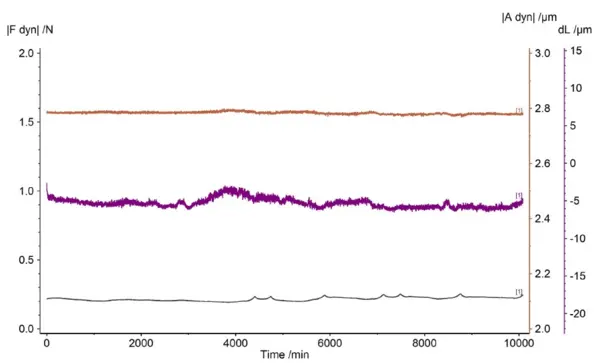
The results of the one-week continuous trial are shown in Figure 1. The dynamic deformation was maintained at 2.8 μm and 150 Hz. The dynamic force required to achieve the deformation is also shown. Force limits and StrainStrain describes a deformation of a material, which is loaded mechanically by an external force or stress. Rubber compounds show creep properties, if a static load is applied.strain limits were programmed into the run to ensure control over the entire trail. The change in sample length (dL) of the chip over the trial shows that the sample remains intact and does not begin to wear over time.
A key attribute of the software for the NETZSCH DMA 303 Eplexor® is that triggers can be added to a trial to stop the run, should a specified event occur. For this trial, the sample is initially bent to reflect the geometry of the intended placement of the implant and that shape is maintained over the entire course of the run. A trigger was added so that if the sample length changed back to horizontal, as would be the case if the specimen broke, the trial would immediately end. This is particularly useful for long trials as users can apply triggers to end the program, should the specimen fail or a desired outcome is reached.
Summary
The DMA 303 Eplexor® offers a wide range of frequency, force, and temperature, which makes it an ideal instrument for thermomechanical measurements across a wide range of application areas. Herein, we described the ability of the instrument to complete accelerated fatigue testing on an implantable biomedical device. Being able to accurately match physiological deformations and forces, while accelerating the oscillation up to 150 Hz allows users to complete fatigue testing in the fraction of the time. A 10-year long trial for the biomedical device tested could be completed in only 3.5 weeks.