Introduction
Thermal analysis is critical to the food and beverage industry for formulation, optimizing manufacturing processes, quality control, studying storage conditions, and determining product shelf life. The basic industrial cheese manufacturing process involves inoculating pasteurized milk with the enzyme rennet to produce coagulation. The curd is then separated from the whey, milled, and processed to a given form factor before being ripened (if aging is required). Cheese has a very unique structure in which fat globules are suspended by micelles formed of the protein casein (the main protein in milk). From a formulation standpoint, adding various polymers results in different sensory perceptions and properties, an example of which is adding hyaluronic acid to pizza cheese [1].
In this study, we sought out to investigate how a simple storage consideration, such as freezing, affects the properties of various types of cheese. Cold storage and freezing are both critical processes to cheese production and distribution, as well as how cheese is stored in the home. Additionally, we wanted to investigate whether we could measure the stretching properties of melted cheese to assess its performance in dishes such as pizza and grilled cheese.
Dynamic Mechanical Analysis (DMA) is primarily used to analyze the viscoelastic properties of polymeric materials but is also used to measure metals, ceramics, or simulate specific mechanical conditions. The NETZSCH DMA 303 Eplexor® is a versatile desktop device capable of measuring over a temperature range from -170°C to 800°C (-274°F to 1472°F), applying a force ranging from 1 mN to 50 N, and operating at frequencies of 0.001 to 150 Hz. In this example, it was utilized to measure the mechanical properties of white cheddar and parmesan before and after a freeze-thaw cycle.
However, measuring how storage conditions and temperature impact the mechanical properties of the solid cheese is only half the story for how we enjoy the product. The extensional properties of melted white cheddar were also measured to determine its performance in cooking scenarios such as with grilled cheese or fondue.
NETZSCH is uniquely positioned position in the field of rheology by offering both conventional rotational/oscillatory rheometers and high-force capillary rheometers: Together, these instruments cover a range of more than six orders of magnitude in shear rates. By using a double cylinder and a zero-length nozzle configuration, the shear and StrainStrain describes a deformation of a material, which is loaded mechanically by an external force or stress. Rubber compounds show creep properties, if a static load is applied.strain viscosities can be determined simultaneously as a function of the shear rate. In this case, the corrected StrainStrain describes a deformation of a material, which is loaded mechanically by an external force or stress. Rubber compounds show creep properties, if a static load is applied.strain properties of melted white cheddar were measured as a function of the shear rate.
DMA Testing to Determine the Effect of Freezing on Cheese Properties
Columns of white Cheddar and Parmesan were tested in compression mode, shown in Figure 1, to determine their mechanical properties as a function of temperature. DMA was utilized to determine the storage modulus (E’) of the cheese samples which describes a material’s ability to store energy, the Viscous modulusThe complex modulus (viscous component), loss modulus, or G’’, is the “imaginary” part of the samples the overall complex modulus. This viscous component indicates the liquid like, or out of phase, response of the sample being measurement. loss modulus (E”) which describes a material’s ability to dissipate energy (typically through heat generated by internal friction), and the damping factor (tan δ) which is the ratio of the Viscous modulusThe complex modulus (viscous component), loss modulus, or G’’, is the “imaginary” part of the samples the overall complex modulus. This viscous component indicates the liquid like, or out of phase, response of the sample being measurement. loss modulus to the storage modulus and describes a material’s ability to elastically or viscously deform to an applied force. Finally, the Complex ModulusThe complex modulus consists of two components, the storage and the loss moduli. The storage modulus (or Young’s modulus) describes the stiffness and the loss modulus describes the damping (or viscoelastic) behavior of the corresponding sample using the method of Dynamic Mechanical Analysis (DMA). complex modulus (denoted |E|, mathematically the root sum squared of E’ and E”) is a simple way to compare the overall stiffness between samples as a function of temperature.

In this study, a sample of either white Cheddar or Parmesan was measured from 20 to either 55 or 65°C (depending on Melting Temperatures and EnthalpiesThe enthalpy of fusion of a substance, also known as latent heat, is a measure of the energy input, typically heat, which is necessary to convert a substance from solid to liquid state. The melting point of a substance is the temperature at which it changes state from solid (crystalline) to liquid (isotropic melt).melting point) after only being refrigerated at 4°C. To understand the effect of a freeze-thaw cycle, samples of white Cheddar and Parmesan were stored at -20°C overnight before being thawed and analyzed with the same temperature program. The result of a freeze-thaw cycle on the properties of white Cheddar is shown in Figure 2, and on Parmesan in Figure 3.
From Figures 2 and 3, there is a clear difference in the cheeses (after only being refrigerated), parmesan has significantly higher modulus values compared to the white cheddar (E’ of 3.02 Vs 0.39 MPa at 25°C), as would be expected since parmesan is classified as a hard cheese. Both cheeses also had higher modulus values and damping factors after a freeze-thaw cycle (Parmesan E’ increased from 3.02 to 3.87, and white cheddar 0.39 to 0.60 MPa at 25°C) suggesting the storage condition influences the material and makes it significantly stiffer.
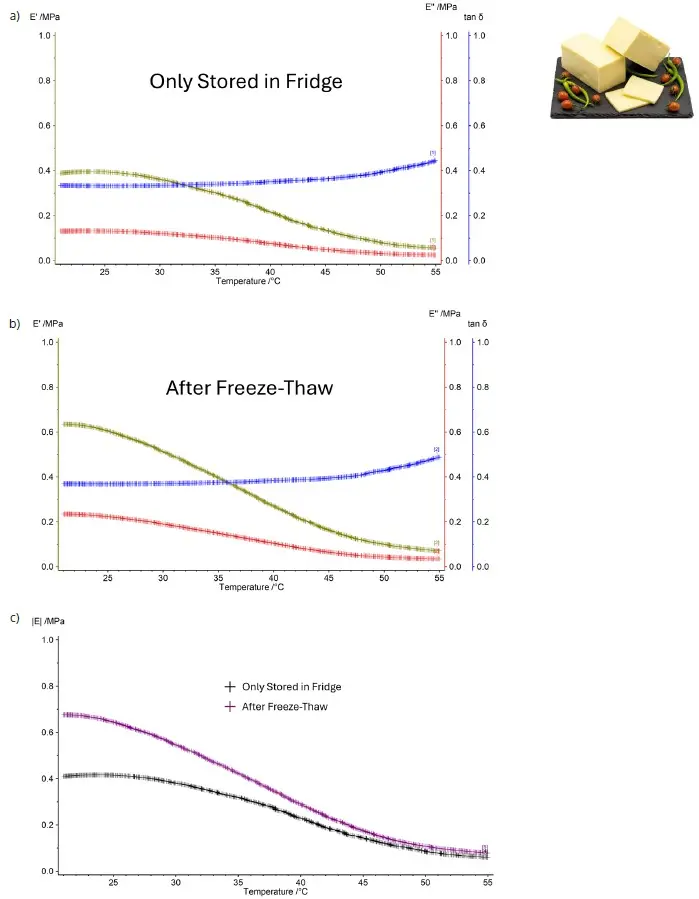

Table 1 summarizes the results of each sample at a selected temperature of 25°C. Understanding the interplay of E’ and E” is important for understanding how the cheese will be perceived during chewing, whether it will resist or easily yield against the force imparted by your teeth [2].
Table 1: Summary of E', E'', and tan δ for white Cheddar and Parmesan at 25°C
| Variable | Unfrozen | Frozen and Thawed | Increase after Freezing |
|---|---|---|---|
White Cheddar | |||
| E' (MPa) | 0.39 | 0.60 | 1.54 |
| E'' (MPa) | 0.13 | 0.22 | 1.69 |
| tan δ | 0.36 | 0.37 | 1.12 |
Parmesan | |||
| E' (MPa) | 3.03 | 3.87 | 1.28 |
| E'' (MPa) | 1.10 | 1.50 | 1.36 |
| tan δ | 0.36 | 0.39 | 1.08 |
It is interesting to note, the effect of increased stiffness after freezing is more prominent at room temperature but reduces greatly as the samples are heated (Figures 2c and 3c).
Finally, it is important to note that the DMA 303 Eplexor® is capable of reaching cryogenic temperatures, and therefore the freeze-thaw cycle could be completed in the instrument itself. However, it was found that the columns of cheese became so stiff that more force was required for dynamic deformation than the instrument could provide. To study these materials during freezing, a higher force instrument such as the DMA 503 Eplexor® is required.
Capillary Rheometry Extrusion and Haul-off-Testing
The NETZSCH Rosand RH2000 and RH7/10 series of capillary rheometers are typically used to understand the viscosity of polymers in the melt. Here, we sought to measure the viscosity of a melting cheese, such as white cheddar (Parmesan does not nicely melt), as a function of shear rate. The sample was measured at 65°C since this is a common temperature used for fondue, an instance in which cheese extension really matters.
Besides basic viscosity measurements, the Rosand instruments are also capable of utilizing various accessories and mathematical models to determine additional properties such as haul-off force, die swell, and extensional viscosity. With the Rosand twin bore design, a long die and an orifice die can be used to simultaneously measure a sample and calculate shear and extensional viscosity using the Cogswell model. From a practical standpoint, this shows how much the melt can be extended at a given shear rate, which is to say, how much the melted cheese will stretch when a slice of pizza is pulled away at a given rate. The shear and extensional properties of the white cheddar are shown in Figure 4. The white cheddar exhibited a common property of polymers in that it was Shear ThinningThe most common type of non-Newtonian behavior is shear thinning or pseudoplastic flow, where the fluid viscosity decreases with increasing shear.shear thinning; the viscosity of the sample decreased with increasing shear rate.
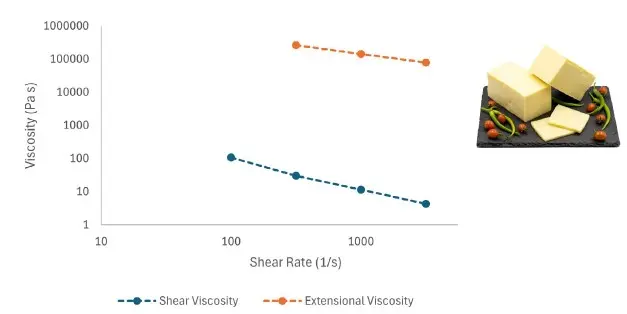
For Newtonian materials, it is well established that the extensional viscosity of the material is three times higher than that of the shear viscosity. For polymer melts, the ratio of extensional viscosity to shear viscosity is much higher, ranging up to several orders of magnitude. Here, it was determined that the white Cheddar had a very high extensional viscosity being several thousand times higher than the shear viscosity. From a practical standpoint, this suggests that the white Cheddar remains highly viscous (think honey vs water) while being sheared and therefore is less likely to break. As the Cheddar is sheared at a faster rate, the extensional viscosity goes down. Therefore, when optimizing a cheese pull, maintaining a high enough temperature and pulling slowly will maximize the distance the Cheddar can be extended.
Summary
Thermal analysis testing is pivotal in the food and beverage industry to aid in everything from formulation to determining shelf life. Herein, we demonstrated how various NETZSCH instruments can be utilized to not only understand how storage temperature impacts the properties of white Cheddar and Parmesan, but also measure properties in the melt like the extension of white Cheddar. Using the DMA 303 Eplexor®®, the mechanical properties of white Cheddar and Parmesan were compared over a range of temperatures. Additionally, the effect of a freeze-thaw cycle on either cheese was shown to significantly increase their modulus, an important consideration for the shipping and handling of the product. The Rosand RH2000 was utilized to model melt properties of white Cheddar, specifically the extensional properties. From a user standpoint, this is essentially a model for cooking and subsequent ‘pull’ of the cheese, a critical variable for marketing and performance.