Introduction
Polyamide (PA), as a highly important engineering plastic, has been widely used in fields such as automotive components, electronic products, textiles, and packaging materials due to its excellent mechanical properties, chemical stability, and Thermal StabilityA material is thermally stable if it does not decompose under the influence of temperature. One way to determine the thermal stability of a substance is to use a TGA (thermogravimetric analyzer). thermal stability. However, moisture absorption is a common issue during the processing of PA. When PA comes into contact with moisture, it leads to changes in its physical and chemical properties, particularly in viscosity. Viscosity plays a crucial role in polymer processing, as it determines the flow behavior of the PA material during processing. Therefore, understanding the relationship between moisture content and viscosity is essential for optimizing PA processing parameters and ensuring the quality of the final product.
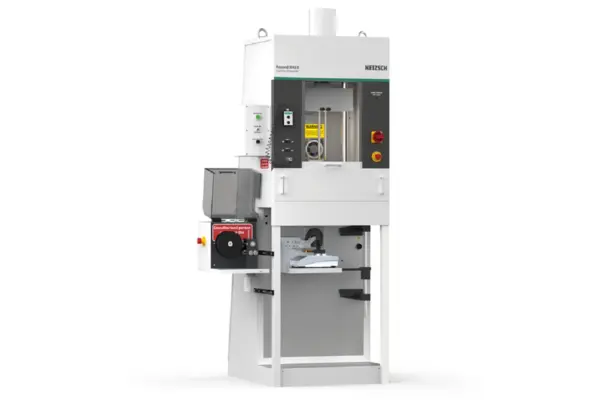
A capillary rheometer, as a commonly used instrument for testing the rheological properties of polymeric materials, can precisely measure the rheological properties of materials over a broad range of shear rates and temperatures. In this study, a NETZSCH Rosand RH10 capillary rheometer was employed to systematically investigate the influence of water content on PA viscosity. This provides valuable insights into the effects of moisture on PA rheological properties. Such findings not only aid in optimizing processing conditions for high-performance PA materials, but also offer significant reference value for technological advancement in the polymer processing industry.
Measurement Conditions and Test Method
The measurement conditions are detailed in Table 1.
Table 1: Measurement conditions
| Instrument | NETZSCH Rosand RH10 |
| Samples | PA |
Pressure transducer | 5000 psi |
| Die specification | L = 16 mm, D = 1 mm |
| Test temperature | 280°C |
| Shear rate range | 10 - 3000 s-1 |
After installing the dies below the left barrel, and waiting for the temperature to be stabilized, PA pellets were slowly added to the barrel, pre-pressurized to 1 MPa, and then preheated at a constant temperature for 5 min. The test was started after this compression step.
Measurement Results and Discussion
Figure 2 shows the apparent shear viscosity versus the apparent shear rate curves for PA samples subjected to different treatments at 280°C. It can be seen in the figure that the shear viscosity of the untreated and dried PA samples gradually decreases with increasing shear rate, exhibiting a typical Shear ThinningThe most common type of non-Newtonian behavior is shear thinning or pseudoplastic flow, where the fluid viscosity decreases with increasing shear.shear-thinning behavior. This occurs because the disentanglement of the PA macromolecular chains intensifies as the shear rate increases, leading to a rapid decrease in shear viscosity.
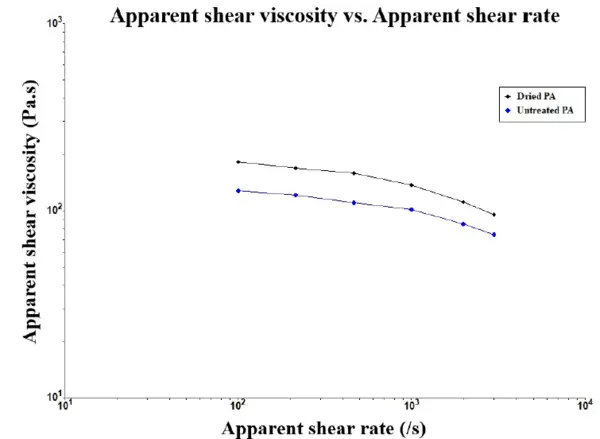
Furthermore, due to the amide group in the PA main molecular chain being a polar group capable of forming hydrogen bonds with water molecules, PA exhibits very strong water absorption. As can also be seen in Figure 2, the shear viscosity of the untreated PA sample is lower than that of the treated PA sample. This is primarily due to the higher water content in the untreated PA sample.
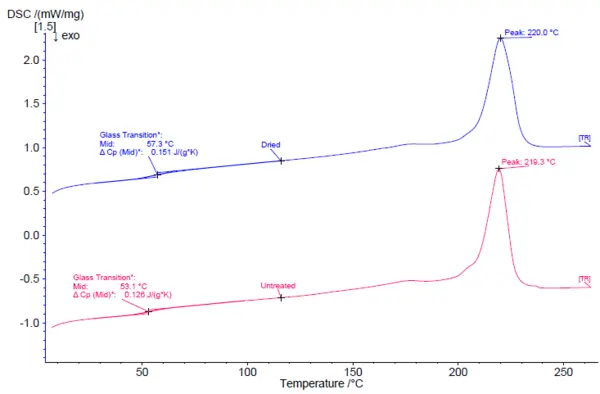
However, water molecules can form hydrogen bonds with the amide groups, replacing the hydrogen bonds between molecular chains. This reduces the DensityThe mass density is defined as the ratio between mass and volume. density of interchain hydrogen bonds, acting as a physical plasticizer (as evidenced by the lower Tg value in the untreated sample's DSC curve in Figure 3), thereby enhancing the mobility of PA chain segments, i.e., reducing the resistance to relative slippage of PA molecular chains during flow. Consequently, the shear viscosity of the PA melt decreases. PA is a product obtained through dehydration condensation on the other hand. At high temperatures, water molecules can chemically react with the amide bonds on the PA molecular chains, leading to chain scission. This is also the reverse reaction of its synthesis. The reduction in the molecular weight of PA inevitably leads to a decrease in its melt shear viscosity.
Shear viscosity is a material property that describes how strongly a fluid resists deformation under shear.
Apparent shear viscosity is the viscosity value you observe or calculate at a specific shear rate, especially for fluids the viscosity of which changes with flow conditions.
The Rosand capillary rheometer with double bore allows for corrections of the Non-NewtonianA non-Newtonian fluid is one that exhibits a viscosity that varies as a function of the applied shear rate or shear stress.non-Newtonian behavior and entrance effects for direct determination of the shear viscosity.
Conclusion
This study evaluated the rheological properties of dried and untreated PA materials using a NETZSCH Rosand RH10 rheometer. It was found that the moisture content significantly affects the shear viscosity of PA samples. PA samples dried in an oven exhibited significantly higher shear viscosity than those not dried.