Introduction
Additive manufacturing – particularly fused deposition modeling (FDM) – has become a widely used technique for the fast and flexible production of polymer-based components. In addition to mechanical properties, the thermal behavior of printed parts is becoming increasingly important. Especially for functional components, thermally stressed housings, application-oriented prototypes or components exposed to local heat generation, knowledge of the Thermal DiffusivityThermal diffusivity (a with the unit mm2/s) is a material-specific property for characterizing unsteady heat conduction. This value describes how quickly a material reacts to a change in temperature.thermal diffusivity is essential for evaluating the material behavior under real operating conditions.
Polylactides (PLA) are among the most commonly used materials in FDM 3D printing. Due to the layer-by-layer deposition of this material, however, direction-dependent thermophysical properties may occur within the print structure. The orientation of the filaments, the cooling conditions and the fusion between adjacent strands influence how quickly heat is transported through the printed component.
Measurement Task
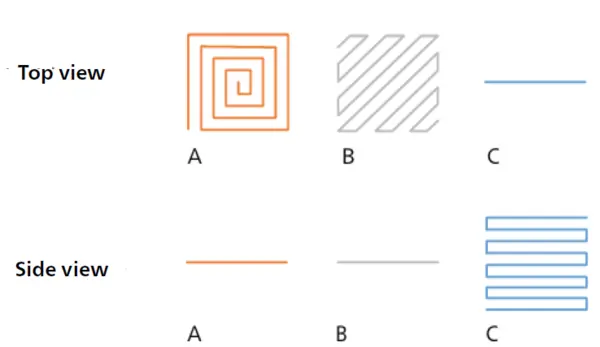
In this study, the Thermal DiffusivityThermal diffusivity (a with the unit mm2/s) is a material-specific property for characterizing unsteady heat conduction. This value describes how quickly a material reacts to a change in temperature.thermal diffusivity of PLA samples printed as shown above was analyzed. The samples were manufactured at the same printing speed but in different orientations. The aim was to investigate the influence of print orientation and the resulting filament arrangement on heat propagation within the material.
The samples were printed at a speed of 60 mm/s. Two variants represent individual filament layers deposited flat directly onto the print bed – one with a linear and one with a spiral filament path. A third sample was built perpendicular to the print bed and exhibits vertical filament fusion.
Method and Measurement Conditions
The Thermal DiffusivityThermal diffusivity (a with the unit mm2/s) is a material-specific property for characterizing unsteady heat conduction. This value describes how quickly a material reacts to a change in temperature.thermal diffusivity was determined by means of Light Flash Analysis (LFA) using the NETZSCH LFA 717 HyperFlash®. In the flash method, the front side of a plane-parallel sample is heated by a short energy pulse. The resulting temperature rise on the rear side of the sample is recorded contact-free by an infrared detector. The Thermal DiffusivityThermal diffusivity (a with the unit mm2/s) is a material-specific property for characterizing unsteady heat conduction. This value describes how quickly a material reacts to a change in temperature.thermal diffusivity of the PLA sample is calculated from the time-dependent signal curve.
The Standard Model* was employed for the evaluation. The essential measurement conditions are summarized in Table 1.
*The Standard Model considers the two dimensional (z-axis and radial) heat loss similar to the former Cape-Lehman [1] model.
Table 1: Measurement Conditions
| Parameter | Setting |
|---|---|
| Sample | Polylactide (PLA) |
| Instrument | LFA 717 HyperFlash® |
| Detector | MCT |
| Sample holder | 4 samples, square |
| Heating rate | 10 K/min |
| Temperature range | -100°C to 125°C |
| Sample dimensions | 10 mm x 10 mm x 09 mm |
Measurement Results
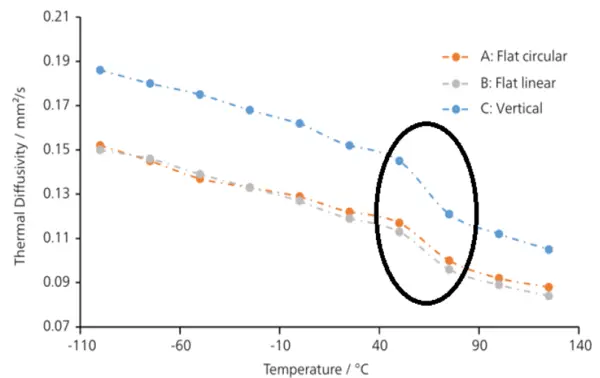
The direct comparison of the Thermal DiffusivityThermal diffusivity (a with the unit mm2/s) is a material-specific property for characterizing unsteady heat conduction. This value describes how quickly a material reacts to a change in temperature.thermal diffusivity curves of the three PLA samples shows a clear influence of the print orientation. The samples printed horizontally on the unheated print bed with linear or spiral filament paths exhibit comparable thermal diffusivities. The vertically printed sample with vertical filament fusion, however, shows higher values over the temperature range investigated.
This higher thermal diffusivity indicates more efficient heat propagation along the vertically connected filament structure. One possible reason is a higher degree of intra- or interfilament fusion, promoted by the vertical layering and heat transfer to already extruded, cooling PLA.
In all data sets, a distinct jump in thermal diffusivity is observed at around 60°C. This effect is characteristic of the Glass Transition TemperatureThe glass transition is one of the most important properties of amorphous and semi-crystalline materials, e.g., inorganic glasses, amorphous metals, polymers, pharmaceuticals and food ingredients, etc., and describes the temperature region where the mechanical properties of the materials change from hard and brittle to more soft, deformable or rubbery.glass transition of PLA. The transition marks the change from a glassy to an increasingly rubber-like material state and correspondingly affects the molecular mobility of the polymer and thus its heat transport properties.
Summary
The measurement results show that the print orientation has a significant influence on the thermal diffusivity of FDM-printed PLA. In particular, the vertically built sample with vertical filament fusion exhibits higher thermal diffusivity than the horizontally printed variants.
Light Flash Analysis with the LFA 717 HyperFlash® enables reliable characterization of such orientation-dependent thermophysical properties. This makes it possible to quantify process-related differences in the thermal behavior of additively manufactured materials and use the results to optimize printing parameters, component geometries and manufacturing strategies.