Introduction
Kapton is a high-temperature polyimide film widely used in demanding applications such as aerospace systems, vacuum electronics, flexible heaters, insulation layers and temperature-resistant electronic assemblies. Because of its low thermal mass, Kapton-based film heaters can reach very high heating rates and are often used for the rapid activation or thermal conditioning of temperature-sensitive components. For this reason, thermal analysis at conventional heating rates alone may not fully represent the real application conditions. Measuring the material response not only at 20 K/min, but also at 300 K/min provides a more application-oriented view of the Decomposition reactionA decomposition reaction is a thermally induced reaction of a chemical compound forming solid and/or gaseous products. decomposition behavior, the mass-loss kinetics and the Thermal StabilityA material is thermally stable if it does not decompose under the influence of temperature. One way to determine the thermal stability of a substance is to use a TGA (thermogravimetric analyzer). thermal stability under fast heating conditions.

Measurement Conditions
The measurement conditions are detailed in table 1.
Table 1: Measurement conditions
| Instrument | STA Jupiter® in TGA mode or TG Libra® |
| Material | High-temperature Kapton polyimide film |
| Temperature range | 30°C to 900°C |
| Heating rate | 20 K/min and 300 K/min |
| Atmosphere | Nitrogen |
| Gas flow rate | 70 ml/min |
| Sample mass | 10 mg |
| Crucible | Platinum with pierced lid |
Results and Discussion
The TGA and DTG curves show a clear influence of the heating rate on the thermal Decomposition reactionA decomposition reaction is a thermally induced reaction of a chemical compound forming solid and/or gaseous products. decomposition behavior of the Kapton film. At 20 K/min, the mass loss occurs in several distinguishable steps. The DTG signal indicates separate Decomposition reactionA decomposition reaction is a thermally induced reaction of a chemical compound forming solid and/or gaseous products. decomposition effects, with visible maxima around 421°C, 525°C and 614°C. This separation allows individual degradation processes to be resolved under moderate heating conditions.
At 300 K/min, the Decomposition reactionA decomposition reaction is a thermally induced reaction of a chemical compound forming solid and/or gaseous products. decomposition is shifted to higher temperatures and the individual mass-loss steps overlap more strongly. Out of three mass-loss steps measured at 20 K/min, only two can be evaluated at 300 K/min. The main DTG maximum is observed at approximately 582°C, indicating that the sample experiences a delayed apparent Decomposition reactionA decomposition reaction is a thermally induced reaction of a chemical compound forming solid and/or gaseous products. decomposition response under rapid heating. This shift is typical for fast heating experiments, where heat transfer, reaction kinetics and the reduced time at each temperature influence the measured thermal response. The comparison demonstrates that a material appearing to decompose in clearly separated stages at 20 K/min can behave much more dynamically when exposed to heating rates closer to real process or application conditions.
The ability to perform measurements at 300 K/min is therefore particularly important for Kapton film heaters and similar low-mass components. In real use, these materials may be exposed to rapid thermal ramps of several hundred kelvins per minute. If only standard heating rates were used, the measured Decomposition reactionA decomposition reaction is a thermally induced reaction of a chemical compound forming solid and/or gaseous products. decomposition temperatures and the apparent stability window could be interpreted too conservatively or may not reflect the actual thermal load profile. Testing at 300 K/min helps reproduce fast thermal activation more realistically and supports the development, qualification and simulation of high-temperature polymer components.
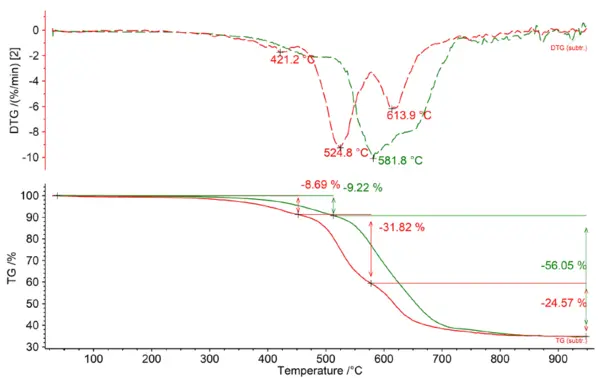
The STA Jupiter® or the TG Libra® are well suited for this type of investigation because it enables stable TGA and DTG measurements even at the very high heating rate of 300 K/min. The curves remain interpretable, and the comparison with the 20 K/min experiment clearly reveals the heating rate-dependent shift and overlap of the Decomposition reactionA decomposition reaction is a thermally induced reaction of a chemical compound forming solid and/or gaseous products. decomposition processes. This makes the instrument a valuable tool for evaluating polymer films under both conventional and application-relevant fast-heating conditions.
Summary
The Kapton polyimide film shows a pronounced dependence of its thermal Decomposition reactionA decomposition reaction is a thermally induced reaction of a chemical compound forming solid and/or gaseous products. decomposition behavior on the applied heating rate. This behavior is highly relevant for applications where rapid temperature changes are part of normal operation. The STA Jupiter® or the TG Libra® successfully capture these effects at both standard and very high heating rates, providing meaningful data for material development, process simulation and thermal reliability assessment.