Glossary
Non-Newtonian
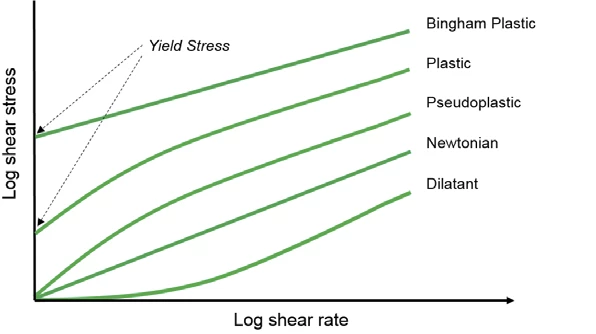
A non-Newtonian fluid is one that exhibits a viscosity that varies as a function of the applied shear rate or shear StressStress is defined as a level of force applied on a sample with a well-defined cross section. (Stress = force/area). Samples having a circular or rectangular cross section can be compressed or stretched. Elastic materials like rubber can be stretched up to 5 to 10 times their original length.stress.
Examples of non-Newtonian materials are Shear ThinningThe most common type of non-Newtonian behavior is shear thinning or pseudoplastic flow, where the fluid viscosity decreases with increasing shear.shear thinning (pseudoplastic), plastic (exhibiting a Yield StressYield stress is defined as the stress below which no flow occurs; literally behaves like a weak solid at rest and a liquid when yielded.yield stress) and Shear ThickeningWhile most suspensions and polymer structured materials are shear thinning, some materials can also show shear thickening behavior where viscosity increases with increasing shear rate or shear stress.shear thickening (dilatant).
Most formulated materials are non-Newtonian to give beneficial material functionality, such as a high viscosity at rest to promote stability, but then Shear ThinningThe most common type of non-Newtonian behavior is shear thinning or pseudoplastic flow, where the fluid viscosity decreases with increasing shear.shear thinning to facilitate ease of application. Rheology is the study of this non-Newtonian behaviour which results from the “break down” under shear of the “associated” (micro)structure in the sample.