Introduction
The rheological behavior of polymer melts is the basis for molding and processing. Using a capillary rheometer, the viscosity changes of polymer melt at different temperatures and shear rates can be tested and the processing behavior of polymers can effectively be predicted, thus providing a strong scientific basis for the processing and quality control of polymer materials.
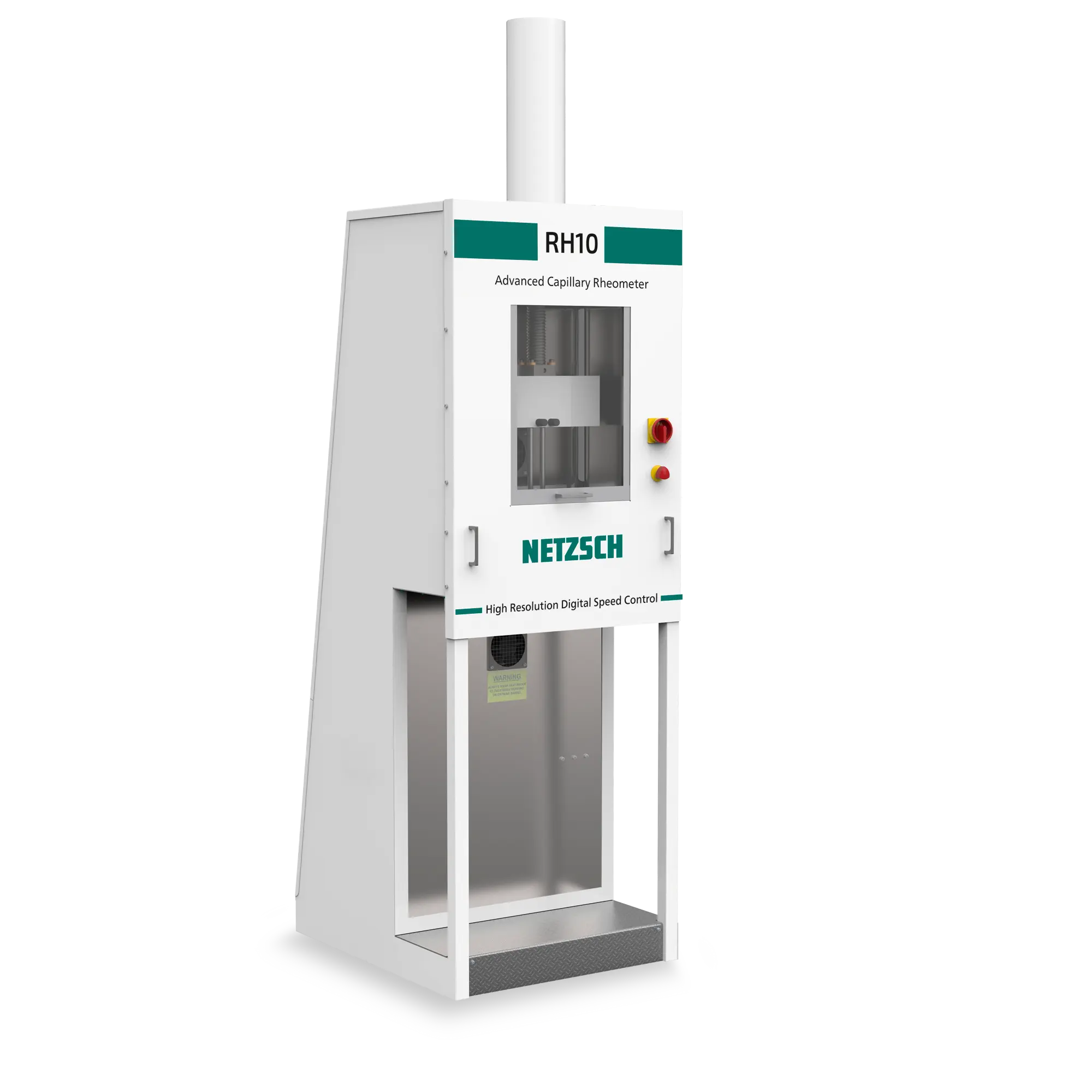
Typically, the rheological properties of polymer materials are tested using a single-barrel system, which takes a long time to test various types or batches of polymer samples under different conditions. Therefore, in order to improve test efficiency, a proven method is to use a dual-barrel capillary rheometer to test two samples simultaneously, which can effectively shorten the waiting time for temperature stabilization between the tests. In this work, the feasibility of the double-barrel test was analyzed by conducting a test series on polyethylene (PE) and Polypropylene (PP) using the NETZSCH Rosand RH10 double-barrel capillary rheometer (Figure 1).
Measurement Conditions and Test Method
The measurement conditions are detailed in Table 1. After installing the dies below the left and right barrels and stabilizing the temperature at 200 ± 0.1°C, PE or PP particles were slowly added to the left and right barrels in turn, compressed to 1 MPa, and then preheated at a constant temperature for 8 minutes. The measurement started after this compression step.
Table 1: Measurement conditions
| Instrument | NETZSCH Rosand RH10 |
| Samples | PE, PP |
Pressure transducer | 10,000 psi and 5,000 psi |
| Die specification | L = 16 mm, D = 1 mm |
| Test temperature | 200°C |
| Shear rate range | 10 ~ 10000 s-1 |
Measurement Results and Discussion
Figure 2 shows the shear viscosity curves of the same PE material tested at 200°C and 10 ~ 10,000 s-1 using dual barrels, where the left and right barrels were used with a die with an length/diameter (L/D) ratio of 16/1, and pressure transducers of 10,000 psi and 5,000 psi, respectively.
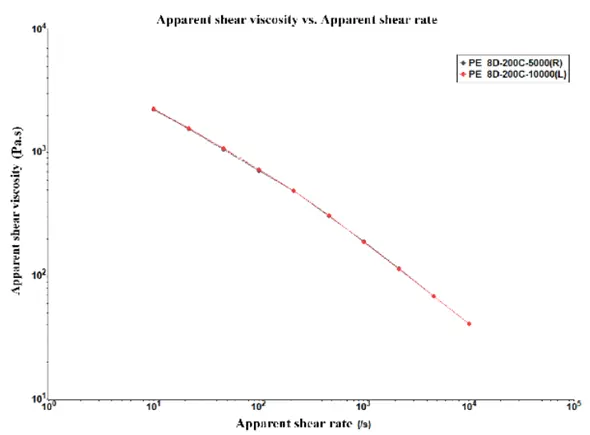
The test data and deviation values are shown in Table 2. As can be seen in Figure 2, the shear viscosity curves tested with the left and right barrels show very good repeatability. Moreover, as shown in Table 2, the deviations in the shear viscosity values obtained at different shear rates are less than 1%. Therefore, accurate results can be obtained by testing with both the left and the right barrel.
Table 2: Test data and deviation of PE in the left and right barrels at 200°C
| Shear rate (s-1) | Shear viscosity (Pa.s) | Average value (Pa·s) | Deviation (%) | |
| Left barrel | Right barrel | |||
| 10 | 2259.40 | 2241.22 | 2250.31 | 0.40 |
| 21.5 | 1583.38 | 1558.92 | 1571.15 | 0.78 |
| 46.42 | 1079.93 | 1059.68 | 1069.81 | 0.95 |
| 100 | 727.73 | 716.45 | 722.09 | 0.78 |
| 215.32 | 493.07 | 492.14 | 492.61 | 0.09 |
| 464.63 | 308.37 | 305.36 | 306.86 | 0.49 |
| 999.96 | 188.81 | 189.83 | 189.32 | -0.27 |
| 2155.44 | 114.09 | 114.57 | 114.33 | -0.21 |
| 4642.62 | 68.74 | 68.74 | 68.74 | 0.01 |
| 10001.14 | 41.09 | 40.92 | 41.01 | 0.20 |
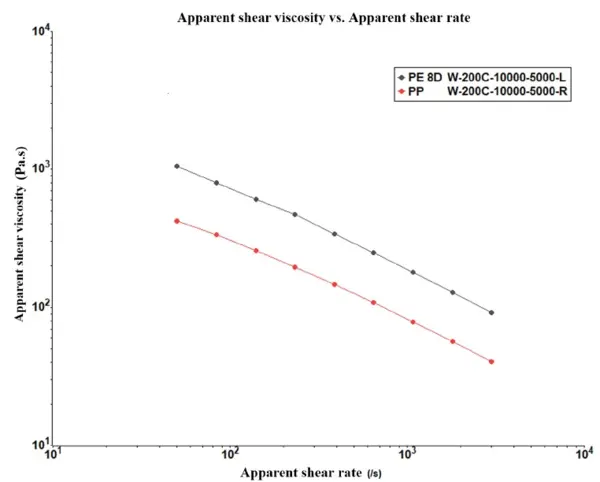
Figure 3 shows the aopparent shear viscosity curves of PE (left barrel, black) and PP (right barrel, red), tested with the dual barrel system at 200°C and 50 ~ 3000 s-1, where the left and right barrels were used with the die with an L/D ratio of 16/1, and pressure transducers of 10000 psi and 5000 psi, respectively. As can be seen in Figure 3, the shear viscosity of PP is significantly lower than that of the PE material at the same shear rate. Therefore, the dual-barrel test can not only obtain the shear viscosity data of two materials at the same time but also intuitively compare the viscosities of the two materials immediately after the test.
Shear viscosity is a material property that describes how strongly a fluid resists deformation under shear.
Apparent shear viscosity is the viscosity value you observe or calculate at a specific shear rate, especially for fluids the viscosity of which changes with flow conditions.
The Rosand capillary rheometer with double bore allows for corrections of the Non-NewtonianA non-Newtonian fluid is one that exhibits a viscosity that varies as a function of the applied shear rate or shear stress.non-Newtonian behavior and entrance effects for direct determination of the shear viscosity.
Conclusion
In this work, the rheological properties of PE and PP materials were tested under different conditions using the NETZSCH Rosand RH10 equipment. For the same material, very accurate test results can be obtained whether using the left or right barrel. When testing different materials using the dual-barrel system, not only can the testing efficiency be improved and the testing time effectively reduced, but also a very intuitive comparison of the test results can be made at the end of the test.