Introduction
While Dynamic Mechanical Analysis (DMA) is primarily used to analyze polymeric materials, the technique can also be applied to a wide range of other fields. These include diverse applications in the food and beverage industry - for instance, the analysis of gummy bear formulations, as demonstrated by Mucha et al. [1]. Industrially, mechanical characterization is often used to assess product quality and consistency within the food space. The DMA 303 Eplexor®® is a versatile desktop device capable of measuring in a temperature range from -170°C to 800°C (-274°F to 1472°F) with a total force of 50 N (static plus dynamic), making it perfectly suited for such applications.
For every person who orders a steak, they will tell you the right and wrong way in which it should be cooked. The trouble is each person you ask will have a different answer. When it comes to a good steak, there are typically two main variables: tenderness and juiciness. Tenderness is essentially a mechanical property describing how soft and chewy the meat is. How juicy the steak is depends on the fat content and distribution, the ageing process, and how it was cooked. In terms of doneness, the internal temperatures for steak are 125°F (52°C) for rare, 130-135°F (54-57°C) for medium-rare, 135-140°F (57-60°C) for medium, 140-150°F (60-66°C) for mediumwell, and 155°F (68°C) or higher for well-done [2]. While everyone knows that the longer the steak is cooked, the tougher it will be, how do we actually measure that? Is it possible to quantitatively assess just how tender the steak is over the cooking process?
Besides simple cooking time, there are several other factors which influence the quality of the final dish. More expensive cuts typically come from areas of less-exercised muscle, leading to improved tenderness. Additionally, the fat content of the meat plays a significant role. Increased marbling leads to juicier and more tender meat, while leaner cuts have a greater muscle fiber DensityThe mass density is defined as the ratio between mass and volume. density with more protein but are overall a tougher product.
For determination of the dynamic-mechanical properties of steak samples, we chose to investigate a relatively inexpensive cut called ‘skirt-steak’ well known for its high muscle fiber content.
We had two primary goals:
a) to see just how much internal temperature affects the mechanical properties, and
b) how fiber alignment affects the perception of tenderness. Beyond scientific curiosity, data like this is important for quality control, and for new industries designing meat alternatives/substitutes.
DMA Investigation of Doneness
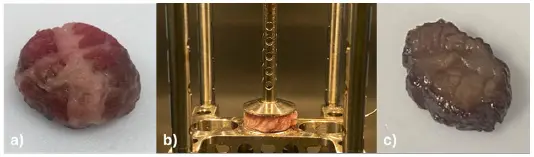
Samples of raw skirt steak (13 mm in diameter, 6 mm in height) were produced for measurement, Figure 1a). The samples were measured in compression to best simulate how the sample would be perceived while chewing. The thermocouple of the DMA was inserted directly into the center point of the specimen to measure the internal temperature, Figure 1b). A contact force of 1.0 N was used to initially flatten the sample and ensure an even contact area with the push rod. A 20 μm dynamic amplitude was applied with a 1.1 proportional factor across the temperature range of 30-80°C using a heat rate of 1 K/min (55 minute total run time). The fully cooked sample after testing is shown in Figure 1c).
Measurement Results
The results of the compressive testing are shown in Figure 2) and summarized for doneness in Table 1). The storage modulus (E’) correlates with the material’s ability to elastically store energy. During cooking, E' typically increases as the steak becomes firmer and chewier. The Viscous modulusThe complex modulus (viscous component), loss modulus, or G’’, is the “imaginary” part of the samples the overall complex modulus. This viscous component indicates the liquid like, or out of phase, response of the sample being measurement. loss modulus (E”) describes the material’s dissipation of energy, typically through internal friction, and viscous behavior. A high E'' indicates that the steak dissipates more energy during deformation by chewing. The values of E’ and E” are linked to structural changes that occur during the cooking process: the muscle fibers contract and lose water, resulting in both a firmer texture and an increase in internal friction.
Table 1: The absolute modulus and increase of mechanical properties of the skirt steak discs in relation to internal temperature and doneness
| Doneness | Internal temperature (°C) | |E| (MPa) | Modulus increase compared to raw |
|---|---|---|---|
| Raw (blue rare) | 45 | 0.27 | 1.0 |
| Rare | 52 | 0.41 | 1.5 |
| Medium-rare | 56 | 0.72 | 2.6 |
| Medium | 58 | 0.86 | 3.2 |
| Medium-well | 62 | 1.20 | 4.4 |
| Well-done | 72 | 3.74 | 12.7 |
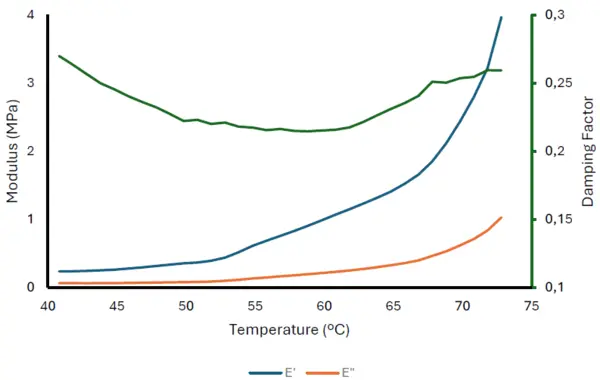
Therefore, the goal of the cooking process is to yield moderate values of both E’ and E” where the steak is structured and pleasantly chewy, but remains juicy. If the cooking process was to continue beyond the point of the meat being well done (not shown here), collagen melts into gelatin and the muscle fibers relax, reducing friction and causing E” to drop.
The damping factor (denoted tan δ) is the ratio of E” over E’ and describes how either elastic or viscous the material behaves. The magnitude of the E’ is much greater than E” suggesting the material behaves predominantly elastically and becomes stiffer with increasing temperature. Interestingly, the damping factor initially decreases and then increases again, indicating that during the cooking process different temperatures result in slight changes in damping properties. Since moisture loss and fat rendering occur simultaneously during cooking, this effect is not unexpected.
The absolute value of the Complex ModulusThe complex modulus consists of two components, the storage and the loss moduli. The storage modulus (or Young’s modulus) describes the stiffness and the loss modulus describes the damping (or viscoelastic) behavior of the corresponding sample using the method of Dynamic Mechanical Analysis (DMA). complex modulus |E| describes the total resistance of a material to deformation under oscillatory StressStress is defined as a level of force applied on a sample with a well-defined cross section. (Stress = force/area). Samples having a circular or rectangular cross section can be compressed or stretched. Elastic materials like rubber can be stretched up to 5 to 10 times their original length.stress and combines both its viscous and elastic components. Table 1 summarizes just how that property changes with internal temperature. A rare steak has a 1.5x higher compressive modulus when compared with raw, while well done has a 12.7x higher modulus. This result indicates a non-linear correlation of tenderness and with respect to internal temperature.
Fiber Effect on Tenderness
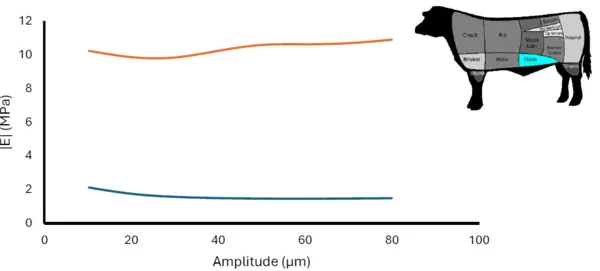
Doneness alone doesn’t impact how tender the final steak is. Skirt steak being a relatively inexpensive cut of meat from the plate and diaphragm of the cow, is known for being lean and having a high DensityThe mass density is defined as the ratio between mass and volume. density of muscle fibers. Therefore, the way in which the steak is cut and served plays a large role in how tender it is. Here, we tested cooked pieces of skirt steak in tensile mode, cut either along the muscle fiber or against the fiber, the result of which is shown in Figure 3. From Figure 3, it can be observed that the sample cut in-line with the muscle fiber (orange line) has a 6.7x higher absolute tensile modulus than those cut perpendicular to the fiber orientation (blue line). This increase in the absolute tensile modulus correlates with the meat being less tender. Therefore, the simple technique of cutting the cooked steak into thin slices against the grain results in significantly more tender meat.
Summary
The DMA 303 Eplexor® offers a wide range of frequency, force, and temperature, which makes it an ideal instrument for dynamic-mechanical measurements across a wide range of application areas. Herein, we described the ability of the instrument to accurately measure the tenderness of a piece of steak both in compression to simulate chewing and in tension to investigate the influence of muscle fiber directionality.
The DMA 303 Eplexor® can be used to not only characterize meat, but many other sample types in the food and beverage industries. Results such as these can be used when designing plant-based meat substitutes in order to best mimic the conventional product.