14.04.2026 by Dr. Shona Marsh
The Art of Flow: Where Rheology Meets Creativity
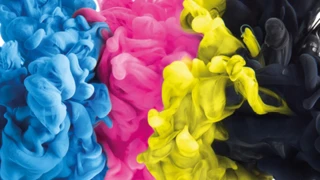
World Art Day honors human creativity. At NETZSCH, we celebrate another essential contributor to artistic success: material intelligence. Because when paints, inks, and coatings perform flawlessly, science and creativity work hand in hand.
Happy World Art Day! (April 15th)
When we admire a beautifully painted wall, a vibrant canvas, or a crisp printed page, we often overlook the science that makes these visuals possible. Behind every smooth brushstroke and flawless finish lies a field of material science known as rheology – the study of how materials flow and deform.
In the world of paints, inks, and coatings, rheology is not just a technical detail – it's the key to performance, precision, and beauty.
🎨 Engineering the Perfect Flow
Whether you're formulating architectural paints, automotive coatings, or high-performance printing inks, understanding rheology is essential. It governs how a liquid behaves under StressStress is defined as a level of force applied on a sample with a well-defined cross section. (Stress = force/area). Samples having a circular or rectangular cross section can be compressed or stretched. Elastic materials like rubber can be stretched up to 5 to 10 times their original length.stress – how it flows, spreads, levels, and ultimately dries.
Key Rheological Properties:
- Viscosity: Determines how thick or thin a fluid is. Too thick, and it streaks; too thin, and it drips.
- ThixotropyFor most liquids, shear thinning is reversible and the liquids will at some point in time gain their original viscosity when a shearing force is removed.Thixotropy: A time-dependent property where viscosity decreases under shear (like brushing or spraying) and recovers at rest. This prevents sagging and ensures even coverage without drips or runs. ThixotropyFor most liquids, shear thinning is reversible and the liquids will at some point in time gain their original viscosity when a shearing force is removed.Thixotropy also improves suspension stability of formulation. It prevents settling of pigments and fillers during storage, ensuring a consistent formulation over time.
- Yield StressYield stress is defined as the stress below which no flow occurs; literally behaves like a weak solid at rest and a liquid when yielded.Yield Stress: The StressStress is defined as a level of force applied on a sample with a well-defined cross section. (Stress = force/area). Samples having a circular or rectangular cross section can be compressed or stretched. Elastic materials like rubber can be stretched up to 5 to 10 times their original length.stress required to initiate flow, which is important for stability and application control.
- Viscoelasticity: Balances solid-like and liquid-like behavior, crucial for understanding drying or Curing (Crosslinking Reactions)Literally translated, the term “crosslinking“ means “cross networking”. In the chemical context, it is used for reactions in which molecules are linked together by introducing covalent bonds and forming three-dimensional networks.curing in addition to factors such as suspension stability and shelf-life.
These properties are fine-tuned using viscosity modifiers: polymers, surfactants, and fillers ensuring optimal performance across different conditions and application methods.
Tools of the Trade: Measuring Rheological Properties
The rheological behavior of paints and inks is influenced by factors such as shear rate, temperature, and composition. Shear-thinning behavior, where viscosity decreases under shear rate or StressStress is defined as a level of force applied on a sample with a well-defined cross section. (Stress = force/area). Samples having a circular or rectangular cross section can be compressed or stretched. Elastic materials like rubber can be stretched up to 5 to 10 times their original length.stress, is particularly important in these materials. This allows them to flow smoothly during application but regain viscosity once on the surface, preventing sagging or dripping.
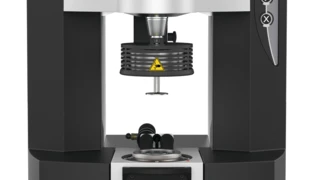
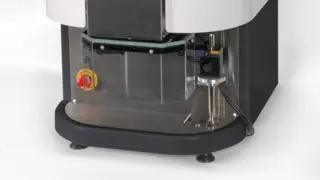
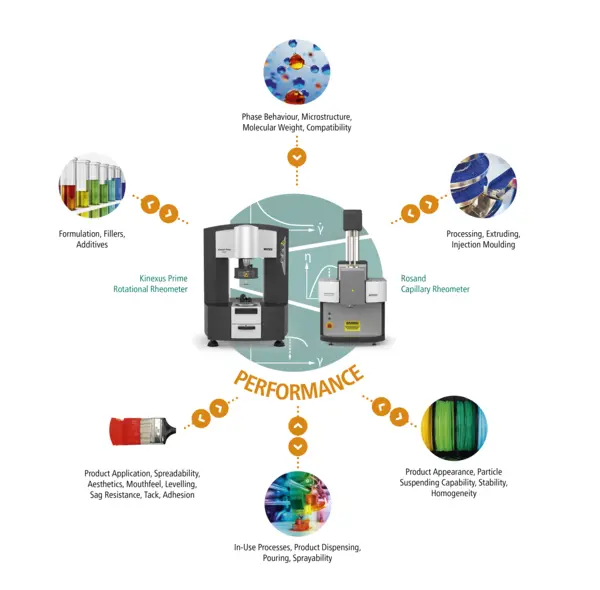
Advanced rheometers, like the NETZSCHKinexus rotational rheometer and Rosand capillary rheometer, allow scientists to simulate real-world conditions—from low shear sedimentation to high-speed spraying. These instruments help formulators:
- Optimize flow for different tools (brush, roller, spray)
- Prevent defects like orange peel or sagging
- Ensure pigment stability and shelf-life
- Monitor Curing (Crosslinking Reactions)Literally translated, the term “crosslinking“ means “cross networking”. In the chemical context, it is used for reactions in which molecules are linked together by introducing covalent bonds and forming three-dimensional networks.curing behavior under heat or UV light
By analyzing flow curves and shear behavior, manufacturers can predict how a product will perform—before it ever hits the shelf.
Where Science Meets Art: Celebrating Our Creative Colleagues
At the heart of every formulation is a desire to create something beautiful. That’s why we’re proud to showcase the artistic talents of our colleagues, who not only understand the science of flow but also bring it to life through their own artwork.

Free Flow Technique
Professional watercolour artist Jane Davies, known for her expressive “free flow” technique, kindly shared her thoughts on flow for this article:
“Flowing paint in my artwork symbolizes the enchantment and natural beauty found in nature. I enjoy letting the paint move freely to reveal its own character, aiming to evoke a sense of wonder and joy in my work. This process reminds me that each piece is unique and meaningful.”
Jane Davies, Watercolor Artist
Her reflection speaks to a principle familiar to every formulator: materials have inherent characteristics that influence how they behave. Differences in pigment composition, DensityThe mass density is defined as the ratio between mass and volume. density, and formulation shape how a paint flows, spreads, or settles – whether on a rheometer or across a sheet of paper.
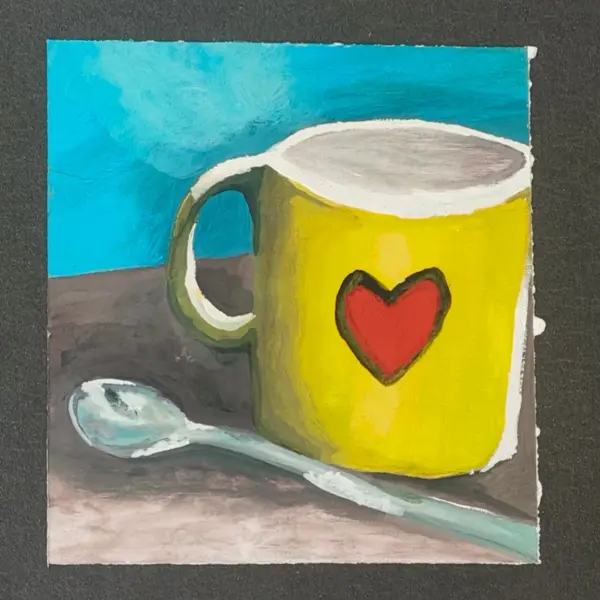
From abstract acrylics to detailed ink illustrations, our colleagues’ creations are a testament to the harmony between technical mastery and creative expression. Each piece reflects the same principles we apply in the lab: balance, control, and an understanding of flow.
“Rheology isn’t just about how materials move. It’s about how they enable us to move others.”
Why It Matters
Understanding rheology isn’t just for scientists. It’s for anyone who values quality, consistency, and creativity.
Whether you're coating a car, printing a label, or painting a mural, rheology ensures that your materials perform exactly as intended.
So next time you see a flawless finish or a vibrant print, take a moment to appreciate the science behind the beauty and the people whose expertise makes it possible.
Happy World Art Day!
Interested to learn more?
Visit our website and get in contact with us!