
29.01.2026 by Aileen Sammler
Identification of Battery Separator Materials by Means of TGA-FT-IR
Beyond Peaks and Curves: Application Insights by NETZSCH and Bruker
The Monthly Blog Series with Bruker Optics – Part 1: Combined thermal analysis and gas analysis for safe battery materials.
How NETZSCH and Bruker enable reliable material identification in lithium-ion batteries
The combination of thermogravimetry (TGA)with Fourier transform infrared spectroscopy (FT-IR) has become an indispensable analytical technique in modern materials characterization. Especially in the polymer-producing, chemical, battery and pharmaceutical industries, TGA-FT-IR is widely used to investigate the Thermal StabilityA material is thermally stable if it does not decompose under the influence of temperature. One way to determine the thermal stability of a substance is to use a TGA (thermogravimetric analyzer). thermal stability, the Decomposition reactionA decomposition reaction is a thermally induced reaction of a chemical compound forming solid and/or gaseous products. decomposition behavior, and the chemical nature of gases released during controlled heating.
Although TGA accurately records mass changes as a function of temperature or time, it cannot directly identify the chemical species released during thermal treatment. By coupling TGA with FT-IR, this limitation is overcome. This approach, known as Evolved Gas Analysis (EGA), allows for the identification of volatile and gaseous Decomposition reactionA decomposition reaction is a thermally induced reaction of a chemical compound forming solid and/or gaseous products. decomposition products and provides a deeper understanding of thermal processes.
As a result, TGA-FT-IR is applied to a broad range of materials, including battery components, polymers, elastomers, pharmaceutical substances, organics, and inorganics. It delivers complementary information that cannot be obtained from thermoanalytical methods alone.
In the first article of our monthly blog series in collaboration with Bruker Optics, these capabilities are illustrated using an example from lithium-ion battery research.
Why Separator Identification Matters in Battery Development
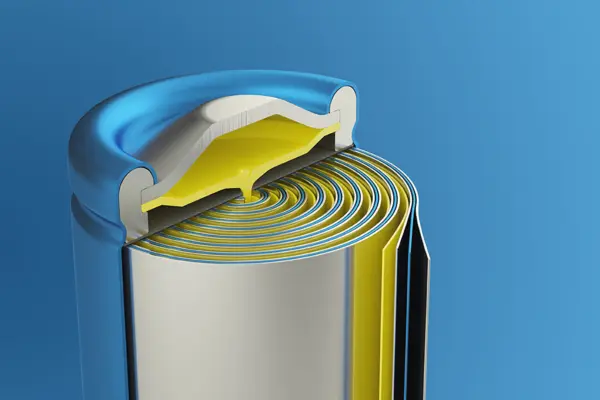
Lithium-ion batteries rely on carefully designed separator materials to ensure safety, performance, and long-term stability. These thin polymer membranes electrically isolate the electrodes while allowing Ionic transport. Even small deviations in separator composition can affect Thermal StabilityA material is thermally stable if it does not decompose under the influence of temperature. One way to determine the thermal stability of a substance is to use a TGA (thermogravimetric analyzer). thermal stability, wettability, or safety behavior in the event of abuse.
For developers, manufacturers, and quality control laboratories, reliable identification of separator materials is therefore essential – especially when comparing suppliers, investigating failures, or validating incoming materials.
This is where thermogravimetric analysis coupled with FT-IR spectroscopy (TGA-FT-IR) offers decisive advantages.
TGA-FT-IR: Combining Thermal Analysis and Gas Identification
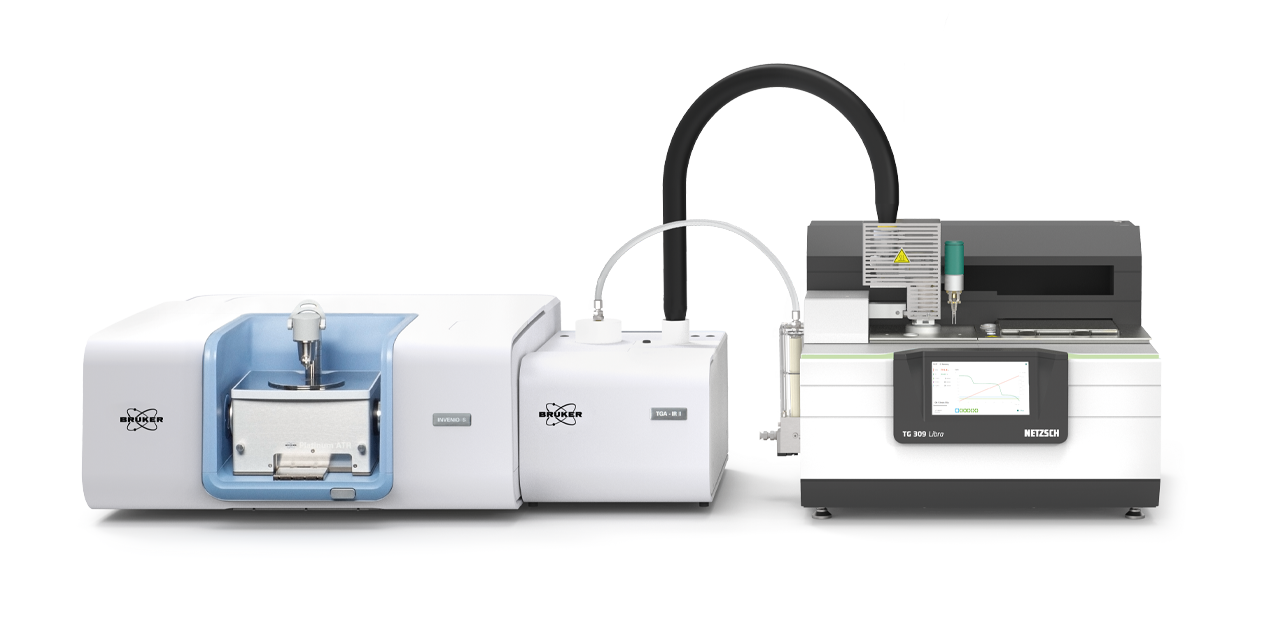
In TGA-FT-IR, gases released during thermal Decomposition reactionA decomposition reaction is a thermally induced reaction of a chemical compound forming solid and/or gaseous products. decomposition are transferred directly from the thermobalance into a Fourier Transform Infrared spectrometer. There, they are identified based on their characteristic IR absorption spectra.
This hyphenated technique enables:
- Identification of polymer types (e.g., polyethylene vs. polypropylene)
- Detection of additives, plasticizers, or processing residues
- Clear differentiation of multilayer or coated separator structures
Application Example: Identifying Separator Materials in Lithium-Ion Batteries
In a recent study, NETZSCH Analyzing & Testing demonstrated how TGA-FT-IR can be used to identify unknown separator materials from lithium-ion batteries.
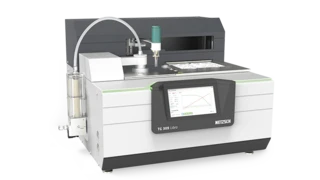
Using a NETZSCH TG Libra® thermobalance coupled with a Bruker INVENIO FT-IR spectrometer, the separator sample was heated under controlled conditions. The resulting mass-loss steps were correlated with the IR spectra of the evolved gases.
This combination provided a complementary set of measurement data with minimal effort:
ATR-IR analysis of the solid samples provided an initial indication of the separator foil’s identity. In addition, the results obtained from TG-FT-IR and c-DTA®, including Melting Temperatures and EnthalpiesThe enthalpy of fusion of a substance, also known as latent heat, is a measure of the energy input, typically heat, which is necessary to convert a substance from solid to liquid state.
The melting point of a substance is the temperature at which it changes state from solid (crystalline) to liquid (isotropic melt).melting point, Thermal StabilityA material is thermally stable if it does not decompose under the influence of temperature. One way to determine the thermal stability of a substance is to use a TGA (thermogravimetric analyzer). thermal stability and identification of the gases evolved, delivered complementary information, allowing for clear and reliable identification of the separator.
Learn More in the Full Application Note
This blog highlights the key concepts and benefits of separator identification using TGA-FT-IR.
Detailed experimental conditions, measurement curves, and data interpretation are available in the full application note:
From Battery Research to Quality Control
TGA-FT-IR is not limited to separator identification. The method supports:
- Failure analysis in battery development
- Incoming material inspection
- Comparison of suppliers or production batches
- Research on the Thermal StabilityA material is thermally stable if it does not decompose under the influence of temperature. One way to determine the thermal stability of a substance is to use a TGA (thermogravimetric analyzer). thermal stability and safety-relevant Decomposition reactionA decomposition reaction is a thermally induced reaction of a chemical compound forming solid and/or gaseous products. decomposition behavior
By combining mass change with chemical identification, laboratories gain a deeper, more reliable understanding of their materials.
A Long-Standing Partnership: NETZSCH and Bruker
The success of TGA-FT-IR applications is built on more than just instrumentation. It relies on integration and experience.
NETZSCH Analyzing & Testing and Bruker Optics have been collaborating since 1993, forming one of the longest-standing partnerships in coupled thermal analysis. What began with an initial installation has evolved into a mature, tightly integrated solution for evolved gas analysis across polymers, pharmaceuticals, chemicals, and energy materials.
This cooperation ensures:
- Optimized gas transfer interfaces
- Reliable synchronization of thermal and spectroscopic data
- Application-ready solutions backed by decades of joint expertise
This article marks Part 1 of our monthly blog series “Beyond Peaks and Curves: Application Insights by NETZSCH and Bruker” on TGA-FT-IR. In the next post, we will focus on detecting plasticizers in sporting goods and toys.

Become an Expert with our Free E-Learning Courses
All NETZSCH E-Learning Basic Courses are free of charge! The content is created by our laboratory method experts, who share their personal experiences with you. Take advantage of flexible online learning, fully adapted to your training needs!