Glossary
Coefficient of Linear Thermal Expansion (CLTE/CTE)
The coefficient of linear thermal expansion (CLTE) describes the length change of a material as a function of the temperature.
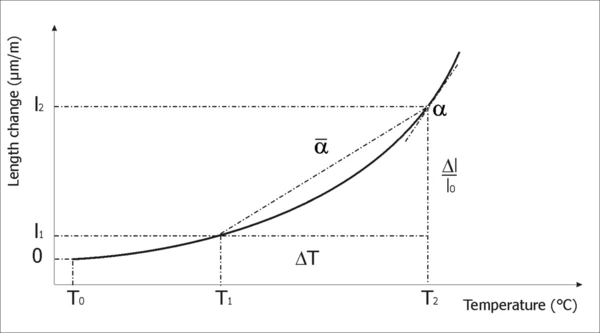
A distinction is made between the mean (average) coefficient of linear thermal expansion and the physical (differential) coefficient of linear thermal expansion.
The mean (average) coefficient of linear thermal expansion is defined as the slope of a secant through two points of the curve of thermal expansion:

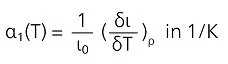
The physical (differential) coefficient of linear thermal expansion is the slope of the expansion curve at a given temperature. It thus corresponds to the first derivative of the curve of thermal expansion according to temperature.