Glossary
Hooke’s Law
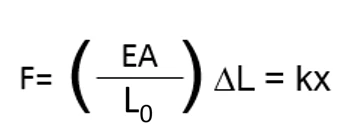
Hooke’s law is a physical principle stating that the amount of force needed to extend a spring by a given distance scales linearly with respect to the distance.
That results in:
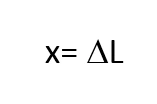
Fs = k⋅x
where:
Fs is the applied force in [N]
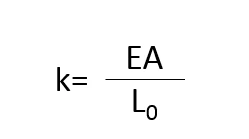
k is the spring constant in [N/mm]
x is the deformation in [mm]

Do you have any questions?
Suitable products for your measurement

Simple harmonic oscillation
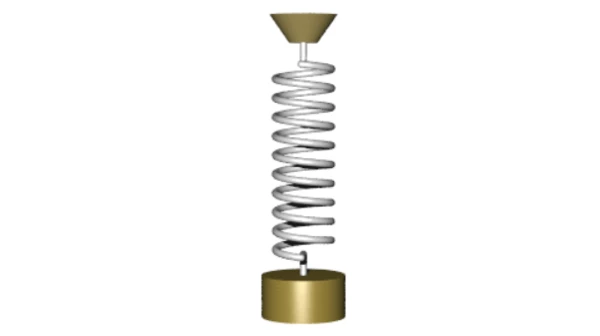
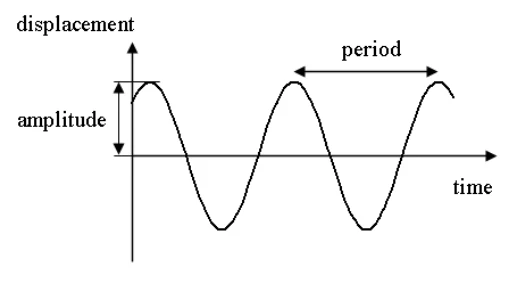
The simplest mechanical oscillating system is a weight attached to a linear spring subject to only weight and tension. The system is in an equilibrium state when the spring is static. If the system is displaced from the equilibrium, there is a net restoring force on the mass, tending to bring it back to equilibrium. However, in moving the mass back to the equilibrium position, it has acquired momentum which keeps it moving beyond that position, establishing a new restoring force in the opposite sense. If a constant force such as gravity is added to the system, the point of equilibrium is shifted. The time taken for an oscillation to occur is often referred to as the oscillatory period.