Help Improve Predictive Models for Recyclates
Contribute Training Data to Proteus® Now Quantify
Recycling streams are inherently complex.
They consist of a wide variety of polymers, additives, and unknown contaminants that often vary significantly from batch to batch. This complexity poses a significant challenge to the polymer recycling industry, making reliable material identification and contamination detection difficult.
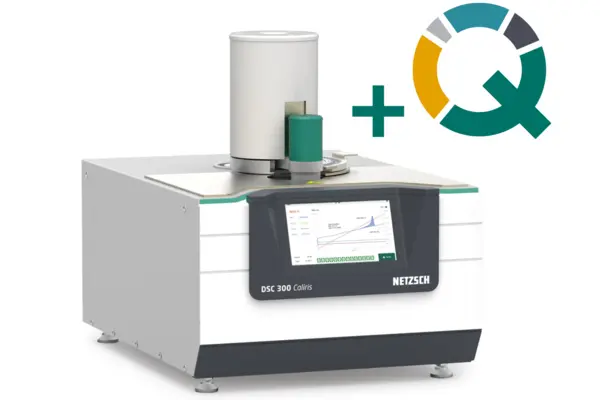
To address this challenge, Proteus® Now Quantify is being developed to improve the detection of contaminations and the classification of materials for recycled polymers. Expanding and refining the underlying material database is key to achieving this objective.
To build reliable machine learning models, we require high-quality, standardized NETZSCH DSC training data from real industrial compounds. We are specifically looking for compounded materials based on virgin polymers that realistically represent typical contamination scenarios found in recycling streams. This enables us to create controlled, well-defined datasets for robust model training.
Your contribution will help increase accuracy, robustness, and industrial applicability of predictions, thereby supporting improved recyclate evaluation in the polymer industry. Dry blends and actual recyclates are not suitable.

“Help us make Proteus® Now Quantify even more powerful and benefit directly from improved analysis results. By sharing standardized NETZSCH DSC training data, you help make the AI models more accurate, robust, and better suited for real industrial recyclates. The more diverse the dataset, the more accurate and valuable the model becomes for everyone.”
Why Standardization Matters
Machine learning models are only as good as the data they are trained on. For Quantify to deliver reliable predictions, the following conditions must be met:
- Measurement conditions must be identical
- Thermal histories must be comparable
- Curve shapes must reflect true compound behavior
Even small deviations in DSC parameters influence the peak shape, enthalpy, and CrystallizationCrystallization is the physical process of hardening during the formation and growth of crystals. During this process, heat of crystallization is released.crystallization behavior, which directly affects the model performance.
Therefore, only measurements conducted under the defined Quantify standard can be used for training.
Quantify Measurement Checklist (Mandatory for Training Data)
Method Parameters
- Sample weight: 10 ± 1 mg
- Heating rate: 10 K/min
- Cooling rate: 10 K/min
- Atmosphere: Nitrogen (default gas flows)
- Crucible: Al Concavus® with pierced lid
- Sensitivity and TempCal valid
- BeFlat® activated
⚠️ These parameters are fixed for Proteus® Now Quantify. Deviations can change peak shapes and reduce prediction reliability.
A detailed measurement guideline document is available here:


What’s in It for You?
Contribute your data and gain benefits while helping advance AI-driven polymer analysis:
- Visibility on our website as an collaboration partner
- Exclusive access to new Proteus® Now Quantify models & features
- Better results for your own materials
- Collaboration opportunities (publications, conferences)
Institutes Driving the Future of AI-Based Polymer Analysis
The following institutes and laboratories have already contributed standardized DSC datasets to support the continuous improvement of Proteus® Now Quantify. By sharing real industrial data, they help strengthen detection of contaminations, material classification, and reliable prediction for polymer recycling streams.
We sincerely thank all partners for their collaboration and for advancing data-driven material analysis together with NETZSCH.




Frequently Asked Questions (FAQ)
Your Contribution

By submitting standardized DSC training data, you help:
- improve contamination detection algorithms
- strengthen CrystallizationCrystallization is the physical process of hardening during the formation and growth of crystals. During this process, heat of crystallization is released.crystallization-based classification
- increase reliable prediction across recyclate streams
- make Quantify more applicable to real industrial materials
The more representative and diverse the dataset, the better the model performance.
How to Participate

- Follow the Quantify measurement checklist (see guideline document above) exactly
- Ensure the material is a real compound (no dry blends)
- Anonymize the polymer type data if you'd like: we only need material classes, filler quantity and composition quantities for each class (see FAQ)
- Email us to discuss your contribution or share data
- Our Quantify experts will reach out to you: