30.09.2025 by Aileen Sammler
From Recyclate Confusion to Clarity – with the Brand-New NETZSCH Proteus® Now Quantify Software
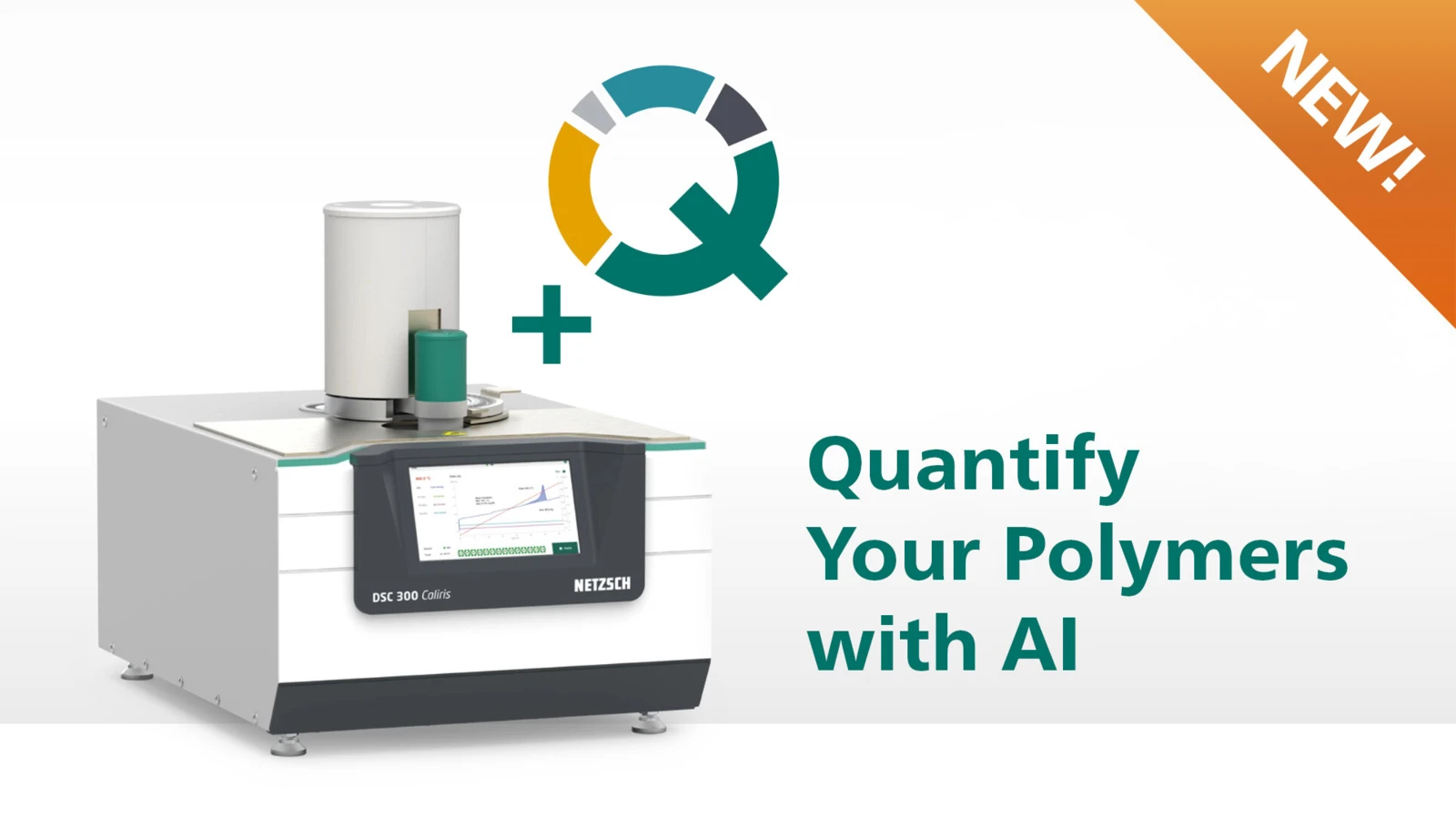
The pressure to integrate more recycled polymers into new products is steadily increasing, driven by sustainability goals and increasingly strict regulations. However, the reality is complex: recyclates are rarely uniform. Knowing exactly what’s inside the material is essential. This is where NETZSCH comes into play with its brand-new Proteus® Now Quantify Software.
From Recyclate Confusion to Clarity
The pressure to integrate more recycled polymers into new products is steadily increasing, driven by sustainability goals and increasingly strict regulations. However, the reality is complex: recyclates are rarely uniform. They often contain a mixture of different polymers, additives, contaminants, and degradation products from multiple life cycles.
Unlike virgin materials, the properties of which are well-documented, recyclates can vary significantly from batch to batch. For example, a material that appears to be polyethylene may contain traces of polypropylene, PET, or other components. These hidden variations complicate processing, affect mechanical performance, and sometimes even compromise product safety.
One thing is clear for manufacturers, compounders, and buyers alike: knowing exactly what’s inside the material is essential. Without reliable analysis, recyclates remain risky instead of becoming trustworthy raw materials. This is where NETZSCH comes into play.
Why Traditional Methods Fall Short
Many recyclers still rely on visual inspection, melt flow index (MFI), or DensityThe mass density is defined as the ratio between mass and volume. density checks. While these methods are quick and inexpensive, they rarely reveal what is truly inside the material. Spectroscopy can help with surface analysis but struggles with blends, additives, and bulk characterization.
However, differential scanning calorimetry (DSC) provides thermal "fingerprints" of polymers and is one of the most trusted tools in thermal analysis. With software support, DSC provides deeper insight into polymer blends. Yet, interpretation of complex mixtures with overlapping peaks requires expertise and time.
This is where the next software generation begins: AI-powered analysis with the brand-new NETZSCH Proteus® Now Quantify software.

Proteus® Now Quantify – AI-Powered Polymer Analysis in Seconds
With Proteus® Now Quantify, complex data interpretation becomes a simple, intuitive workflow:
- Perform a DSC measurement on your NETZSCH analysis instrument.
- Export the data from Proteus® Analysis 9.8+
- Upload the file to the cloud-based Quantify platform.
- Receive accurate, reproducible results in seconds
The Proteus® Now Quantify software will be available starting in November 2025.
Your Benefits at a Glance
- Save time
Near real-time results, no manual evaluation required. - Increase confidence
Confirm composition, detect deviations early, and reduce risks with a transparent, AI-driven workflow. - Accessible for everyone
Even non-specialists achieve expert-level evaluations – no data science knowledge needed. - Practical value
For compounders and processors, Quantify provides data-driven insights to optimize use of recyclates in production. OEMs can rely on greater transparency and confidence in the quality of the finished parts they receive.

Who Is Quantify For?
Proteus® Now Quantify is designed for anyone working with plastics – especially those in:
- Recycling and recyclate production, especially compounders (verify composition, improve quality control)
- Quality assurance & purchasing (gain confidence in product consistency and pricing decisions)
- R&D and product development (support new sustainable formulations)
With Quantify, polymer analysis is democratized: what once required years of expertise can now be done by lab technicians, production managers, or sustainability leads alike.
What’s Behind the AI?
Proteus® Now Quantify combines classical machine learning (e.g., decision trees) with deep learning (neural networks). Even overlapping melting peaks are accurately resolved. Each result comes with an uncertainty score, which provides a confidence measure and helps identify borderline or unknown cases.
Which Polymers Are Already Supported?
Quantify already covers the central polymers of today’s packaging industry:
- Homopolymer polypropylene (PP-H)
- High-DensityThe mass density is defined as the ratio between mass and volume. density polyethylene (HDPE)
- Low-DensityThe mass density is defined as the ratio between mass and volume. density polyethylene (LDPE)
- Linear low-DensityThe mass density is defined as the ratio between mass and volume. density polyethylene (LLDPE)
But our real focus is on what’s next:
- Upcoming: PET, EVA, EVOH, PA6, PA11, PA12, PLA, PVAL, and PVDC
- Beyond packaging: engineering plastics for automotive and amorphous polymers for electronics
- Long-term: full integration of filled polymers, supported by complementary techniques such as Thermogravimetric Analysis (TGA)
With each release, Quantify expands to reflect real-world needs—turning even complex recyclate systems into clear, reliable insights.
From Waste to Valuable Raw Material
Proteus® Now Quantify represents a major step forward in recyclate analysis:
- Faster evaluation
- Measurably higher quality
- Significantly lower error rates
- Full control of your recyclates
Recyclates move from being a source of uncertainty to becoming a reliable, high-quality raw material – enabling a more sustainable circular economy.
The Proteus® Now Quantify software will be available starting in November 2025.
Want to find out more? Visit our website:
AI-Powered Polymer Quantification with DSC 300 Caliris® - Explained in 5 minutes
Go to product page
Share this article