21.01.2026 by Aileen Sammler
The Guarded-Hot-Plate Method: How Gas Type and Pressure Can Change the Thermal Conductivity of Your Insulation Materials
Find out how gas type and pressure can significantly affect the Thermal ConductivityThermal conductivity (λ with the unit W/(m•K)) describes the transport of energy – in the form of heat – through a body of mass as the result of a temperature gradient (see fig. 1). According to the second law of thermodynamics, heat always flows in the direction of the lower temperature.thermal conductivity of insulation materials — and how the GHP 456 Titan® enables precise measurements under inert gas and vacuum. NETZSCH supports you in finding the right solution for your application.
If you work with insulation materials – whether in product development, quality assurance, or thermal design – you need Thermal ConductivityThermal conductivity (λ with the unit W/(m•K)) describes the transport of energy – in the form of heat – through a body of mass as the result of a temperature gradient (see fig. 1). According to the second law of thermodynamics, heat always flows in the direction of the lower temperature.thermal conductivity data that is both accurate and representative of real-world application conditions. Standard measurements performed under ambient laboratory conditions often don’t capture this.
Why? Because the gas type and pressure have a major effect on the effective Thermal ConductivityThermal conductivity (λ with the unit W/(m•K)) describes the transport of energy – in the form of heat – through a body of mass as the result of a temperature gradient (see fig. 1). According to the second law of thermodynamics, heat always flows in the direction of the lower temperature.thermal conductivity of open-pore materials. Depending on your application, this can determine whether a system remains thermally stable or overheats.
Our NETZSCH application laboratory has performed different analyses for you. In this article, you will learn:
- why open-pore insulation materials react so sensitively,
- how significant the effects of gas and pressure really are,
- and what you need to consider when performing precise measurements.
Why open-pore insulation materials are so sensitive to gas and pressure
The Thermal ConductivityThermal conductivity (λ with the unit W/(m•K)) describes the transport of energy – in the form of heat – through a body of mass as the result of a temperature gradient (see fig. 1). According to the second law of thermodynamics, heat always flows in the direction of the lower temperature.thermal conductivity of fibrous insulation materials such as glass wool occurs via three mechanisms:
- heat transfer through the solid,
- radiative heat transfer,
- heat transfer through the gas phase.
The gas phase is particularly critical. In open-pore materials, the purge or surrounding gas effectively replaces the “cell gas” and directly influences the material’s Thermal ConductivityThermal conductivity (λ with the unit W/(m•K)) describes the transport of energy – in the form of heat – through a body of mass as the result of a temperature gradient (see fig. 1). According to the second law of thermodynamics, heat always flows in the direction of the lower temperature.thermal conductivity.
In addition, the gas pressure determines how many particles are available for heat transfer.
The outcome: Even small changes in gas type or pressure can lead to large shifts in the thermal conductivity measured.
What the measurements show – and what this means for you
1. Different gases cause significant deviations
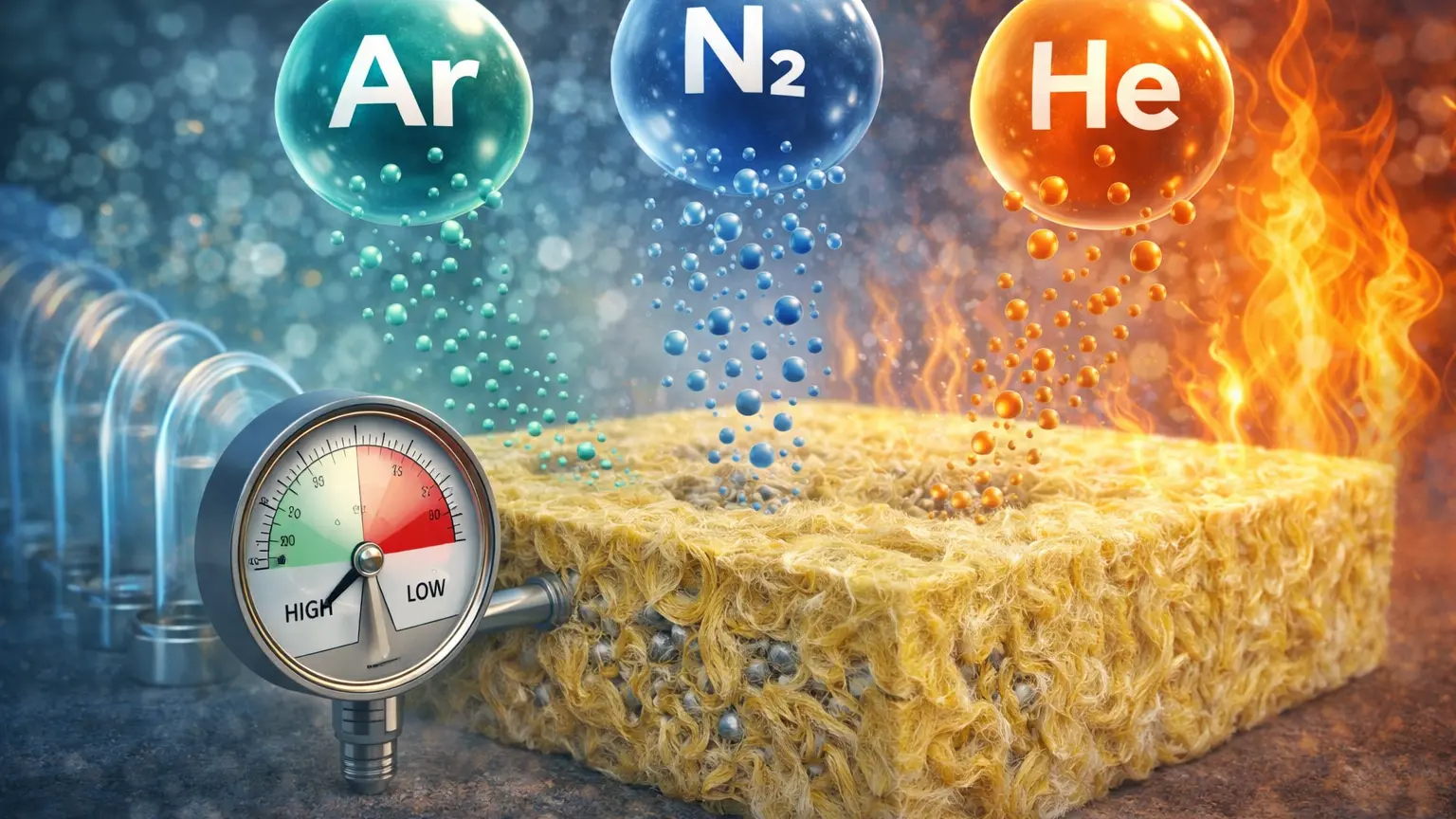
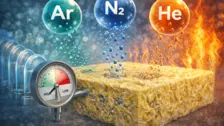
Glass wool (NIST SRM 1450D) was measured under nitrogen, argon, and helium.
The results:
- in Nitrogen ≈ air → virtually identical values
- in Argon: approx. 28% lower effective thermal conductivity
- in Helium: approx. 4× higher effective thermal conductivity
Why this matters to you:
- Argon simulates scenarios with very low gas thermal conductivity.
- Helium represents the other extreme and is typical of gases with high thermal conductivity.
- If you only measure in air, you may not obtain values that reflect actual operating conditions.
2. Pressure dependency: the characteristic S-curve
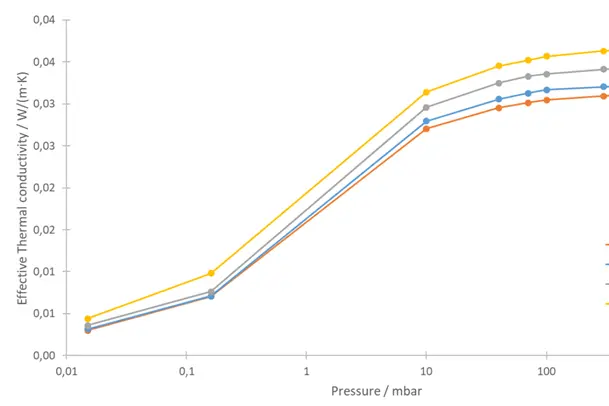
Under nitrogen, pressures ranging from approx. 0.01 mbar to 1000 mbar were investigated.
The result: The effective thermal conductivity remains constant at first – and then drops sharply below approx. 300 mbar.

Practical implications:
- At moderately reduced pressures, little changes initially.
- Once the mean free path of the gas molecules approaches the pore diameter, the behavior shifts.
- Below that threshold, the heat transfer depends only on the particle DensityThe mass density is defined as the ratio between mass and volume. density – the thermal conductivity drops rapidly.
This is particularly relevant if you:
- design components for vacuum applications,
- work in aerospace, cryogenics, or high-performance insulation,
- require realistic boundary conditions for simulation,
- need to characterize low-pressure scenarios.
What this means for your measurement strategy
If you require reliable thermal conductivity data for open-pore insulation materials under challenging conditions, your measurement system must:
- introduce different purge gases in a controlled manner,
- support true vacuum conditions,
- allow precise pressure regulation,
- provide stable steady-state measurement results.
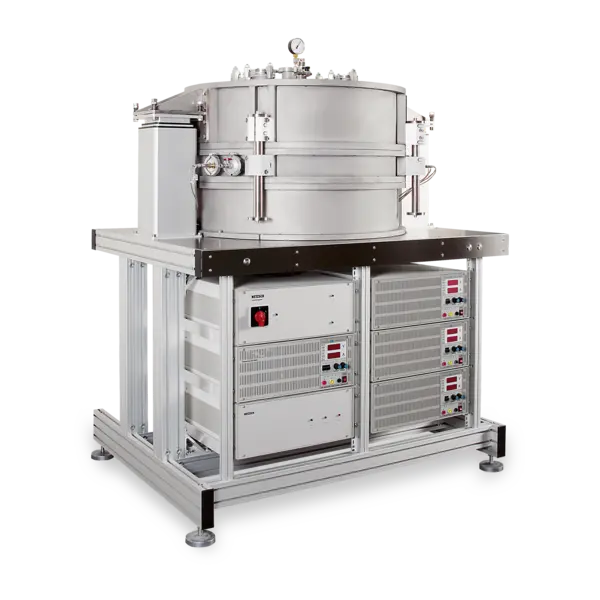
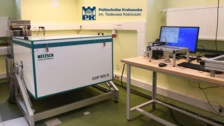
The NETZSCH GHP 456 Titan® analysis instrument meets all these requirements with its intuitive software and fully automatic pressure control.
What this means for you in practice
To obtain accurate and application-relevant thermal conductivity values, you can :
- measure not only in air, but also in the relevant cell gas,
- evaluate pressure dependency when your material is used under reduced pressure,
- always interpret literature values in the context of measurement conditions,
- use a measurement system that supports reproducible atmosphere changes.
This helps you avoid common pitfalls:
- overly optimistic thermal conductivity estimates,
- incorrect material selection,
- unreliable simulation results,
- thermal issues during operation.
Get the Full Report!
Visit GHP as Key Technology: Precise Characterization of the Thermal Conductivity of Insulation Materials under Inert Gas and Vacuum Atmospheres - NETZSCH Analyzing & Testing or download the full application note as a pdf here:
NETZSCH supports you in selecting the right measurement method!
Open-pore insulation materials are highly sensitivity to gas type and pressure. If your material is used under these conditions, its thermal conductivity must also be tested under the same conditions. Otherwise, you will obtain an inaccurate effective thermal conductivity.
Only when gas type and pressure are controlled to reflect real-world conditions will you obtain thermal conductivity values that reliably match actual operating performance. The GHP 456 Titan® is the ideal measuring device for determining effective thermal conductivity under such challenging conditions.
As a solution provider, NETZSCH supports you throughout this process, from selecting the appropriate measurement method, to defining the correct atmosphere and pressure conditions, to determining which system best fits your application. The GHP 456 Titan® is specifically designed to handle such demanding measurements under inert gases and vacuum.
If you would like to find out which solution is best suited for your specific application, please get in touch with your local NETZSCH sales representative. Together, we will find the configuration that delivers the reliable data you need for development, quality assurance, and simulation.

Local Contact



Become an Expert with our Free E-Learning Courses
All NETZSCH E-Learning Basic Courses are free of charge! The content is created by our laboratory method experts, who share their personal experiences with you. Take advantage of flexible online learning, fully adapted to your training needs!