Introduction
Thermal insulation materials are crucial for minimizing heat loss and ensuring stable temperature conditions in technical systems. Their Thermal ConductivityThermal conductivity (λ with the unit W/(m•K)) describes the transport of energy – in the form of heat – through a body of mass as the result of a temperature gradient (see fig. 1). According to the second law of thermodynamics, heat always flows in the direction of the lower temperature.thermal conductivity is often characterized with precision using stationary methods, such as the Guarded Hot Plate (GHP) method. These investigations are relevant not only in materials research, but also in space travel, where insulation materials are used in a vacuum with extreme temperature fluctuations. GHP measurements provide valuable data for thermal design and performance evaluation, among other things.
The effective Thermal ConductivityThermal conductivity (λ with the unit W/(m•K)) describes the transport of energy – in the form of heat – through a body of mass as the result of a temperature gradient (see fig. 1). According to the second law of thermodynamics, heat always flows in the direction of the lower temperature.thermal conductivity of fibrous insulation materials (e.g., glass wool) depends mainly on three heat transfer mechanisms:
- Heat transfer through the solid
- Heat transfer through radiation
- Heat transfer through the gas phase
Depending on the temperature, DensityThe mass density is defined as the ratio between mass and volume. density and gas within the insulation material, the effective Thermal ConductivityThermal conductivity (λ with the unit W/(m•K)) describes the transport of energy – in the form of heat – through a body of mass as the result of a temperature gradient (see fig. 1). According to the second law of thermodynamics, heat always flows in the direction of the lower temperature.thermal conductivity can vary greatly.
This application note focuses on different atmospheres. Standard glass wool (NIST SRM 1450D), which has a known Thermal ConductivityThermal conductivity (λ with the unit W/(m•K)) describes the transport of energy – in the form of heat – through a body of mass as the result of a temperature gradient (see fig. 1). According to the second law of thermodynamics, heat always flows in the direction of the lower temperature.thermal conductivity in air, was tested in the GHP 456 Titan®. The device is equipped with a furnace that allows for various purge gases, as well as for measurements under reduced pressure.
Experimental
The NIST SRM 1450D material was examined at mean sample temperatures (Tmean) between 10°C and 60°C with a temperature difference (ΔT) of 20 K across the measurement plates. The measurements were performed under different gases (argon, nitrogen, helium) at different pressures (approx. 0.01 mbar to 1000 mbar). Prior to each measurement using another gas, the device (including the sample) was evacuated twice and purged with the new gas.
Results and Discussion
Figure 1 shows the Thermal ConductivityThermal conductivity (λ with the unit W/(m•K)) describes the transport of energy – in the form of heat – through a body of mass as the result of a temperature gradient (see fig. 1). According to the second law of thermodynamics, heat always flows in the direction of the lower temperature.thermal conductivity of the sample in different purge gases (nitrogen, argon and helium). The measurement results are summarized in table 1.
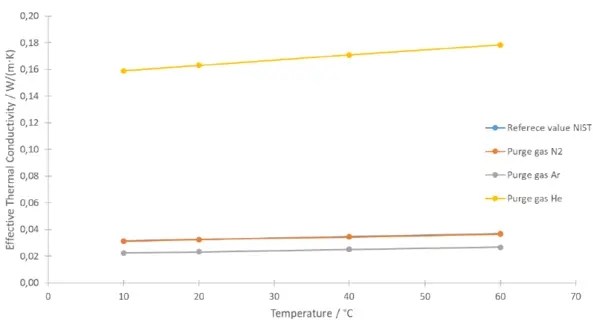
Table 1: Thermal conductivity of standard glass wool (NIST SRM 1450D), determined in different purge gases in comparison with literature
| Temperature °C | (W/m·K) | |||
| Literature [2] | N2 | Ar | He | |
| 10 | 0.0313 | 0.0312 | 0.0224 | 0.1590 |
| 20 | 0.0324 | 0.0324 | 0.0233 | 0.1631 |
| 40 | 0.0346 | 0.0345 | 0.025 | 0.1708 |
| 60 | 0.03868 | 0.0366 | 0.0267 | 0.1785 |
Since glass wool is an open-pored system, the purge gas penetrates the material and thus changes its effective thermal conductivity. The thermal conductivity of air and nitrogen is almost identical (see table 2). As expected, there is no significant difference detectable between the reference values for glass wool and the measurements under nitrogen. Argon, on the other hand, has significantly lower thermal conductivity than nitrogen (approximately 31% lower), as reflected in the measurement of the thermal conductivity of glass wool with argon purging. The measured values are approximately 28% lower than those obtained with nitrogen.
Unlike argon, helium has a significantly higher thermal conductivity than nitrogen. The effective thermal conductivity of glass wool with helium purging is approximately four times higher than with nitrogen or air.
Table 2: Thermal conducitiviy of different gases at 20°C [1]
Figure 2 illustrates how pressure affects the thermal conductivity of open-pore insulation materials. It shows the thermal conductivity of glass wool at different temperatures. The S-curve is typical of pressure-dependent measurements. It clearly shows that the thermal conductivity of the cell gas significantly influences the effective thermal conductivity, and that there is substantial dependence on pressure below a certain threshold (approximately 300 mbar). This can be explained by the free path length of the gas molecules or atoms.
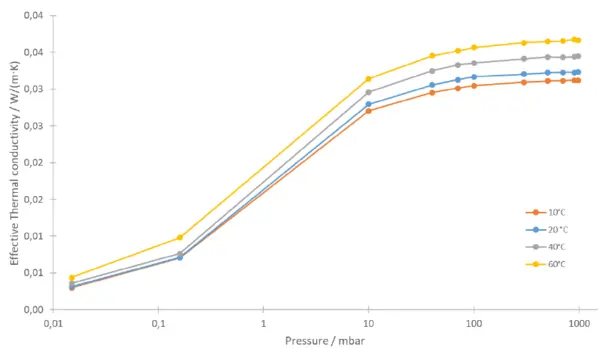
Heat transfer within a gas is mainly determined by the number of particles and the mean free path between them. At slightly lower pressures, the mean free path increases, but the number of particles decreases. Thus, the thermal conductivity remains constant. However, this no longer applies at very low pressures [3]. From a certain point onward (here, approximately 300 mbar), there are insufficient particles to collide, and the mean free path length falls within the range of pore diameters. Beginning at this point, heat transfer in the gas depends solely on the number of gas particles. If the number of particles decreases due to lower pressure, heat transfer via the gas decreases significantly, as does the effective thermal conductivity of the entire material.
Summary
Due to their structure, the thermal conductivity of insulation materials depends heavily on pressure and cell gas. The GHP 456 Titan® is the ideal measuring device for determining effective thermal conductivity under such challenging conditions. Thanks to its intuitive software and automatic pressure control, it is still easy to perform measurements.