Introduction
Polymer composites present a unique challenge in Thermal ConductivityThermal conductivity (λ with the unit W/(m•K)) describes the transport of energy – in the form of heat – through a body of mass as the result of a temperature gradient (see fig. 1). According to the second law of thermodynamics, heat always flows in the direction of the lower temperature.thermal conductivity measurements. With thermal conductivities often ranging from 0.2 to 1 W/(m·K), they can be challenging for common steady-state thermal measurement techniques such as the guarded hot plate (GHP) and heat flow meter (HFM) methods given their relatively high conductivities and rigid structure. Additionally, special precautions must be made to obtain accurate thermal properties using these techniques as they were designed for compressible insulations with thermal conductivities less than 0.1 W/(m·K). Laser or light flash analysis (LFA), on the other hand, was designed to measure homogeneous, isotropic materials and the inclusion of common fillers such as glass fibers may cause deviations in the temperature rise curve which must be accounted for using the proper model. This also necessitates the use of DSC (differential scanning calorimetry) to obtain Specific Heat Capacity (cp)Heat capacity is a material-specific physical quantity, determined by the amount of heat supplied to specimen, divided by the resulting temperature increase. The specific heat capacity is related to a unit mass of the specimen.specific heat capacity values to calculate Thermal ConductivityThermal conductivity (λ with the unit W/(m•K)) describes the transport of energy – in the form of heat – through a body of mass as the result of a temperature gradient (see fig. 1). According to the second law of thermodynamics, heat always flows in the direction of the lower temperature.thermal conductivity of such materials given the lack of comparable (anisotropic) reference standards in LFA. In contrast, the guarded heat flow meter (GHFM) technique was specifically designed to measure rigid materials with thermal conductivities ranging from 0.1 to 30 W/(m·K), making it a practical and straightforward method for evaluating the thermal properties of such materials.
To explore the viability of these techniques in the measurement of reinforced composites, GPO-3, an electricalgrade glass fiber reinforced thermoset with a polyester matrix, was measured using HFM, GHFM, LFA and DSC. GPO-3 is commonly used as an electrical insulator given its electrical and flame-retardant properties.
Experimental
Thermal conductivity was directly determined using both the TCT 716 Lambda Guarded Heat Flow Meter and HFM 446 Lambda by following the procedures laid out in their respective ASTM methods, ASTM E1530 and ASTM C518. Thermal DiffusivityThermal diffusivity (a with the unit mm2/s) is a material-specific property for characterizing unsteady heat conduction. This value describes how quickly a material reacts to a change in temperature.Thermal diffusivity was determined using the LFA 467 HyperFlash® and Specific Heat Capacity (cp)Heat capacity is a material-specific physical quantity, determined by the amount of heat supplied to specimen, divided by the resulting temperature increase. The specific heat capacity is related to a unit mass of the specimen.specific heat capacity (cp) was determined using the DSC 214 Polyma by following ASTM E1461 and ASTM E1269, respectively. Thermal conductivity was then calculated using the measured values of Specific Heat Capacity (cp)Heat capacity is a material-specific physical quantity, determined by the amount of heat supplied to specimen, divided by the resulting temperature increase. The specific heat capacity is related to a unit mass of the specimen.specific heat capacity, Thermal DiffusivityThermal diffusivity (a with the unit mm2/s) is a material-specific property for characterizing unsteady heat conduction. This value describes how quickly a material reacts to a change in temperature.thermal diffusivity and specimen DensityThe mass density is defined as the ratio between mass and volume. density.
A single 305 by 305 mm plate of GPO-3 fiberglass with a thickness of approximately 6 mm was obtained from Polyply® Composites LLC for testing. The GPO-3 plate was first measured via HFM with the use of the instrumentation kit composed of silicone sheets and sample surface-mounted thermocouples which were used to reduce Contact ResistanceAccording to the second law of thermodynamics, heat transfer between two systems always moves in the direction from higher to lower temperatures. The amount of thermal energy transferred by heat conduction, e.g., through a wall of a building, is influenced by the thermal resistances of the concrete wall and the insulation layer.contact resistance between the specimen and instrument plates as well as to obtain accurate values of the sample surface temperature. The GPO-3 plate was measured at mean temperatures ranging from -10 to 80°C in 10°C increments. A temperature difference of approximately 6°C was held across the sample during testing. Calibration was performed using a borosilicate glass reference standard.
Once the HFM measurements were complete, the board was then cut into four approximately 50 mm diameter discs for testing via GHFM (figure 1) and three approximately 12.5 mm diameter discs for testing via LFA. The four GHFM specimens were not modified in the through-thickness direction while the three LFA specimens were sanded down to a thickness of approximately 2 mm for testing.
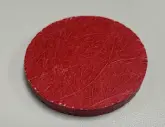
The GHFM measurements were conducted over a temperature range of approximately -10°C to 120°C in 10°C increments, and calibration was carried out using Vespel® SP-1. A thin layer of silicone thermal joint compound was applied between the specimens and instrument plates to minimize interfacial resistance. A pressure of approximately 175 kPa was applied to the specimens during testing. A temperature difference of roughly 24°C was held across the specimens during testing.
LFA measurements were similarly conducted over a temperature range of approximately -10°C to 120°C in 10°C increments. Specimens were spray coated with approximately 5 μm of graphite prior to testing. Thermal DiffusivityThermal diffusivity (a with the unit mm2/s) is a material-specific property for characterizing unsteady heat conduction. This value describes how quickly a material reacts to a change in temperature.Thermal diffusivity was calculated using the NETZSCH Transparent [1] model which corrects for radiative effects seen in the temperature rise curve of the measurement. Specific Heat Capacity (cp)Heat capacity is a material-specific physical quantity, determined by the amount of heat supplied to specimen, divided by the resulting temperature increase. The specific heat capacity is related to a unit mass of the specimen.Specific heat capacity values determined via DSC were used in conjunction with the measured specimen DensityThe mass density is defined as the ratio between mass and volume. density in order to obtain the Thermal ConductivityThermal conductivity (λ with the unit W/(m•K)) describes the transport of energy – in the form of heat – through a body of mass as the result of a temperature gradient (see fig. 1). According to the second law of thermodynamics, heat always flows in the direction of the lower temperature.thermal conductivity values.
The 120°C maximum test temperature via GHFM and LFA was chosen to be safely below the mechanical U.L. Temperature Index value of 140°C to ensure the sample did not change from measurement to measurement and could withstand the 175 kPa the GHFM specimens were placed under [2].
Results and Analysis
It should be noted that the given results for all methods are not corrected for thermal expansion.
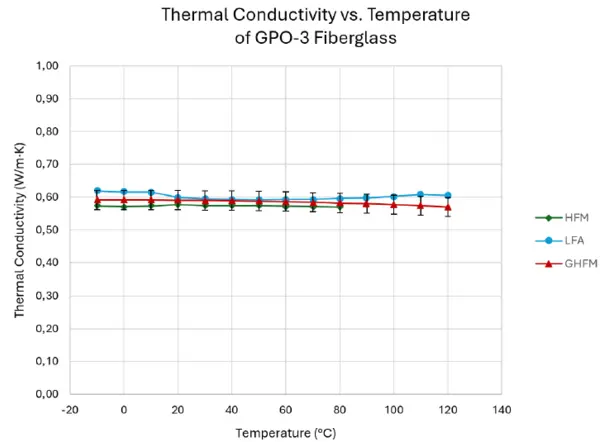
The Thermal ConductivityThermal conductivity (λ with the unit W/(m•K)) describes the transport of energy – in the form of heat – through a body of mass as the result of a temperature gradient (see fig. 1). According to the second law of thermodynamics, heat always flows in the direction of the lower temperature.thermal conductivity measurement results are illustrated in figure 2.
Summary
Despite possible challenges in measuring fiber reinforced polymers, the results from each method showed consistency in the results. The error bars shown in Figure 1 are ±5% using the values measured via GHFM and nearly all obtained values of Thermal ConductivityThermal conductivity (λ with the unit W/(m•K)) describes the transport of energy – in the form of heat – through a body of mass as the result of a temperature gradient (see fig. 1). According to the second law of thermodynamics, heat always flows in the direction of the lower temperature.thermal conductivity from each method fall within this range. Thermal conductivity values reported for the GHFM were calculated based on a quadratic fit of the measured points generated by the measurement software. Thermal conductivity values reported for LFA were calculated from the material DensityThe mass density is defined as the ratio between mass and volume. density, Thermal DiffusivityThermal diffusivity (a with the unit mm2/s) is a material-specific property for characterizing unsteady heat conduction. This value describes how quickly a material reacts to a change in temperature.thermal diffusivity measured via LFA and Specific Heat Capacity (cp)Heat capacity is a material-specific physical quantity, determined by the amount of heat supplied to specimen, divided by the resulting temperature increase. The specific heat capacity is related to a unit mass of the specimen.specific heat capacity measured via DSC.
An increased measurement uncertainty must be expected for HFM and LFA results. The lower values of thermal conductivity obtained using HFM compared to the other two methods were anticipated due to the very low thermal resistance of the specimen, which was roughly 0.011 m2·K/W, nearly half of the limit of the technique as stated for the instrument of 0.02 m2·K/W. LFA results are not corrected for thermal expansion. Nevertheless, the results of this study indicate that it is possible to measure polymer matrix composites using a variety of techniques and obtain good agreement between methods.