Introduction
Due to its excellent magnetic and thermophysical properties, pure iron is frequently used in electromagnetic components where efficient heat transfer is essential. Examples include transformer cores, electric motors, induction coils, and components in power electronics, where both magnetic and thermal stresses occur. Precise understanding of the thermal properties over a wide temperature range is therefore essential for reliably designing components and accurately simulating their operational behavior under real-world conditions.
Knowledge of Thermal ConductivityThermal conductivity (λ with the unit W/(m•K)) describes the transport of energy – in the form of heat – through a body of mass as the result of a temperature gradient (see fig. 1). According to the second law of thermodynamics, heat always flows in the direction of the lower temperature.thermal conductivity is crucial, as it significantly determines how efficiently heat is transported within a material. In applications involving pure iron, particularly in electromagnetic components, it directly influences temperature distribution, heat dissipation, and thus the operational safety and service life of the components. Insufficient heat dissipation can lead to local overheating, reduced efficiency, or even failure. Therefore, precise understanding of the Thermal ConductivityThermal conductivity (λ with the unit W/(m•K)) describes the transport of energy – in the form of heat – through a body of mass as the result of a temperature gradient (see fig. 1). According to the second law of thermodynamics, heat always flows in the direction of the lower temperature.thermal conductivity is essential for the thermal design, optimization, and simulation of industrial systems.
Method and Measurement Conditions
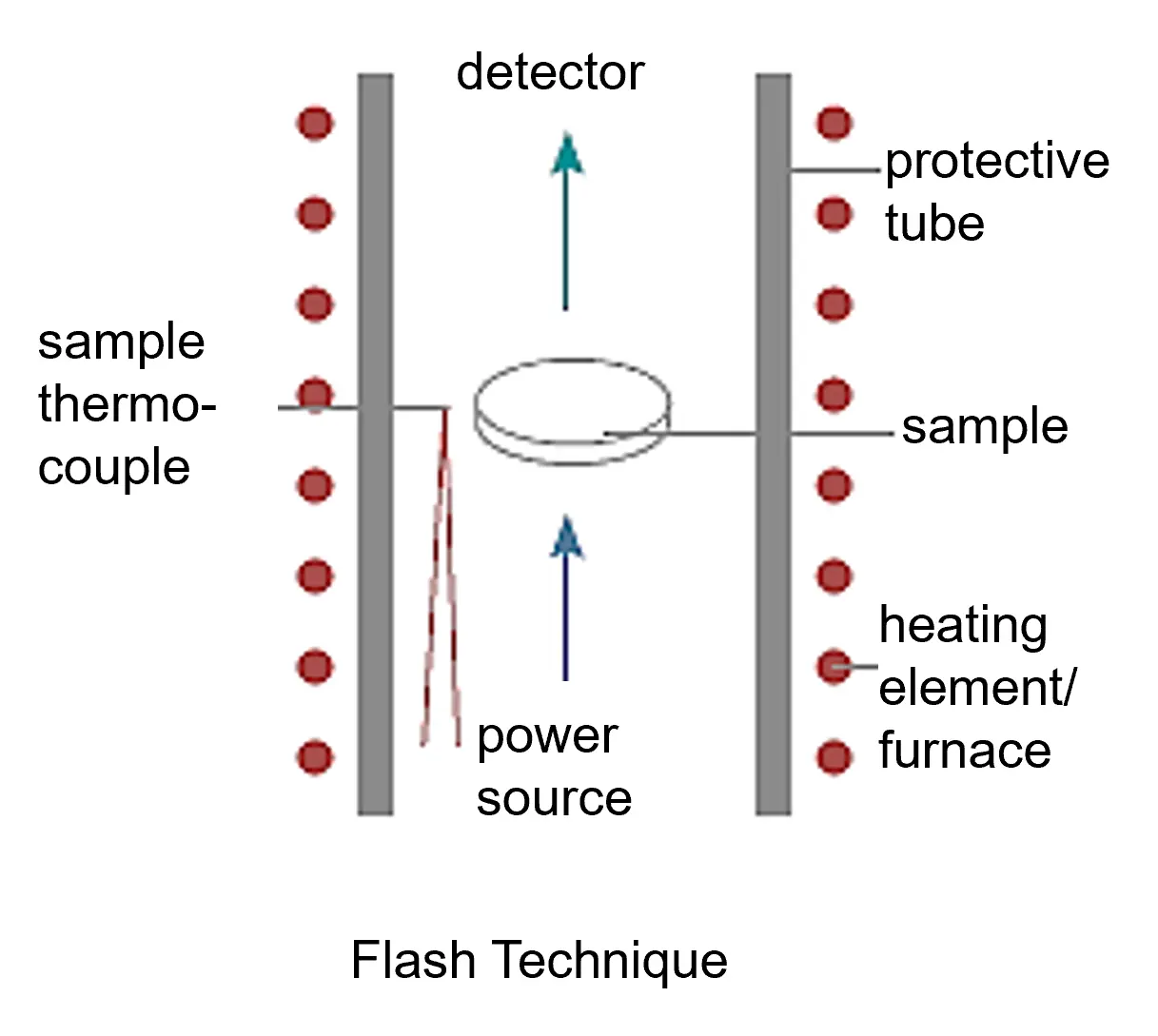
Laser flash analysis (LFA, see figure 1) is primarily used to determine the Thermal DiffusivityThermal diffusivity (a with the unit mm2/s) is a material-specific property for characterizing unsteady heat conduction. This value describes how quickly a material reacts to a change in temperature.thermal diffusivity (α) of a material. When combined with DensityThe mass density is defined as the ratio between mass and volume. density (ρ) and Specific Heat Capacity (cp)Heat capacity is a material-specific physical quantity, determined by the amount of heat supplied to specimen, divided by the resulting temperature increase. The specific heat capacity is related to a unit mass of the specimen.specific heat capacity (cp), the Thermal ConductivityThermal conductivity (λ with the unit W/(m•K)) describes the transport of energy – in the form of heat – through a body of mass as the result of a temperature gradient (see fig. 1). According to the second law of thermodynamics, heat always flows in the direction of the lower temperature.thermal conductivity (λ) can be calculated (λ = α · cp · ρ).
During the measurement, the bottom of the sample is heated by a short laser pulse. The resulting temperature increase on the opposite side is detected using an infrared detector. The Thermal DiffusivityThermal diffusivity (a with the unit mm2/s) is a material-specific property for characterizing unsteady heat conduction. This value describes how quickly a material reacts to a change in temperature.thermal diffusivity of the material can then be determined based on this temperature profile over time and corresponding mathematical models.
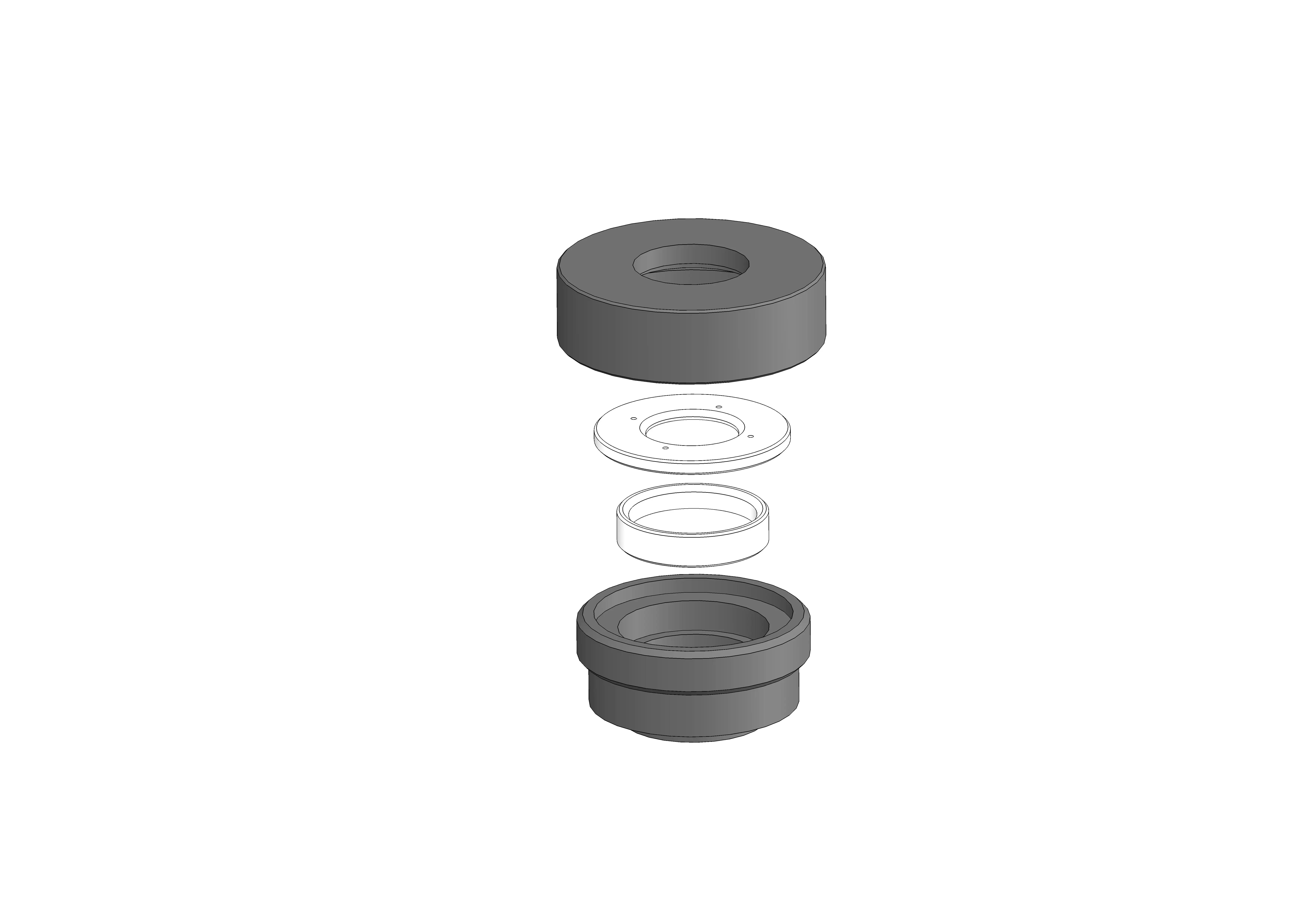
Using a special sapphire sample holder for molten metals (see figure 2), the Thermal DiffusivityThermal diffusivity (a with the unit mm2/s) is a material-specific property for characterizing unsteady heat conduction. This value describes how quickly a material reacts to a change in temperature.thermal diffusivity of a pure iron sample was continuously measured with the LFA 707 StratoFlash® Classic as it transitioned from the solid to the liquid state.
The Specific Heat Capacity (cp)Heat capacity is a material-specific physical quantity, determined by the amount of heat supplied to specimen, divided by the resulting temperature increase. The specific heat capacity is related to a unit mass of the specimen.specific heat capacity (cp) was determined in the temperature range from room temperature to 1600°C using the DSC 500 Pegasus®, equipped with a rhodium furnace. The measurement conditions are detailed in table 1.
Table 1: LFA measurement conditions
| Temperature range | RT - 1600°C |
| Sample holder | Sapphire for molten metals |
| Sample size | Ø 1.39 mm; thickness ~ 1,4 mm; planparallel surfaces |
| Coating | Graphite |
| Specific Heat Capacity (cp)Heat capacity is a material-specific physical quantity, determined by the amount of heat supplied to specimen, divided by the resulting temperature increase. The specific heat capacity is related to a unit mass of the specimen.Specific heat capacity | By means of DSC 500 Pegasus® |
| Atmosphere | Ar |
| Heating rate | Variable 10 to 20 K/min |
| Energy | 650 V; 600 μs |
Results and Discussion
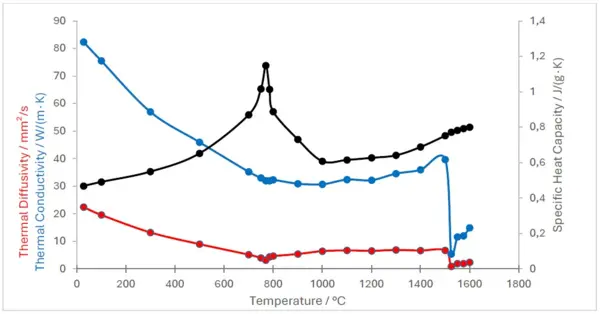
Figure 3 depicts the typical behavior of pure iron, including the Curie transition (≈770°C). Both the Thermal DiffusivityThermal diffusivity (a with the unit mm2/s) is a material-specific property for characterizing unsteady heat conduction. This value describes how quickly a material reacts to a change in temperature.thermal diffusivity (red curve) and the Specific Heat Capacity (cp)Heat capacity is a material-specific physical quantity, determined by the amount of heat supplied to specimen, divided by the resulting temperature increase. The specific heat capacity is related to a unit mass of the specimen.specific heat capacity (black curve) exhibit distinct changes at this point, with a local minimum and maximum, respectively. Thus, the Curie transition can clearly bee seen in the Thermal DiffusivityThermal diffusivity (a with the unit mm2/s) is a material-specific property for characterizing unsteady heat conduction. This value describes how quickly a material reacts to a change in temperature.thermal diffusivity and Specific Heat Capacity (cp)Heat capacity is a material-specific physical quantity, determined by the amount of heat supplied to specimen, divided by the resulting temperature increase. The specific heat capacity is related to a unit mass of the specimen.specific heat capacity, whereas the Thermal ConductivityThermal conductivity (λ with the unit W/(m•K)) describes the transport of energy – in the form of heat – through a body of mass as the result of a temperature gradient (see fig. 1). According to the second law of thermodynamics, heat always flows in the direction of the lower temperature.thermal conductivity (blue curve) shows no effect in this region. In the melting range above 1525°C, the thermal diffusivity and Thermal ConductivityThermal conductivity (λ with the unit W/(m•K)) describes the transport of energy – in the form of heat – through a body of mass as the result of a temperature gradient (see fig. 1). According to the second law of thermodynamics, heat always flows in the direction of the lower temperature.thermal conductivity significantly decrease as the lattice structure breaks down and heat transport via phonons no longer occurs.
Summary
From solid to liquid: Using the LFA 707 StratoFlash® Classic, equipped with a special sapphire sample holder, metals can continuously be characterized all the way down to the melt. The resulting data provides valuable insights into the temperature-dependent thermal conductivity behavior, forming a reliable basis for simulation, material selection and component optimization, even under extreme operating conditions.