Introduction
Determining the Specific Heat Capacity (cp)Heat capacity is a material-specific physical quantity, determined by the amount of heat supplied to specimen, divided by the resulting temperature increase. The specific heat capacity is related to a unit mass of the specimen.specific heat capacity (cp) of 1.4301 stainless steel is crucial for understanding its thermal behavior in real-world operating conditions. This fundamental material data is essential for designing and optimizing thermal processes in industry. Typical areas of application include plant and process engineering, as well as the food and chemical industries, where stainless steel is often used as a structural material. Knowledge of precise heat storage capacity is particularly important in applications involving cyclic or transient temperature loads. This enables more realistic thermal simulations to be performed and improves the operational safety and efficiency of components.
DSC-cp, Determination
The Specific Heat Capacity (cp)Heat capacity is a material-specific physical quantity, determined by the amount of heat supplied to specimen, divided by the resulting temperature increase. The specific heat capacity is related to a unit mass of the specimen.specific heat capacity (cp) is typically determined using DSC via a comparative measurement method with a reference material (e.g., in accordance with DIN EN ISO 11357).
First, a suitable calibration is performed on the DSC (usually temperature calibration). Each Specific Heat Capacity (cp)Heat capacity is a material-specific physical quantity, determined by the amount of heat supplied to specimen, divided by the resulting temperature increase. The specific heat capacity is related to a unit mass of the specimen.specific heat capacity determination of a material includes three measurements; the baseline, a sapphire reference sample and the sample itself and can then be calculated according to the following equation:

All measurements are performed at a defined heating rate in an inert gas atmosphere to ensure consistent conditions. The Specific Heat Capacity (cp)Heat capacity is a material-specific physical quantity, determined by the amount of heat supplied to specimen, divided by the resulting temperature increase. The specific heat capacity is related to a unit mass of the specimen.specific heat capacity (cp) is determined within a defined temperature range. Stable baselines and high reproducibility of the measurement conditions are essential.
During the measurement, the DSC records the heat flow as a function of temperature. When calculating the Specific Heat Capacity (cp)Heat capacity is a material-specific physical quantity, determined by the amount of heat supplied to specimen, divided by the resulting temperature increase. The specific heat capacity is related to a unit mass of the specimen.specific heat capacity, the amount of heat energy absorbed by the sample compared to the standard material is taken into account. Phase transitions or reactions within the sample may affect the evaluation. Second-order Phase TransitionsThe term phase transition (or phase change) is most commonly used to describe transitions between the solid, liquid and gaseous states.phase transitions, such as Glass Transition TemperatureThe glass transition is one of the most important properties of amorphous and semi-crystalline materials, e.g., inorganic glasses, amorphous metals, polymers, pharmaceuticals and food ingredients, etc., and describes the temperature region where the mechanical properties of the materials change from hard and brittle to more soft, deformable or rubbery.glass transitions, must therefore be taken into account, whereas first-order Phase TransitionsThe term phase transition (or phase change) is most commonly used to describe transitions between the solid, liquid and gaseous states.phase transitions, such as melting processes, must be excluded.
The result provides the temperature-dependent apparent* specific heat capacity of the sample, which can be used for material characterization or further thermophysical calculations. The exact measurement conditions are shown in table 1.
*The apparant specific heat capacity is a term in thermodynamics, used to describe the thermal behavior of materials which undergo Phase TransitionsThe term phase transition (or phase change) is most commonly used to describe transitions between the solid, liquid and gaseous states.phase transitions (e.g., melting, evaporation) during heating or cooling.
Table 1: DSC measurement parameters
| Measuring head | DSC-cp of the DSC 500 Pegasus® |
|---|---|
| Furnace | Rhodium |
| Crucible | Pt/Rh crucible with lid (with Al2O3-Liner) |
| Sample thermocouple | Type S |
| Purge gas | Ar (70 ml/min) |
| Temperature program |
|
| Sample mass | 140.952 mg |
| Calibration standard | Sapphire (83.265 mg) |
Results and Discussion
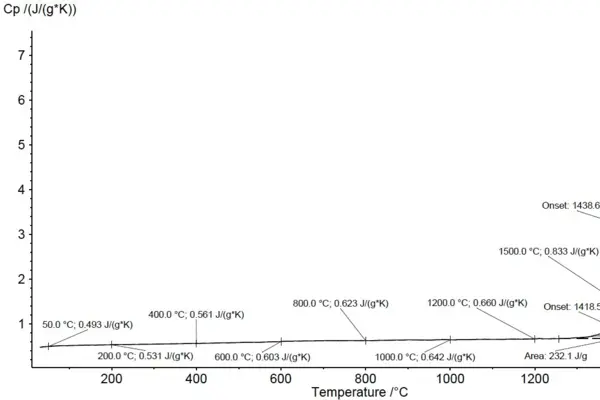
Figure 1 shows the measurement curve, illustrating the temperature-dependent apparent specific heat capacity (cp) of 1.4301 stainless steel in the range from room temperature to approximately 1550°C. At the beginning and during heating (up to approximately 1200°C), the material shows, as expected, largely stable behavior with a slight increase in cp values. The measured values here range from approximately 0.49 to 0.66 J/(g·K). A distinct rise in the cp curve can be observed starting at approximately 1400°C. The transformation starts at approximately 1418°C, while a pronounced EndothermicA sample transition or a reaction is endothermic if heat is needed for the conversion.endothermic effect is observed at 1477.5°C. This sharp peak is typical of a first-order Phase TransitionsThe term phase transition (or phase change) is most commonly used to describe transitions between the solid, liquid and gaseous states.phase transition and indicates the melting process of the material. In the region of the melting reaction, additional energy is required for the transformation from the solid to the liquid state (latent heat), which is reflected in the sharply increased apparent cp value and the broad peak structure. In the range of a melting transition, cp is not uniquely defined due to the latent heat associated with the Phase TransitionsThe term phase transition (or phase change) is most commonly used to describe transitions between the solid, liquid and gaseous states.phase transition.
Integration of the peak yields a transformation enthalpy of approximately 232 J/g, representing the energetic signature of the melting process. The transformation endpoint is at around 1482°C, by which point the material is fully in the liquid state.
Summary
Determination of the specific heat capacity provides comprehensive thermophysical information that is crucial for characterizing materials and developing processes. A key advantage is that it captures the full thermal behavior across an extremely wide temperature range, including the solid state, Phase TransitionsThe term phase transition (or phase change) is most commonly used to describe transitions between the solid, liquid and gaseous states.phase transitions and melting. This enables consistent datasets to be created for parameters such as cp, enthalpy and melting enthalpy, without any data gaps. Furthermore, measuring down to the Melting Temperatures and EnthalpiesThe enthalpy of fusion of a substance, also known as latent heat, is a measure of the energy input, typically heat, which is necessary to convert a substance from solid to liquid state. The melting point of a substance is the temperature at which it changes state from solid (crystalline) to liquid (isotropic melt).melting point enables the unambiguous identification and quantification of Phase TransitionsThe term phase transition (or phase change) is most commonly used to describe transitions between the solid, liquid and gaseous states.phase transitions, particularly the Melting Temperatures and EnthalpiesThe enthalpy of fusion of a substance, also known as latent heat, is a measure of the energy input, typically heat, which is necessary to convert a substance from solid to liquid state. The melting point of a substance is the temperature at which it changes state from solid (crystalline) to liquid (isotropic melt).melting temperature and the associated latent heat. This is especially relevant for alloys such as 1.4301 stainless steel. This data can be incorporated directly into thermal simulations (e.g., casting or high-temperature processes), enabling the realistic modelling of heating, melting and solidification processes.
The DSC 500 Pegasus® allows for precise Specific Heat Capacity (cp)Heat capacity is a material-specific physical quantity, determined by the amount of heat supplied to specimen, divided by the resulting temperature increase. The specific heat capacity is related to a unit mass of the specimen.cp measurements across a wide temperature range. Due to the system's high sensitivity and stable measurement conditions, thermophysical material properties can reliable be determined, even in demanding high-temperature applications.