Introduction: Quality Control Meets Circular Economy
Recyclates differ fundamentally from virgin polymers. While virgin materials are produced under tightly controlled conditions with well-defined specifications, recyclates often represent unknown material systems. Even when marketed as “PP” or “PP mix,” significant uncertainty remains regarding contamination, mixed fractions, additive packages, degradation history, and supplier-tosupplier variability. Technical datasheets, if available, are often incomplete and unreliable. Small compositional variations in polymer blends can result in disproportionately large effects on processing behavior and final performance, including mechanical instability, processing failure, or long-term property degradation. This uncertainty drives conservative decisions such as overengineering, material downgrading, or outright rejection of recyclates. These practices limit the economic value of recycled materials and slow the transition toward a circular plastics economy.
Proteus® Now Quantify
To address this analytical gap, NETZSCH developed Proteus® Now Quantify, an AI-supported solution based on Differential Scanning Calorimetry (DSC) for the identification and quantification of polymer compositions in unknown materials. Key knowledge gained from its development is that the reliability of AI-based quantification depends fundamentally on the quality, consistency, and standardization of training data.
AI Does Not Compensate for Poor Data Quality
Machine learning algorithms can not correct for inconsistent experiments, systematic measurement errors, or incorrect data. Instead, they learn the statistical relationships present in the dataset − whether those relationships reflect physical material behavior or experimental artifacts. If measurement parameters vary, calibrations drift, or labels are inconsistent, the model will internalize these inconsistencies as valid patterns.
For Quantify, successful implementation required more than just assembling a large dataset. It also required ensuring that all training data was generated under identical, well-defined experimental conditions. This requirement arises from the fundamental characteristics of DSC measurements and how their signals are interpreted by machine-learning models.
DSC curves provide a thermal fingerprint of polymer systems, including melting transitions, CrystallizationCrystallization is the physical process of hardening during the formation and growth of crystals. During this process, heat of crystallization is released.crystallization behavior, and Glass Transition TemperatureThe glass transition is one of the most important properties of amorphous and semi-crystalline materials, e.g., inorganic glasses, amorphous metals, polymers, pharmaceuticals and food ingredients, etc., and describes the temperature region where the mechanical properties of the materials change from hard and brittle to more soft, deformable or rubbery.glass transition features. These characteristics are highly informative for polymer identification and quantification. However, they are also sensitive to experimental parameters. From a machine-learning perspective, variability introduced by changing measurement parameters is statistically indistinguishable from variability caused by differences in material composition.
Consequently: Training data and unknown samples must be measured under the same, strictly standardized conditions for a physically meaningful and industrial reliable AI-based quantification.
Standardized Measurement Conditions for Proteus® Now Quantify
Sample Mass
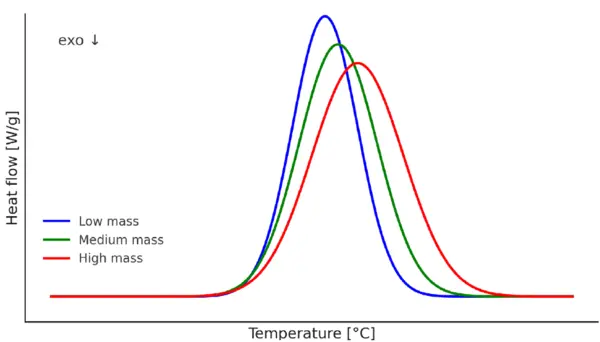
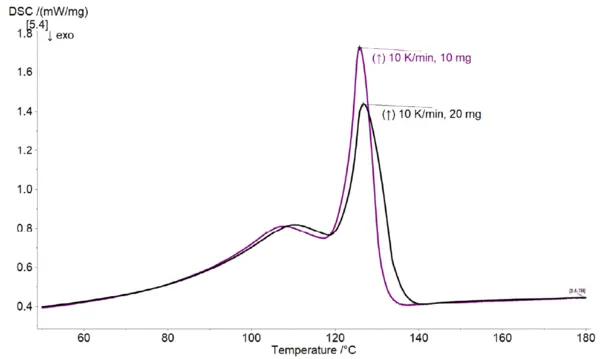
Sample mass directly affects peak width and shape:
- High mass leads to thermal gradients and increases thermal lag, resulting in peak broadening, temperature shifts, and reduced resolution between overlapping transitions.
- Low mass increases signal-to-noise ratio, increasing baseline sensitivity and measurement uncertainty.
A schematic representation of this effect is illustrated in figure 1, while a real example of a polymer mixture is shown in figure 2.
In Proteus® Now Quantify, a standardized value of 10 mg is applied. This parameter was used as a training condition for Quantify’s ML models, and deviations affect signal strength or peak shape.
Heating and Cooling Rates
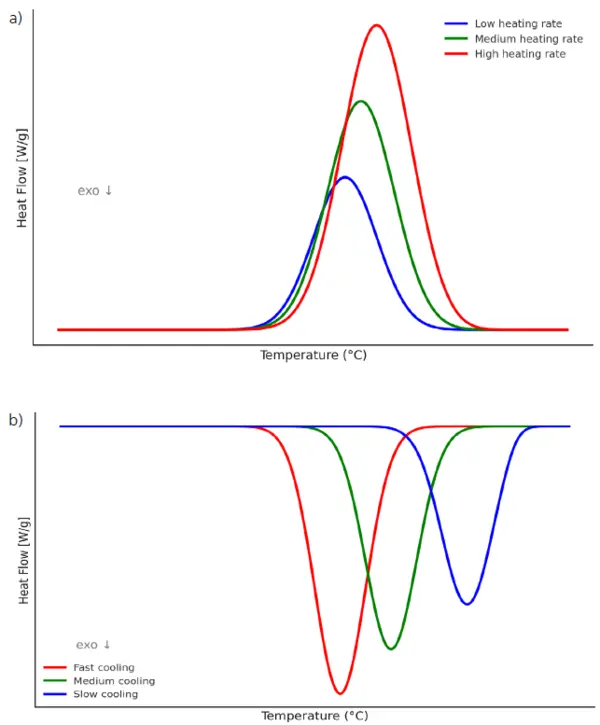
Heating and cooling rates influence peak position and shape. Even identical materials exhibit systematic shifts in peak position and morphology at different rates.
- Higher heating rates shift transitions to higher temperatures and can broaden peaks, reducing resolution between closely spaced thermal events.
- Higher cooling rates shift CrystallizationCrystallization is the physical process of hardening during the formation and growth of crystals. During this process, heat of crystallization is released.crystallization to lower temperatures and can alter peak shape and apparent Crystallinity / Degree of CrystallinityCrystallinity refers to the degree of structural order of a solid. In a crystal, the arrangement of atoms or molecules is consistent and repetitive. Many materials such as glass ceramics and some polymers can be prepared in such a way as to produce a mixture of crystalline and amorphous regions.crystallinity.
These effects are schematically represented in figure 3, whereas figures 4 and 5 show an example of a polymer mixture.
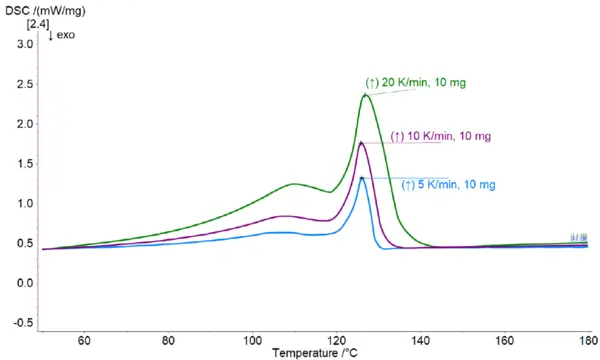

To ensure comparability between training data and application measurements, both heating and cooling rates are fixed. In Proteus® Now Quantify, a value of 10 K/min is applied. This parameter represents an optimized balance between resolution and measurement time and was specifically selected to ensure robust and reproducible model performance.
DSC Instrument Calibration Requirements
In addition to standardized measurement parameters, proper instrument calibration is essential to ensure that extracted DSC features are physically meaningful and comparable across time and instruments.
- Heat-flow calibration (Sensitivity): Provides correct enthalpy values (J/g), which are critical for composition.
- Temperature calibration (TempCal): Delivers accurate onset temperatures, melting points, and Glass Transition TemperatureThe glass transition is one of the most important properties of amorphous and semi-crystalline materials, e.g., inorganic glasses, amorphous metals, polymers, pharmaceuticals and food ingredients, etc., and describes the temperature region where the mechanical properties of the materials change from hard and brittle to more soft, deformable or rubbery.glass transition temperatures used for material identification.
- Baseline calibration (BeFlat®): Stabilizes the baseline to prevent artifacts that could be misinterpreted as material-related features by the machine-learning model.
Without these calibrations, systematic measurement errors may be encoded into the model during training and subsequently misinterpreted as compositional differences.
Training Data Integrity: Controlled Data Beats Large Data
Quantify was trained using virgin polymer blends with known compositions, providing reliable ground truth for supervised learning.
A key finding was that label integrity is more important than dataset size. Increasing the amount of data does not necessarily improve performance; in fact, model robustness can deteriorate if additional data introduces inconsistent labels, variable measurement conditions, or ambiguous class definitions. Reliable AI-based quantification therefore requires:
- Traceable reference materials
- Consistent class definitions/boundaries
- Expert validation and review of training datasets
- Strict adherence to standardized measurement protocols
Outlook
Proteus® Now Quantify currently supports polyolefins and is being expanded to additional polymer families. Development continues through structured data collection, iterative retraining, and feedback from development partners and early adopters.
AI alone will not solve the challenges of recycling. However, when combined with standardized measurement protocols, proper calibration, and high-quality training data, AI becomes a powerful tool for making advanced materials analysis accessible, reproducible, and scalable within industrial quality control environments.
Quick Checklist: Measurement Conditions for Proteus® Now Quantify
Before analzying unknown samples, ensure the following conditions are fufilled:
Measurement Parameters
✅Sample mass: 10 mg ± 1 mg
✅Heating rate: 10 K/min
✅Cooling rate: 10 K/min
Calibration Status
✅Heat-flow calibration (sensitivity) up to date
✅Temperature calibration (TempCal) up to data
✅Baseline calibration (BeFlat®) applied
Further Reading
Topics such as variability across grades and suppliers within a polymer class, the relationship between virgin training data and recyclate analysis, and blend complexity (including overlapping peaks and co-CrystallizationCrystallization is the physical process of hardening during the formation and growth of crystals. During this process, heat of crystallization is released.crystallization limits) are addressed in the following Application Notes:
Using DSC to Quantify Polymer Mixtures – Possibilities a and Challenges
DSC Measurements on Recycling Materials: Objective Interpretation with Proteus® Now Quantify