Introduction
Differential Scanning Calorimetry (DSC) is the most frequently used thermal analysis technique, in which the difference in the heat flow rate between the sample crucible and the reference crucible is determined with a controlled temperature/time program, providing information about the EndothermicA sample transition or a reaction is endothermic if heat is needed for the conversion.endothermic and ExothermicA sample transition or a reaction is exothermic if heat is generated.exothermic effects of the samples (e.g., Glass Transition TemperatureThe glass transition is one of the most important properties of amorphous and semi-crystalline materials, e.g., inorganic glasses, amorphous metals, polymers, pharmaceuticals and food ingredients, etc., and describes the temperature region where the mechanical properties of the materials change from hard and brittle to more soft, deformable or rubbery.glass transition, melting, CrystallizationCrystallization is the physical process of hardening during the formation and growth of crystals. During this process, heat of crystallization is released.crystallization, etc.). It is widely used in the polymer field due to the advantages of its convenient operation, small sample masses and fast measurements. For most thermoplastic polymers, a heating-cooling-reheating program is the most commonly used temperature program. However, the curves of the first and second heating are usually quite different, raising the question: Which one should be concerned, the first or second heating?
Melting Temperatures and EnthalpiesThe enthalpy of fusion of a substance, also known as latent heat, is a measure of the energy input, typically heat, which is necessary to convert a substance from solid to liquid state. The melting point of a substance is the temperature at which it changes state from solid (crystalline) to liquid (isotropic melt).Melting and CrystallizationCrystallization is the physical process of hardening during the formation and growth of crystals. During this process, heat of crystallization is released.crystallization are the most common effects in thermoplastic materials. Taking melting and CrystallizationCrystallization is the physical process of hardening during the formation and growth of crystals. During this process, heat of crystallization is released.crystallization as an example, generally speaking, the first heating curve reflects the original Crystallinity / Degree of CrystallinityCrystallinity refers to the degree of structural order of a solid. In a crystal, the arrangement of atoms or molecules is consistent and repetitive. Many materials such as glass ceramics and some polymers can be prepared in such a way as to produce a mixture of crystalline and amorphous regions.crystallinity (depending on the thermal history) of the material, the cooling curve shows the CrystallizationCrystallization is the physical process of hardening during the formation and growth of crystals. During this process, heat of crystallization is released.crystallization behavior, and the second heating curve reflects the thermal properties of the material with always the same thermal history due to controlled and reproducible cooling beforehand. The different curves show the behavior of the sample in different states, so all of them are useful. Which curve should be concerned depends on the purpose of the test and the information needed. This Application Note illustrates this issue with three application examples.
1. Some of the PA6 parts cracked (NOK) during assembly, while others did not (OK); DSC identifies the difference between the NOK and OK parts.
The NOK parts and the OK parts are tested by means of DSC applying a typical heating, cooling and reheating program, and heating/cooling rates of 10 K/min. Figures 1 and 2 show the results of the first and second heating, respectively. The melting peak temperatures of the two samples are close during the first heating, but the melting enthalpy of the NOK sample is significantly higher than that of the OK sample, indicating that the Crystallinity / Degree of CrystallinityCrystallinity refers to the degree of structural order of a solid. In a crystal, the arrangement of atoms or molecules is consistent and repetitive. Many materials such as glass ceramics and some polymers can be prepared in such a way as to produce a mixture of crystalline and amorphous regions.crystallinity of the NOK material is higher (24.88%). High Crystallinity / Degree of CrystallinityCrystallinity refers to the degree of structural order of a solid. In a crystal, the arrangement of atoms or molecules is consistent and repetitive. Many materials such as glass ceramics and some polymers can be prepared in such a way as to produce a mixture of crystalline and amorphous regions.crystallinity means the arrangement of the molecular chain is more regular, and then the material shows higher hardness and modulus, but lower toughness, weaker resistance to crack extension, and cracks easily. The degree of Crystallinity / Degree of CrystallinityCrystallinity refers to the degree of structural order of a solid. In a crystal, the arrangement of atoms or molecules is consistent and repetitive. Many materials such as glass ceramics and some polymers can be prepared in such a way as to produce a mixture of crystalline and amorphous regions.crystallinity relates to the material itself (e.g., impurities, inhomogeneous) and also depends on the thermal history (processing conditions, such as mold temperature). The measurement parameters are detailed in table 1.
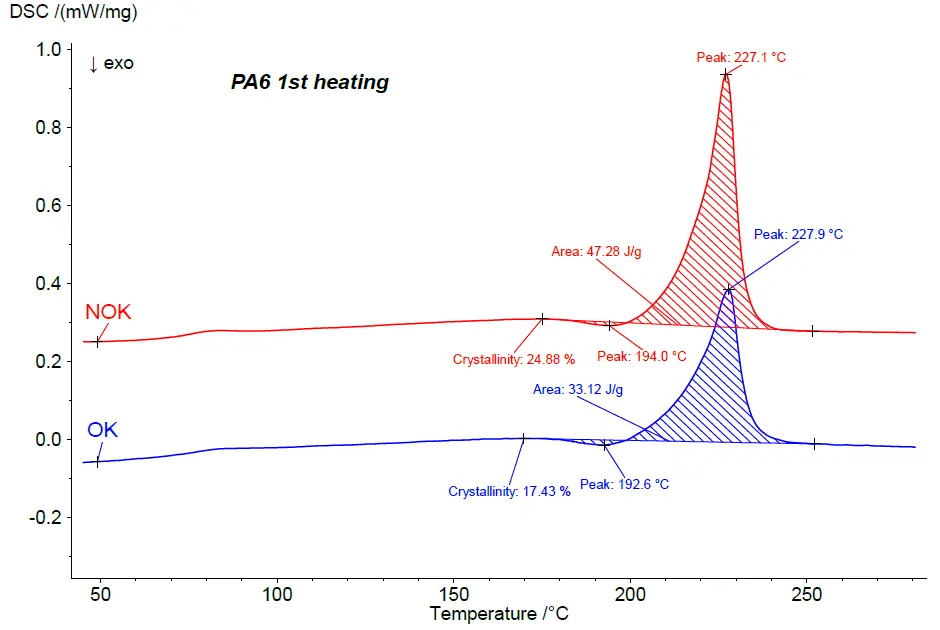
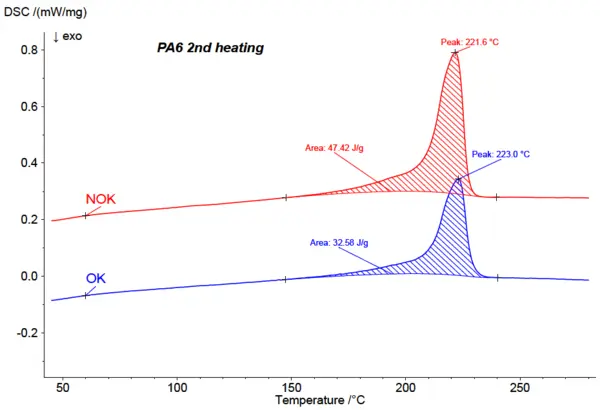
Table 1: DSC measurement parameters
| Instrument | DSC 300 Caliris® | |
| Samples | Sample OK (PA6) | Sample NOK (PA6) |
| Sample mass [mg] | 10.81 | 13.41 |
| Temperature program | RT - 290°C - RT - 290°C | |
| Heating/cooling rate | 10 K/min | |
| Crucible | Concavus® Al pans with pierced lid | |
| Atmosphere | N2 | |
After eliminating the effect of thermal history (the cooling rate was always 10 K/min), the melting enthalpy of the NOK sample is still higher than that of the OK sample during the second heating. It is supposed that the main reason for the difference in Crystallinity / Degree of CrystallinityCrystallinity refers to the degree of structural order of a solid. In a crystal, the arrangement of atoms or molecules is consistent and repetitive. Many materials such as glass ceramics and some polymers can be prepared in such a way as to produce a mixture of crystalline and amorphous regions.crystallinity of the two samples is the material itself, e.g., filler or impurities, which need to be further analyzed using other methods (such as TGA, spectroscopy, and mechanical properties testing, etc.).
2. PET pellets from different producers show different behavior during the spinning process; DSC helps identify the differences between the two products.
During the spinning process, one type of PET fiber showed rupture whilst another did not. For the investigation of the pellets from the different DSC producers, the two materials were measured with a heating, cooling and reheating program; the heating/cooling rate amounted to 10 K/min. Figures 3 and 4 show the curves of the first and second heating, respectively. Sample B shows a Glass Transition TemperatureThe glass transition is one of the most important properties of amorphous and semi-crystalline materials, e.g., inorganic glasses, amorphous metals, polymers, pharmaceuticals and food ingredients, etc., and describes the temperature region where the mechanical properties of the materials change from hard and brittle to more soft, deformable or rubbery.glass transition, cold CrystallizationCrystallization is the physical process of hardening during the formation and growth of crystals. During this process, heat of crystallization is released.crystallization and melting effects during the first heating, while for sample A, only melting effects are detected. Although the melting enthalpies of the two samples are quite similar, the area of the cold CrystallizationCrystallization is the physical process of hardening during the formation and growth of crystals. During this process, heat of crystallization is released. crystallization (21 J/g) of sample B must be taken into consideration for comparison of the original crystallinity of the two samples. The crystallinity for sample B is 11.5 % and thus much lower compared to the crystallinity of sample A with 24.53%. The higher crystallinity reduces toughness, and the material ruptures easily during spinning. The measurement parameters are detailed in table 2.
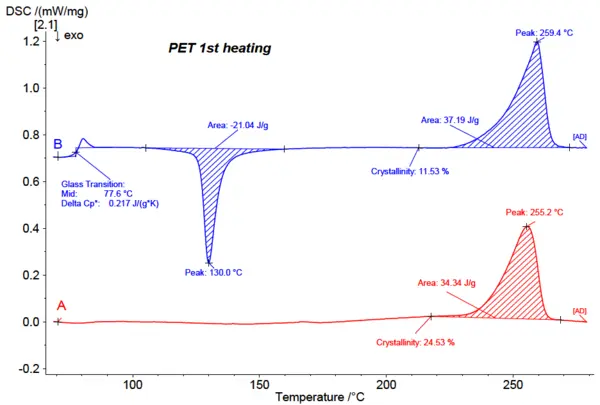
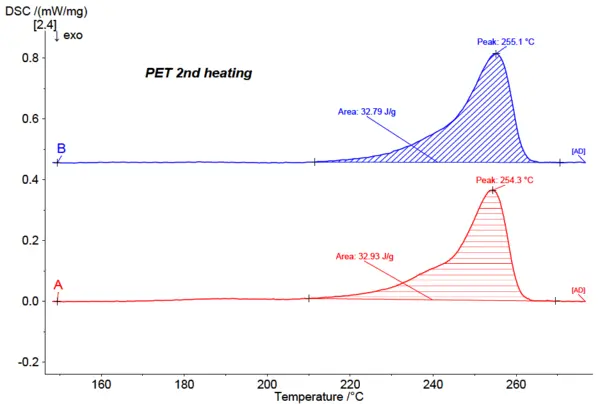
Table 2: Measurement parameters
| Instrument | DSC 300 Caliris® | |
| Samples | Sample A (PET) [NOK] | Sample B (PET) [OK] |
| Sample mass [mg] | 10.00 | 9.90 |
| Temperature program | RT - 280°C - RT - 280°C | |
| Heating/cooling rate | 10 K/min | |
| Crucible | Concavus® Al pans with pierced lid | |
| Atmosphere | N2 | |
After eliminating the effect of the thermal history, the melting enthalpy of the two samples is almost the same during the second heating, which means there is no big difference between the CrystallizationCrystallization is the physical process of hardening during the formation and growth of crystals. During this process, heat of crystallization is released. crystallization properties of the two samples. So the difference of crystallinity during the first heating may be related to the processing conditions, e.g., the cooling rate. The spinning performance of pellets A could be improved by adjusting the cooling procedure to reduce the Crystallinity / Degree of CrystallinityCrystallinity refers to the degree of structural order of a solid. In a crystal, the arrangement of atoms or molecules is consistent and repetitive. Many materials such as glass ceramics and some polymers can be prepared in such a way as to produce a mixture of crystalline and amorphous regions. degree of crystallinity.
3. Some batches of the raw PP granules rupture easily during the film-forming process, while other batches featured good quality. By means of DSC, reason for this failure can be analyzed.
Two batches of OK granules (no rupture) and four batches of NOK granules (rupture during stretching process) are tested by means of DSC with a heating-cooling-reheating program, and at heating/cooling rates of 10 K/min. Figures 5, 6, and 7 show the curves of the first heating, cooling and second heating of the PP samples. The behavior of the NOK samples and OK samples is similar during the two heating runs. During cooling, however, the CrystallizationCrystallization is the physical process of hardening during the formation and growth of crystals. During this process, heat of crystallization is released. crystallization temperature of the NOK samples (onset temperature around 119°C) is higher than that of the OK samples (onset temperature around 116°C), and the slope of the right side of the ExothermicA sample transition or a reaction is exothermic if heat is generated.exothermal peak of the NOK samples appears steeper than that of the OK samples, which means that the NOK samples crystallize also faster than the OK samples. Therefore, it is supposed that the rupture issue is probably related to the CrystallizationCrystallization is the physical process of hardening during the formation and growth of crystals. During this process, heat of crystallization is released. crystallization behavior of the raw granules. The NOK material may contain some microparticles that act as nucleation agent, resulting in a higher CrystallizationCrystallization is the physical process of hardening during the formation and growth of crystals. During this process, heat of crystallization is released. crystallization temperature and faster crystallization speed. If the NOK granules were processed under the same condition as OK, it would break easily during stretching. The measurement parameters are summarized in table 3.
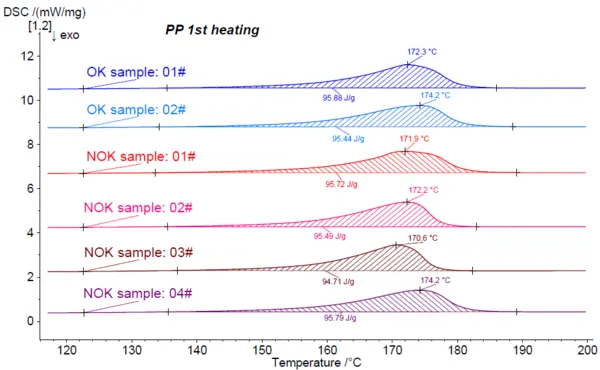
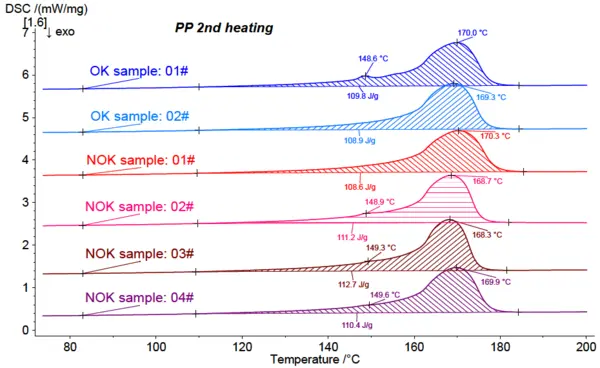
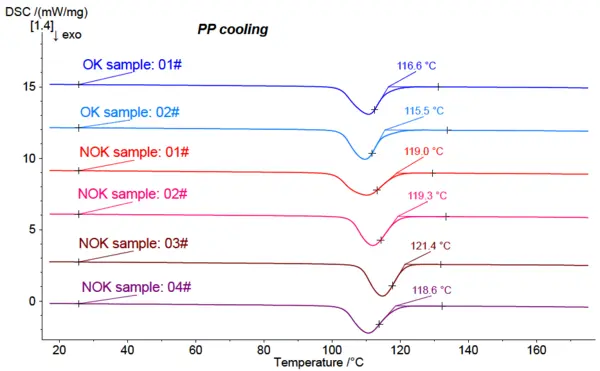
Table 3: Measurement parameters
| Instrument | DSC 300 Caliris® | |||||
| PP samples | OK#01 | OK#02 | NOK#1 | NOK#2 | NOK#3 | NOK#4 |
| Sample mass [mg] | 11.12 | 9.68 | 9.46 | 9.93 | 9.62 | 9.87 |
| Temperature program | Heating from 10°C to 200^C, cooling from -10°C and reheating to 200°C | |||||
| Heating/cooling rate | 10 K/min | |||||
| Crucible | Al pans with pierced lid | |||||
| Atmosphere | N2 | |||||
Conclusion
These examples illustrate how to analyze DSC heating/cooling curves in relation to an actual problem (failure analysis). The first DSC heating curves reveal the original crystallinity of the material, including the effect of its thermal history. The crystallization behavior can be analyzed from the cooling curves; the second heating curves show the thermal behavior of the material after eliminating the thermal histories. Failure analysis by DSC will be different with respect to materials and processing conditions, so the results of DSC measurements should be analyzed in terms of the exact failure. Any additional information on the processing conditions such as processing temperature is helpful for correctly interpreting the results and drawing the right conclusions.