Glossary
Phase Transitions
The term phase transition (or phase change) is most commonly used to describe transitions between the solid, liquid and gaseous states.
A phase of a thermodynamic system and the states have uniform physical properties. Thermodynamic phase transitions can be separated into different orders like 1st order transitions for melting procedures and 2nd order transitions for such aspects like the change in magnetic properties.
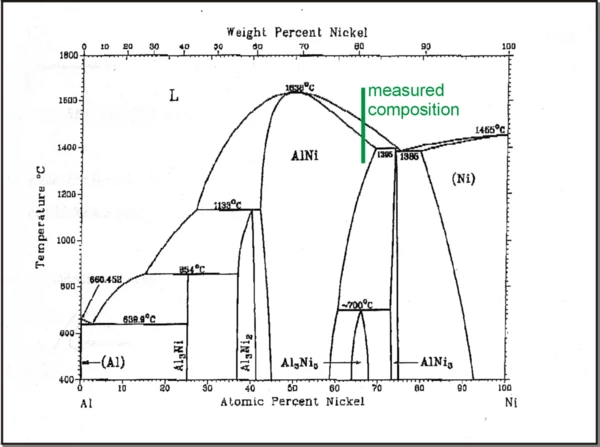
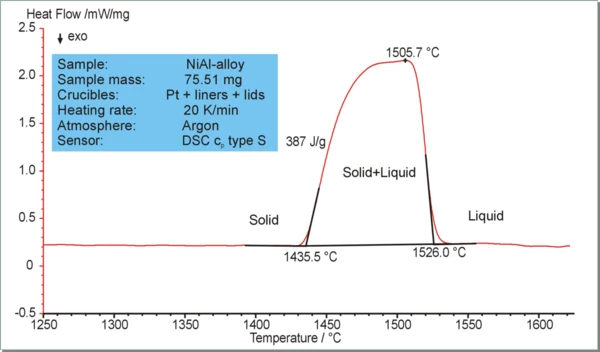
During a phase transition of a given medium, certain properties of the medium change, often discontinuously, because of a change in some external condition, such as temperature, pressure or other parameters. This discontinuous changes are referred to 1st. order transitions, whereas continuous changes are referred to 2nd.order transitions. The DSC and the combined TGA-DSC methods are both powerful tools for investigating phase transitions and even constructing phase diagrams, such as for the Al-Ni binary system displayed below.