Evolved Gas Analysis Overview (EGA)
Identify the Gases Behind Thermal Events
What happens when a material loses mass during heating? Evolved Gas Analysis (EGA) goes beyond detecting the thermal event – it helps identify the gases responsible for it.
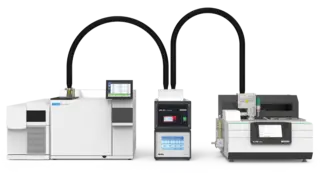
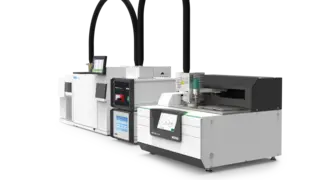
By coupling a thermal analyzer such as a Thermogravimetric Analyzer (TGA) or Simultaneous Thermal Analyzer (STA) with a gas analysis system, volatile products can be detected and identified as they are released from the sample. This provides valuable chemical information directly correlated with temperature, time, mass changes and thermal effects.
NETZSCH offers comprehensive coupling solutions for FT-IR, Mass Spectrometry (MS) and Gas Chromatography-Mass Spectrometry (GC-MS) – supported by decades of expertise in thermal analysis and gas transfer technology.
Three Powerful Techniques for Evolved Gas Analysis
FT-IR – Molecular Fingerprints of Evolved Gases
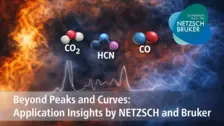
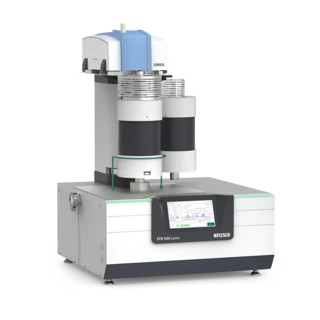
Fourier Transform Infrared Spectroscopy (FT-IR) measures the characteristic infrared absorption of molecules. The resulting spectra act like molecular fingerprints and allow many evolved gas species to be identified based on their characteristic absorption bands. The continuous transfer of gases from the thermal analyzer makes FT-IR particularly valuable for following changes in gas composition as a function of temperature and time. It is especially useful for identifying organic and inorganic gaseous species, Decomposition reactionA decomposition reaction is a thermally induced reaction of a chemical compound forming solid and/or gaseous products. decomposition products, water and solvent release, polymer degradation, and functional-group-specific changes.



Mass Spectrometry – Fast and Highly Sensitive Gas Detection
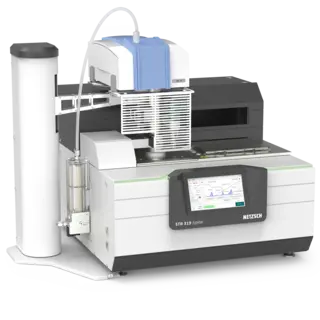
Mass Spectrometry (MS) detects ions according to their mass-to-charge ratio. Characteristic masses and fragmentation patterns provide information about the substances released from the sample. Its high sensitivity and fast response make MS particularly powerful for detecting even low gas concentrations and monitoring several gas species simultaneously throughout a thermal measurement. It is especially useful for analyzing small molecules and permanent gases, Decomposition reactionA decomposition reaction is a thermally induced reaction of a chemical compound forming solid and/or gaseous products. decomposition and PyrolysisPyrolysis is the thermal decomposition of organic compounds in an inert atmosphere.pyrolysis products, Solid-Gas ReactionsSolid-gas reactions are a type of heterogeneous solid-state reaction occurring when a reactive solid is exposed to a stream of reactive gas. Typical examples of solid-gas reactions are sorption and corrosion of metals.solid-gas reactions, and complex temperature-dependent gas evolution.
GC-MS – Separate Complex Mixtures Before Identification
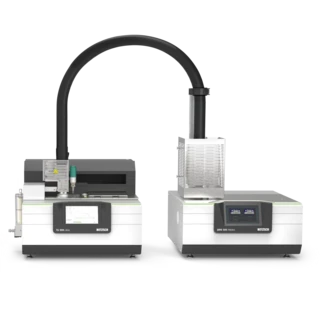
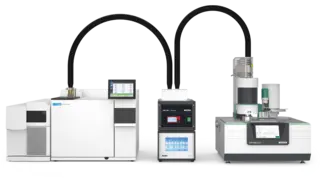
When several organic compounds are released at the same time, direct identification can become challenging. Gas Chromatography-Mass Spectrometry (GC-MS) adds an important separation step: the gas chromatograph first separates volatile and semi-volatile compounds, while the mass spectrometer subsequently provides detailed information for their identification. This makes GC-MS particularly powerful for analyzing complex gas mixtures and organic components, including additives and plasticizers, solvents, organic Decomposition reactionA decomposition reaction is a thermally induced reaction of a chemical compound forming solid and/or gaseous products. decomposition products, and samples from pharmaceuticals, polymers, food and cosmetics.
Evolved Gas Analysis at a Glance
Go beyond Thermal Analysis with Gas Identification
What Is Evolved Gas Analysis?
What is actually leaving the sample?
This additional dimension helps distinguish between processes such as the release of moisture or residual solvents, evaporation of volatile components, thermal Decomposition reactionA decomposition reaction is a thermally induced reaction of a chemical compound forming solid and/or gaseous products. decomposition, PyrolysisPyrolysis is the thermal decomposition of organic compounds in an inert atmosphere.pyrolysis, OxidationOxidation can describe different processes in the context of thermal analysis.oxidation and combustion, binder burnout and dewaxing, desorption and outgassing, as well as Solid-Gas ReactionsSolid-gas reactions are a type of heterogeneous solid-state reaction occurring when a reactive solid is exposed to a stream of reactive gas. Typical examples of solid-gas reactions are sorption and corrosion of metals.solid-gas reactions.
What Is a Coupling in Thermal Analysis?
What Can You Learn from Evolved Gas Analysis?
Why Combine Thermal Analysis and Gas Analysis?
A separate gas analysis can tell you what substances are present. A thermal analysis measurement can tell you when material changes occur.
The coupling connects both pieces of information.
This provides several advantages:
- Direct correlation: Link gas evolution to temperature, time, mass changes and thermal effects.
- More confident interpretation: Assign individual mass-loss steps to specific volatile products.
- Deeper material understanding: Move from describing a thermal event to understanding the chemistry behind it.
- Efficient analysis: Obtain complementary thermal and chemical information from the same experiment.
- Better differentiation: Distinguish materials, formulations or degradation pathways that show similar thermal behavior.
Why Should You Choose a NETZSCH Thermal Analyzer for Your Coupling?
Reliable Evolved Gas Analysis depends on more than the gas analyzer itself. The quality of the gas transfer from the sample to the detector is equally important.
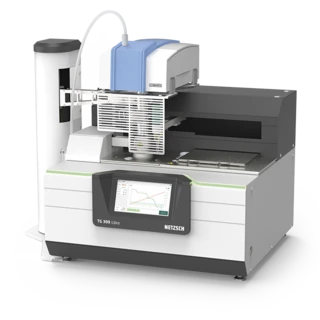
NETZSCH thermal analyzers have been developed with coupling applications in mind. Decades of experience in EGA have led to optimized solutions for transporting evolved gases from the furnace to the gas analyzer.
- Optimized Gas Transfer
Carefully designed gas paths help transport evolved products efficiently from the thermal analyzer to the detector.
- Heated Transfer Systems
Heated interfaces and transfer lines help prevent condensation of volatile decomposition products and minimize cold spots along the gas path.
- Low Dilution and Fast Response
Optimized gas volumes and carrier-gas conditions reduce unnecessary dilution. This supports sensitive detection and a close correlation between the thermal event and the gas-analysis signal.
- Direct Correlation of Thermal and Gas Data
NETZSCH software solutions support the combined evaluation of thermal-analysis and gas-analysis data. Temperature, time, TGA or DSC signals and gas information can be correlated for easier interpretation.
- Flexible Coupling Solutions
Different applications require different approaches. NETZSCH provides solutions ranging from integrated FT-IR systems such as PERSEUS® to transfer-line FT-IR couplings, quadrupole mass spectrometers and GC-MS systems.
- One Partner for Thermal Analysis and Coupling Expertise
The performance of a coupled system depends on the interaction between the thermal analyzer, gas transfer and gas analyzer. NETZSCH combines expertise in thermal analysis with decades of experience in designing and optimizing coupling solutions.
Long Instrument Life
Always There for You
Powerful Cooperation
Unlimited Warranty

Our Quality Promise:
NETZSCH’s Unlimited Warranty
At NETZSCH, our commitment to quality goes beyond the instruments themselves. We understand that your investment in advanced technology is a long-term one, and and that’s why we offer something truly unique – our Unlimited Warranty.
Evolved Gas Analysis Across a Wide Range of Applications
EGA provides valuable information wherever heating, processing or use of a material results in the release of gaseous products.
Polymers and Elastomers
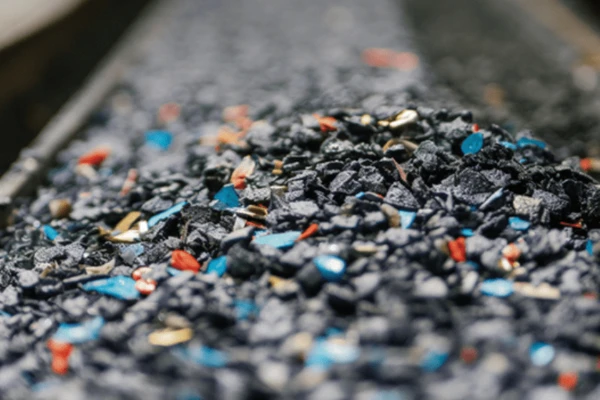
Investigate polymer degradation, additives, plasticizers, residual monomers, fillers, flame retardants and the composition of complex formulations.
Batteries and Energy Materials
Study electrolyte components, decomposition products, electrode materials and reactions occurring under defined atmospheres.

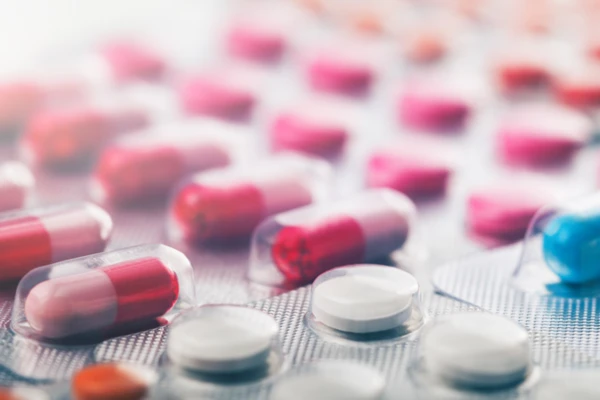
Pharmaceuticals and Life Sciences
Analyze residual solvents, moisture, decomposition pathways, excipients and the Thermal StabilityA material is thermally stable if it does not decompose under the influence of temperature. One way to determine the thermal stability of a substance is to use a TGA (thermogravimetric analyzer). thermal stability of pharmaceutical materials.
Biomass, Food and Cosmetics
Identify volatile and semi-volatile compounds, products, residual substances and complex organic decomposition products.
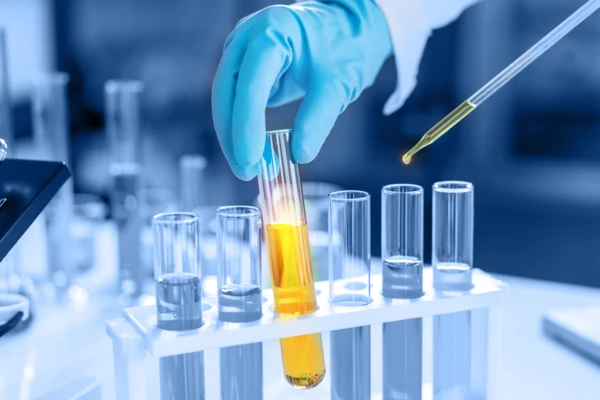
Chemicals and Organic Materials
Characterize purity, volatile components, reaction products, solvents and thermal decomposition mechanisms.
Metals, Alloys and Nuclear Materials
Study OxidationOxidation can describe different processes in the context of thermal analysis.oxidation, reduction, corrosion, hydrogen release and other solid-gas interactions under controlled conditions.
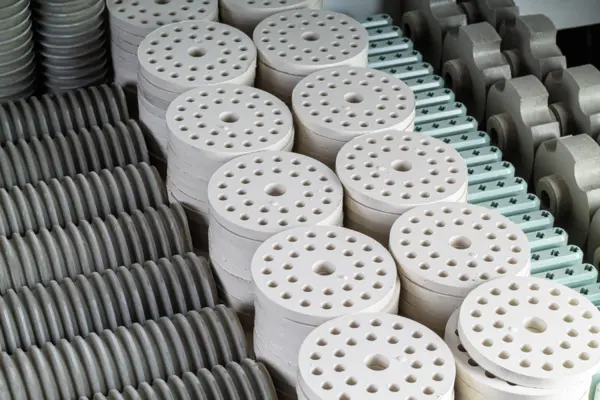
Ceramics, Glass and Building Materials
Investigate binder burnout, dehydration, carbonate decomposition, organic components and high-temperature reactions.

Consultancy & Sales
Do you have further questions about the instrument or the method? Would you like to speak to a sales represenative?
Service & Support
Do you already have an instrument and need technical support or spare parts?
Media and Training

Become an Expert in Evolved Gas Analysis!
Our Training Department offers exciting training courses on various methods throughout the year.
In addition to providing a solid theoretical basis, our courses focus on practical, application-specific aspects. Information on equipment technology, calibration, sample preparation, planning, preparation and execution of measurements as well as evaluation and interpretation of results will help you master your daily measurement tasks. Find out more about the courses we offer and register now!