Introduction
Additive manufacturing technologies, in particular 3D printing with filaments, have developed considerably in recent years and are increasingly being used in areas such as prototyping, design, architecture, arts and crafts, and functional components for indoor and outdoor use. Of particular interest are so-called “filled filaments”, in which functional fillers such as wood fibers or metal powder (e.g., stainless steel) are added to the base material – often polylactic acid (PLA). These material combinations open up new possibilities in terms of the appearance, texture and functionality of the printed objects.
Wood-filled PLA filaments give components a natural surface and are often used in furniture design, model making or sustainable product development. Metal-filled PLA variants, on the other hand, enable the creation of objects with a higher weight, improved stability, or specific aesthetics, e.g., decorative elements or functional prototypes with increased temperature resistance. These materials are used by the German Research Association for Tools and Materials (FGW), for example, in demonstrator and prototype construction for tool development in order to create more sustainable application solutions.
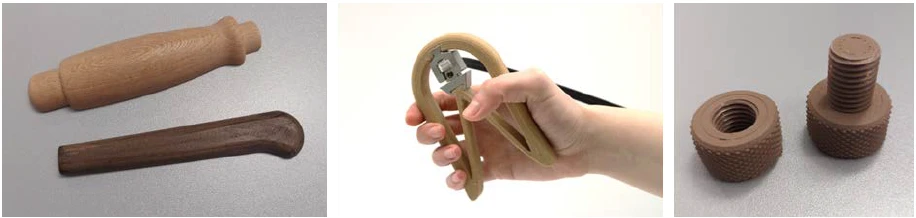
Figure 1 shows examples of applications of PLA filaments filled with wood and metal in the context of demonstrator and prototype construction. On the left are knife and tool handles made of wood-filled filament, which offer a pleasant feel as well as a natural, aesthetically pleasing surface. The second image shows a functional demonstrator of crimping pliers based on flexible mechanisms – an example of the implementation of complex motion mechanics using additive manufacturing with sustainable materials. On the right is a screw with a matching nut made of bronze-filled filament, which serves as an illustrative prototype for metal-like applications thanks to its increased weight and metallic appearance.
A key advantage of PLA-based filaments is their biodegradability and their comparatively environmentally friendly production from renewable raw materials such as corn starch or sugar cane.
Targeted filling with organic or inorganic materials enables the development of PLA compounds that are not only more sustainable, but also match – or even surpass – the mechanical properties and weather resistance of conventional (non-biodegradable) filaments such as ABS or PETG, all while maintaining comparable or even lower production costs.
To assess the suitability of filled PLA filaments for demanding applications, a purely mechanical characterization is not sufficient. Especially when developing sustainable materials, it is crucial to precisely understand their thermal resistance and thermal Decomposition reactionA decomposition reaction is a thermally induced reaction of a chemical compound forming solid and/or gaseous products. decomposition behavior. This is where thermogravimetric analysis (TGA) provides valuable insights.
By precisely recording mass losses as a function of temperature, conclusions can be drawn about the stability of the polymer carrier, the presence and quantity of fillers, and the start and progression of thermal degradation processes. In combination with evolved gas analysis – for example, by FT-IR – the resulting Decomposition reactionA decomposition reaction is a thermally induced reaction of a chemical compound forming solid and/or gaseous products. decomposition products can also be identified.
In this study, two commercially available PLA-based filaments filled with wood and stainless steel were compared with each other. The measurement parameters are detailed in table 1.
Table 1: Measurement Conditions
| Instrument | TG 309 Libra®, coupled to the Bruker Optics FT-IR INVENIO via external gas cell |
|---|---|
| Temperature program | RT-850°C, N2 atmosphere, 850°C-1000°C, air atmosphere |
| Heating rate | 10 K/min |
| Sample mass | 15 to 20 mg |
| Crucible | Al2O3, 85 μl, open |
Results and Discussion
At the beginning, the ATR FT-IR spectra of the two starting materials were recorded (figure 2). Both filled PLA filaments showed very good agreement with the existing database spectrum of PLA. However, the influence of the existing filling material cannot yet be identified here.
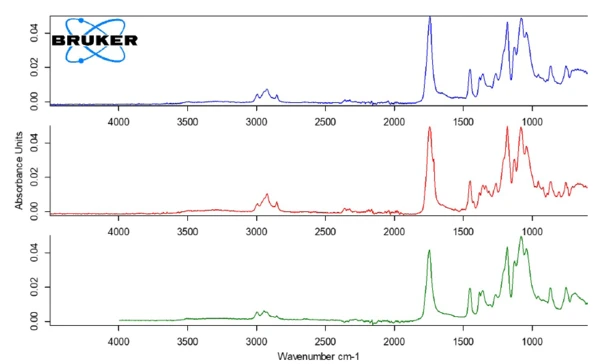
Figure 3 shows a comparison of the TGA results for the two filled filaments. Both filaments were heated in an inert atmosphere up to 850°C at 10 K/min. The wood-filled filament already showed a small mass loss of 1.02% below 200°C, which is presumably due to the release of moisture from the wood content. PyrolysisPyrolysis is the thermal decomposition of organic compounds in an inert atmosphere.Pyrolysis set in for both samples above 250°C. Here, a mass loss of 39.73% was detected for the stainless steel-filled filament.
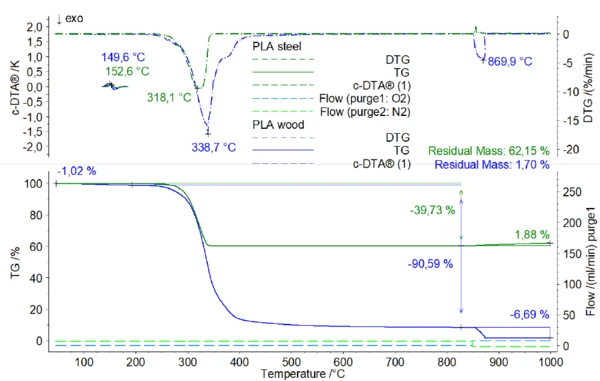
In the case of the wood-filled filament, the PyrolysisPyrolysis is the thermal decomposition of organic compounds in an inert atmosphere.pyrolysis of the polymer component was superimposed by the PyrolysisPyrolysis is the thermal decomposition of organic compounds in an inert atmosphere.pyrolysis of the wood component. This led to a total mass loss of 90.59%. Finally, above 850°C, synthetic air was used as a purge gas. The sample containing wood showed the combustion of the resulting PyrolysisPyrolysis is the thermal decomposition of organic compounds in an inert atmosphere.pyrolysis soot. In contrast, the stainless steel-filled sample showed a slight mass increase, which can be attributed to the OxidationOxidation can describe different processes in the context of thermal analysis.oxidation of the metal content. The residual masses of the two samples are referred to as Ash ContentThe ash is a measure of the mineral oxide content on a weight basis. Thermogravimetric analysis (TGA) in an oxidative atmosphere is a well-proven method to determine the inorganic residue, commonly referred to ash, in organic materials such as polymers, rubbers, etc. Therefore, the TGA measurement will identify if a material is filled and calculates the total filler content.ash content and amounted to 1.70% (PLA+wood) and 62.15% (PLA+stainless steel).
The melting ranges of the samples can be taken from the c-DTA® (calculated DTA) signal. These were around 150°C. The temperature range above the Melting Temperatures and EnthalpiesThe enthalpy of fusion of a substance, also known as latent heat, is a measure of the energy input, typically heat, which is necessary to convert a substance from solid to liquid state. The melting point of a substance is the temperature at which it changes state from solid (crystalline) to liquid (isotropic melt).melting temperature and below the onset of Decomposition reactionA decomposition reaction is a thermally induced reaction of a chemical compound forming solid and/or gaseous products. decomposition can be used as the processing temperature for 3D printing. However, a printing temperature that is too high can cause polymer degradation to begin already during the printing process.
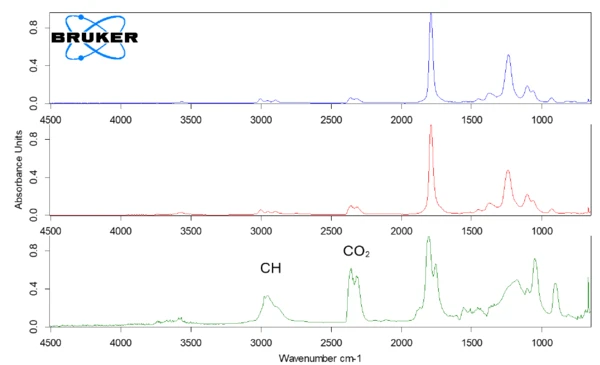
To analyze the evolved gases, they were transferred to the external gas measuring cell of the Bruker FT-IR INVENIO using a heated transfer line. The spectra obtained are shown in figure 4. The PyrolysisPyrolysis is the thermal decomposition of organic compounds in an inert atmosphere.pyrolysis of the polymer shows the same characteristics for both samples (blue and red spectrum), even if no individual components can be identified. The IR band at 1790 cm-1 indicates the release of a carbonyl function, which typically occurs in the degradation products of PLA. Presumably, many substances are released simultaneously.
The green spectrum in figure 4 shows the PyrolysisPyrolysis is the thermal decomposition of organic compounds in an inert atmosphere.pyrolysis of the wood components. In addition to the carbonyl functions, further peaks and shoulders become visible. For example, CH functionalities and CO2 were detected, which are typical for the thermal degradation of biomass samples. It can be deduced from this that the wood filler is decomposed at higher temperatures, while only the PLA base is decomposed at lower temperatures.
Conclusion
TGA-FT-IR can be used to obtain comprehensive information on the Thermal StabilityA material is thermally stable if it does not decompose under the influence of temperature. One way to determine the thermal stability of a substance is to use a TGA (thermogravimetric analyzer). thermal stability and composition of filled PLA filaments. The analysis shows the melting range of the PLA matrix and the onset of thermal Decomposition reactionA decomposition reaction is a thermally induced reaction of a chemical compound forming solid and/or gaseous products. decomposition. This data can be used to identify a safe processing window. Organic fillers, such as wood, produce volatile compounds and PyrolysisPyrolysis is the thermal decomposition of organic compounds in an inert atmosphere.pyrolysis soot during PyrolysisPyrolysis is the thermal decomposition of organic compounds in an inert atmosphere.pyrolysis, while metallic fillers leave a clear ash residue that can be used to determine the filler content.
The coupled FT-IR gas analysis enables the identification of the Decomposition reactionA decomposition reaction is a thermally induced reaction of a chemical compound forming solid and/or gaseous products. decomposition products released. This allows the material composition to be precisely evaluated and the material, including the filler type, to be clearly identified.