Introduction
The thermal analysis of cement raw materials containing silicon dioxide, calcium carbonate, calcium sulfate dihydrate, and calcium hydroxide is a key approach to investigate the complex physical and chemical transformations that take place during heating and are decisive for clinker formation.
Simultaneous TGA-DSC measurements provide a combined view of mass changes and associated thermal effects, offering a comprehensive description of the material’s overall thermal behavior across a wide temperature range. When complemented by FT-IR spectroscopy, the technique is further expanded by linking thermal events to the composition of the gases released during heating, thereby significantly increasing the interpretative value of the analysis. In particular, the direct STA-FT-IR coupling based on the PERSEUS®® concept provides clear advantages, as the FT-IR spectrometer is directly mounted on the STA furnace, resulting in a very short, heated gas path with minimal dead volume and excellent synchronization between thermal and spectroscopic signals, which is especially beneficial for the investigation of complex mineral systems. The small footprint of the coupled instrument setup fits into most lab surroundings.
Measurement Conditions
The measurement conditions are detailed in table1.
Table 1: Measurement conditions
| Instrument | NETZSCH STA Jupiter® PERSEUS® |
|---|---|
| Temperature program | RT to 1450°C |
| Heating rate | 20 K/min |
| Purge gas | Synthetic air, 70 ml/min |
| Crucible | Platinum, 85 μl, with lid and washer of Al2O3 between the crucible and the sensor |
| Sample mass | 24 mg |
Results and Discussion
In the TGA-DSC diagram shown in figure 1, a sequence of several thermal processes can be identified that are typical for cement and cement related raw material and extend over the entire temperature range up to approximately 1400°C.
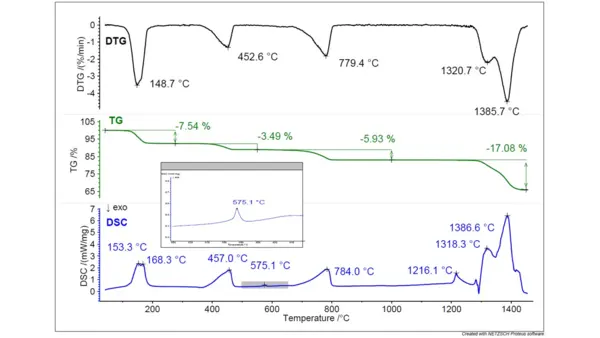
In the temperature range between 100 and 200°C, a mass loss of about 7.5% is observed in the TGA signal, accompanied by a DTG minimum at 149°C and two overlapping EndothermicA sample transition or a reaction is endothermic if heat is needed for the conversion.endothermic DSC effects with peaks at 153°C and 168°C. This region is characteristic for the release of physically bound water as well as the dehydration of calcium sulfate dihydrate to hemihydrate and/or anhydrite.
Between 400°C and 600°C, a further mass loss of approximately 3.5% occurs, associated with a DTG signal at around 453°C and an EndothermicA sample transition or a reaction is endothermic if heat is needed for the conversion.endothermic DSC peak with a peak temperature of 457°C. This behavior is typical for the dehydroxylation of calcium hydroxide, during which structurally bound water is released.
The effect observed in the DSC signal at approximately 575°C is characteristic for the reversible α–β phase transformation of quartz (SiO₂).
Between 700°C and 850°C, an additional mass loss of 5.9 % is detected, correlating with a clear DTG minimum at 779°C and an EndothermicA sample transition or a reaction is endothermic if heat is needed for the conversion.endothermic DSC signal with a peak temperature of 784°C. This step is characteristic for the thermal Decomposition reactionA decomposition reaction is a thermally induced reaction of a chemical compound forming solid and/or gaseous products. decomposition of calcium carbonate, i.e., decarbonation accompanied by the release of CO₂.
The DSC Effect at 1216°C is a hint on a Phase TransitionsThe term phase transition (or phase change) is most commonly used to describe transitions between the solid, liquid and gaseous states.phase transition, marking the formation of silicate phases.
Above approximately 1250°C, a mass loss of about 17% is observed, accompanied by several intense DSC signals with maxima at around 1318°C and 1386°C, as well as pronounced DTG peaks at 1321°C and 1386°C. Among other processes, the Decomposition reactionA decomposition reaction is a thermally induced reaction of a chemical compound forming solid and/or gaseous products. decomposition of CaSO₄ to CaO and the associated release of sulfur oxides occur in this temperature range. In addition, these effects also mark the transition from pure Decomposition reactionA decomposition reaction is a thermally induced reaction of a chemical compound forming solid and/or gaseous products. decomposition reactions to high temperature induced phase transformations and the onset of melting processes, which are typical for cement and clinker related system.
The complete IR data is shown in figure 2 in temperature- and wavenumber-dependent 3D plot. The TGA curve is plotted in red at the back and shows the correlation of the mass loss to the increase in IR intensity. For detailed evaluation of the IR data, single IR spectra were taken at different temperatures and compared to the EPA-NIST library.
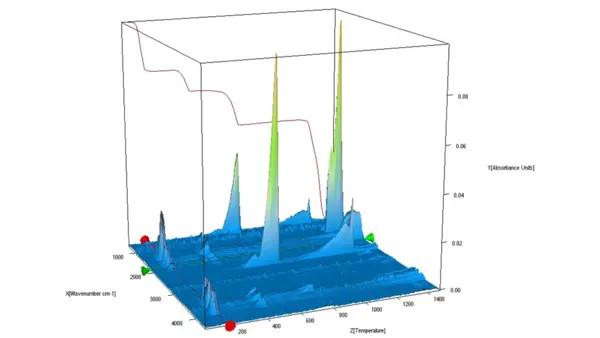
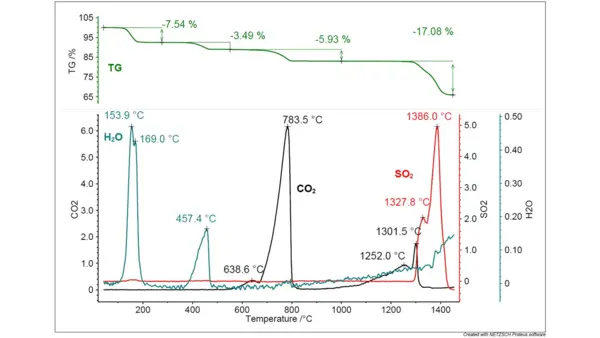
This revealed the release of water during the first two mass-loss steps, which correlates well with the dehydration of calcium sulphate and dehydroxylation of calcium hydroxide. The release of carbon dioxide was found between 550°C and 800°C due to the Decomposition reactionA decomposition reaction is a thermally induced reaction of a chemical compound forming solid and/or gaseous products. decomposition of carbonates. The last mass-loss step released SO2 from the sulphate Decomposition reactionA decomposition reaction is a thermally induced reaction of a chemical compound forming solid and/or gaseous products. decomposition. The traces of gas release can be easily correlated to the TGA curve, see figure 3.
Summary
The STA-FT-IR analysis of cement and cement related raw material enables a comprehensive characterization of the physical and chemical processes occurring during heating. By combining TGA and DSC, mass changes and the associated thermal effects are recorded simultaneously, while FT-IR coupling allows the unambiguous identification of the gases released during these processes. This makes it possible to clearly assign individual reaction steps such as dehydration, dehydroxylation, decarbonation, and sulfate Decomposition reactionA decomposition reaction is a thermally induced reaction of a chemical compound forming solid and/or gaseous products. decomposition. A key advantage of the method is the direct correlation between mass loss, thermal effects, and gas composition, which significantly reduces ambiguity in the interpretation of overlapping reactions.
STA-FT-IR therefore represents a powerful tool for the analysis and optimization of cement raw materials and clinker formation processes.