Introduction
Battery separators are key components in electrochemical energy storage systems, providing Ionic conductivity while preventing electrical contact between the electrodes. Their structure and stability directly influence the performance, durability, and safety of batteries.
Among the various separator designs, ceramic-polymer composite separators and paper-based separators have gained increasing attention for advanced applications. In ceramic-polymer composites, inorganic particles such as alumina, silica or zirconia are embedded within a polymer matrix. This hybrid structure enhances mechanical strength, electrolyte wettability, and, most importantly, Thermal StabilityA material is thermally stable if it does not decompose under the influence of temperature. One way to determine the thermal stability of a substance is to use a TGA (thermogravimetric analyzer). thermal stability. The ceramic phase acts as a heat-resistant backbone that maintains dimensional integrity under elevated temperatures, reducing the risk of shrinkage or pore collapse that could otherwise cause internal short circuits. The electron pathway is also irreversibly disconnected at these temperatures, which are well ahead of the point at which Thermal runawayA thermal runaway is the situation where a chemical reactor is out of control with respect to temperature and/or pressure production caused by the chemical reaction itself. Simulation of a thermal runaway is usually carried out using a calorimeter device according to accelerated rate calorimetry (ARC).thermal runaway may occur.
Paper-based separators, typically made of cellulose or synthetic fibers, constitute another promising class of materials. Their fibrous network provides excellent electrolyte absorption and uniform ion transport pathways. In addition, these separators are lightweight, sustainable, and can be tailored in porosity and thickness. However, their thermal and chemical robustness depends heavily on the fiber composition and possible surface modifications or coatings designed to withstand hightemperature environments.
The Thermal StabilityA material is thermally stable if it does not decompose under the influence of temperature. One way to determine the thermal stability of a substance is to use a TGA (thermogravimetric analyzer). thermal stability of both separator types is critical for safe battery operation. Under overheating or abusive conditions, separators must retain their shape and mechanical integrity to prevent electrode contact. Understanding dimensional changes and softening behavior at elevated temperatures is therefore essential for assessing safety margins.
Thermomechanical analysis (TMA) is a valuable tool for this purpose. By measuring the thermal expansion, shrinkage, or deformation of separator samples as a function of temperature, TMA provides insight into their thermal response and structural transitions. Such measurements help compare different separator formulations, guide material improvements, and ensure reliable performance under demanding thermal conditions.
Thermogravimetry (TGA) provides important information about the Thermal StabilityA material is thermally stable if it does not decompose under the influence of temperature. One way to determine the thermal stability of a substance is to use a TGA (thermogravimetric analyzer). thermal stability and Decomposition reactionA decomposition reaction is a thermally induced reaction of a chemical compound forming solid and/or gaseous products. decomposition behavior of battery separators. Understanding these processes helps identify separator formulations that resist degradation and maintain their structural integrity at elevated temperatures. TGA data therefore supports safer separator design and helps establish operating limits for reliable battery performance.
Measurement Conditions
The TGA measurement conditions are detailed in table 1 and the TMA measurement conditions are summarized in table 2.
Table 1: TGA measurement conditions
| Instrument | STA Jupiter® series |
|---|---|
| Furnace | SiC |
| Sample carrier | TGA pin, type S |
| Crucible | 300 μl, Al2O3 crucible, open |
| Sample mass | 20.26 mg (paper separator) 14.60 mg (composite separator) |
| Gas flow | 100 ml/min |
| Gas atmosphere | Inert/5% oxygen |
| Temperature program | RT - 600°C, 10 K/min |
Table 2: TMA measurement conditions
| Instrument | TMA Hyperion® series |
|---|---|
| Furnace | Steel |
| Sample holder | SiO2, tension |
| Sample length | ~ 10 mm |
| Force | 1 mN |
| Gas flow | 50 ml/min |
| Gas atmosphere | Nitrogen |
| Temperature program | RT - 400°C, 5 K/min |
Measurement Results and Discussion
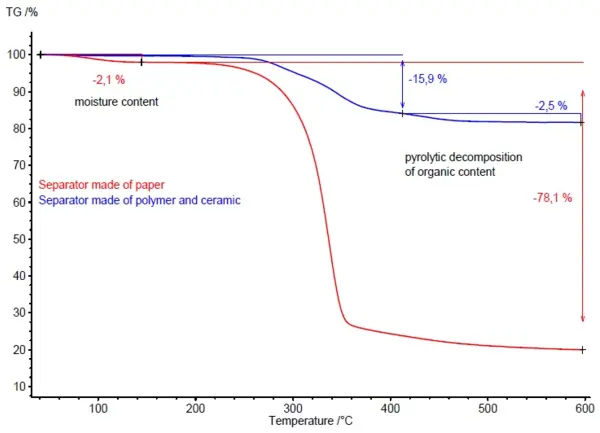
The Thermal StabilityA material is thermally stable if it does not decompose under the influence of temperature. One way to determine the thermal stability of a substance is to use a TGA (thermogravimetric analyzer). thermal stability of different separator types was investigated by TGA experiments under different conditions. Figure 1 depicts the comparison of the TGA curves of a composite separator made of polymer-coated ceramics and a paper separator under inert conditions. The paper separator shows a mass-loss step of 2.1% in the temperature range up to 150°C, which can be related to the moisture content. Both separators start to decompose above 220°C. For the paper separator, 78% of the initial mass was lost due to PyrolysisPyrolysis is the thermal decomposition of organic compounds in an inert atmosphere.pyrolysis. Only Pyrolytic CarbonPyrolytic carbon is carbon which is generated by the pyrolysis of organic matter in an oxygen-free atmosphere. pyrolytic carbon remained. In the case of the composite separator, only the polymer content was pyrolyzed (mass loss about 18%), whereas the ceramic part and the produced Pyrolytic CarbonPyrolytic carbon is carbon which is generated by the pyrolysis of organic matter in an oxygen-free atmosphere. pyrolytic carbon persisted.
In the presence of minimal oxygen content (e.g., released by Decomposition reactionA decomposition reaction is a thermally induced reaction of a chemical compound forming solid and/or gaseous products. decomposition of the cathode material), the TGA trend is significantly different from the behavior under an inert atmosphere. At 5% oxygen, the combustion of the residual carbon overlaps with the pyrolytic Decomposition reactionA decomposition reaction is a thermally induced reaction of a chemical compound forming solid and/or gaseous products. decomposition of the organic content; see figure 2.
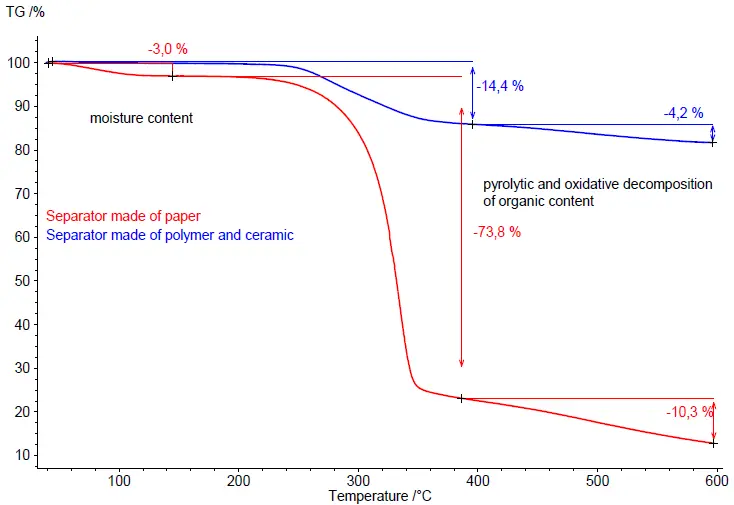
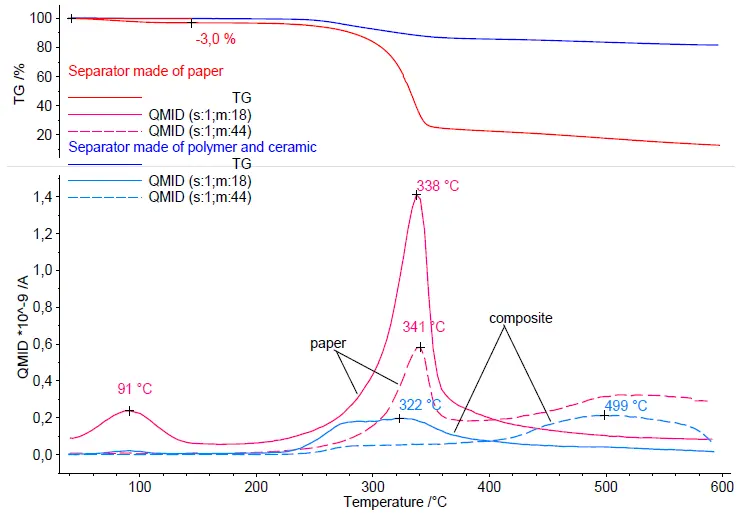
Figure 3 shows the same TGA data of the two separators in an oxygen-containing atmosphere along with the traces of H2O (m/z 18) and CO2 (m/z 44) recorded by the mass spectrometer. The evolved gas analysis proves the release of water during the first mass-loss step for the paper separator and the simultaneous release of water and carbon dioxide during the main mass-loss step.
The mechanical stability of different separator types was investigated by TMA experiments. Figure 4 depicts the comparison of the thermal expansion of the paper separator (red) and the composite separator (blue). The measurements were conducted in an inert atmosphere. The composite separator remains mechanically stable over the entire measurement. Only slight shrinkage was detected at the end of the measurement, at 400°C. In contrast to that, with the paper separator, a decrease in length is observed right at the start of the measurement.
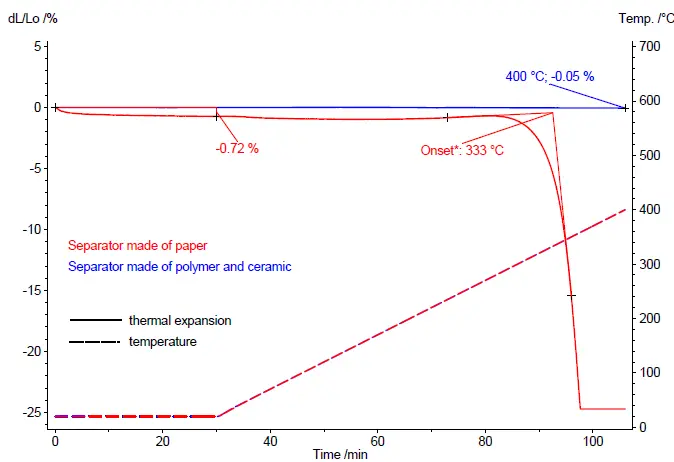
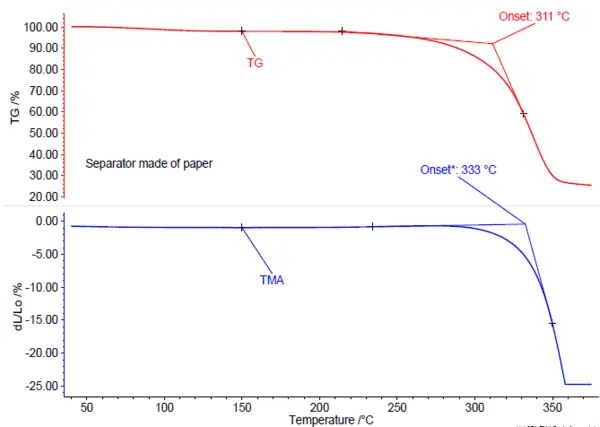
This is due to drying of the material. At higher temperatures, PyrolysisPyrolysis is the thermal decomposition of organic compounds in an inert atmosphere.pyrolysis of the organic parts of the two separators starts, leading to a loss of mechanical stability for the paper separator at 333°C (extrapolated onset). The mass loss due to PyrolysisPyrolysis is the thermal decomposition of organic compounds in an inert atmosphere.pyrolysis and the loss of mechanical stability occur in a similar temperature range, as can be seen in figure 5, which shows a comparison of the TGA and TMA curves of the paper separator.
Summary
TGA-MS and TMA measurements provide a reliable means of predicting the behavior of separators during thermal events in lithium-ion batteries, such as those caused by misuse (e.g., rapid charging/discharging; short circuits) or technical failure. In this study, the ceramic-coated polymer separator exhibited significantly greater thermal and structural stability than the paper separator, maintaining its integrity up to 400°C, whereas the paper separator lost its mechanical stability already at lower temperatures.
Additionally, TGA-MS and TMA analyses are valuable for characterizing pristine materials to identify any necessary pre-treatment steps. For the paper separator, initial shrinkage and mass loss due to moisture release were observed at the beginning of the measurement. These analytical techniques thus provide essential insights for the selection and optimization of separator materials, contributing to the overall safety and reliability of lithium-ion batteries.