Introduction
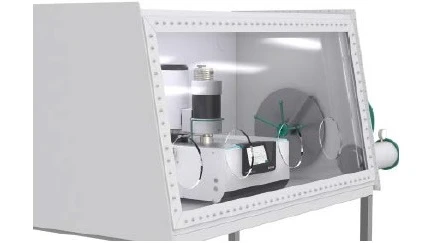
A glovebox is a sealed enclosure designed to facilitate the manipulation of materials in a controlled atmosphere. This system is essential in many scientific and industrial applications (e.g., nuclear and battery research and production) where ambient air or moisture could interfere with sensitive processes or reactive substances.
There are two primary types of glovebox systems:
- Personnel-protective systems – These operate under pressure that is lower than the surrounding atmosphere to ensure that no harmful substances escape into the environment. Examples include gloveboxes used for handling infectious agents or radioactive materials (in this case, a hot cell can be used).
- Material-protective systems – These operate under overpressure, making them ideal for working with substances that require a strictly controlled atmosphere. The overpressure prevents ambient air from entering, thereby maintaining a highly consistent and defined internal environment.
Experimental
This work focuses on the second type — a glovebox with overpressure — since this is ideally suited for thermal analysis applications involving reactive or hygroscopic materials.
In the synthesis of mixtures — such as salt — it is essential to know the precise mass and purity of each component in order to accurately produce the desired composition. Many salts, including calcium nitrate (Ca(NO₃)₂), are highly hygroscopic and readily absorb moisture from the ambient atmosphere. This absorbed water alters the effective mass and composition of the salt, leading to significant deviations in stoichiometry.
To ensure accurate composition, it is therefore necessary to purify and dry the initial compounds prior to mixture preparation. Conducting these steps under ambient conditions can introduce uncontrolled moisture, resulting in inaccurate mixing ratios and compromised material properties. Working inside a glovebox with a rigorously controlled, low-humidity atmosphere (typically <1 ppm H₂O and O₂) ensures that the materials remain dry, allowing for precise weighing and handling of hygroscopic substances throughout the entire synthesis process.
Test Results
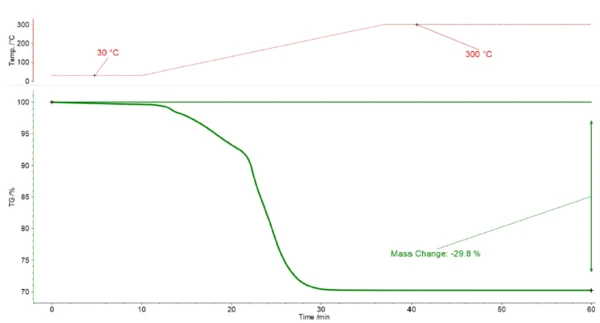
To determine the moisture content of the salt, thermogravimetric analysis (TGA) can be employed. For this purpose, Ca(NO₃)₂ · xH₂O was heated to 300°C under an inert atmosphere (N2) in a graphite crucible in a TGA instrument, where the mass loss due to water release was recorded as a function of temperature and time. The corresponding results are shown in figure 2. The mass loss amounted to 29.8%, which corresponds to the initial amount of water molecules of 3.87 moles per 1 mole of Ca(NO3)2.
To assess the rate of moisture reabsorption under ambient conditions, the crucible was briefly removed from the TGA and then immediately reinserted for a subsequent mass measurement. Despite the fact that the exposure time outside the TGA was short, a mass loss of 0.2% (relative to the initial sample mass) was still observed (see red curve in figure 3), indicating significant moisture uptake even within this brief period.
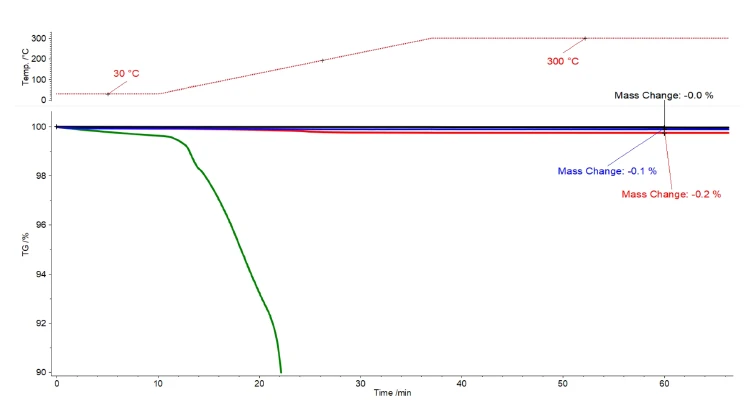
There are several ways to minimize moisture absorption during sample handling. For example, using a crucible lid with a small orifice can reduce direct contact with humid air, or alternatively, purging the crucibles on the autosampler with a dry inert gas can further reduce rehydration before measurement. These methods have been applied to the sample; the results are presented in figure 3. These measurements demonstrate that moisture uptake after a TGA measurement can be effectively minimized by using a crucible lid (0.1% mass loss) or, yet more effectively, by purging the autosampler (ASC) with a dry inert gas (0.0% mass loss).
However, these measures do not fully resolve the issue of sample storage between measurements or before further processing. For moisture-sensitive samples, storage in a desiccator is a common solution, but even more effective is storage in a glovebox under an inert atmosphere.
Operating a TGA or STA (Simultaneous Thermal Analyzer) system directly inside a glovebox offers significant advantages: It enables both precise determination of moisture content and moisture-free handling as well as storage of the sample without transferring it into ambient conditions.
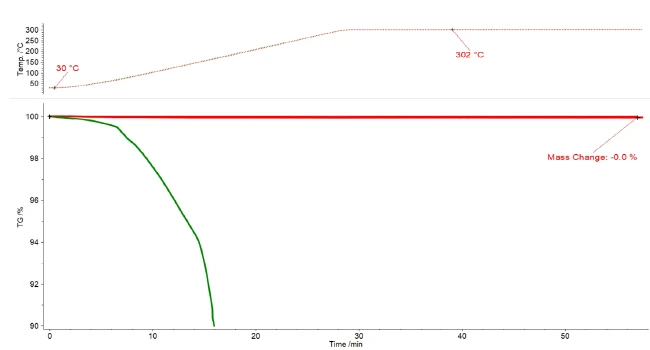
Figure 4 illustrates this approach: A second sample of Ca(NO₃)₂·xH₂O (initial mass loss: 29.5%) was dried using an STA located inside a glovebox. After the drying procedure, the crucible was left open in the glovebox atmosphere for eight days. During the remeasurement, no additional mass loss was observed, confirming the sample’s stability in the dry glovebox environment.
When using NETZSCH STA 449/509 systems, the availability of a wide range of crucible materials, sizes, and geometries allows not only for precise thermal analysis but also for drying larger material quantities, making these instruments well-suited for preparative drying steps in the synthesis of salt mixtures (figure 5). This flexibility enables researchers to tailor experimental setups to specific requirements, ensuring both analytical accuracy and practical efficiency in sample preparation.

Conclusion
The integration of a TGA or STA system into a glovebox offers clear advantages for the analysis and handling of moisture-sensitive materials. By performing thermal analysis directly within a glovebox under a dry, inert atmosphere, it becomes possible to work precisely with the mass of individual compounds such as Ca(NO₃)₂ or other hygroscopic salts as well as to store and further process the samples without any risk of rehydration.
Experimental results confirm that samples dried and stored in the glovebox remain stable over extended periods, even when left in an open crucible.
Overall, the use of TGA/STA instruments inside a glovebox is a robust and efficient approach for maintaining sample integrity throughout the entire workflow — from analysis to synthesis — especially in applications where atmospheric moisture poses a critical challenge.