Introduction
The reduction of copper oxide (CuO) powder to metallic copper (Cu) using hydrogen gas is a well-known redox reaction that plays an important role in both research and industrial applications. Technically, this process is employed in fields such as powder metallurgy, catalyst preparation, and electronic materials, where controlled reduction of metal oxides is required to obtain highpurity metals with tailored microstructures. In addition, hydrogen-based reduction processes are increasingly investigated as sustainable alternatives to carbon-based metallurgical ones, since they can significantly reduce CO₂ emissions.
Studying this reaction by simultaneous thermal analysis (STA), which combines thermogravimetry (TGA) and differential scanning calorimetry (DSC), is particularly important. STA allows precise monitoring of the mass loss associated with the oxygen release during reduction, while simultaneously detecting thermal effects.
This study, performed with the STA Jupiter®, not only monitored the reduction of CuO to Cu, but also proved the purity of the copper powder obtained, by means of further heating to the Melting Temperatures and EnthalpiesThe enthalpy of fusion of a substance, also known as latent heat, is a measure of the energy input, typically heat, which is necessary to convert a substance from solid to liquid state. The melting point of a substance is the temperature at which it changes state from solid (crystalline) to liquid (isotropic melt).melting temperature of copper.
Measurement Conditions
The measurement conditions are detailed in table 1.
Table 1: Measurement conditions
| Instrument | STA Jupiter® |
|---|---|
| Furnace | Platinum |
| Sample carrier | TG-DSC, type S |
| Sample mass | 5.11 mg |
| Crucible | Pt with Al2O3 liner and pierced lid |
| Atmosphere | Ar 95% + hydrogen 5% |
| Gas flow | 70 ml/min |
| Temperature program | RT - 1150°C |
| Heating rate | 20 K/min |
Results and Discussion
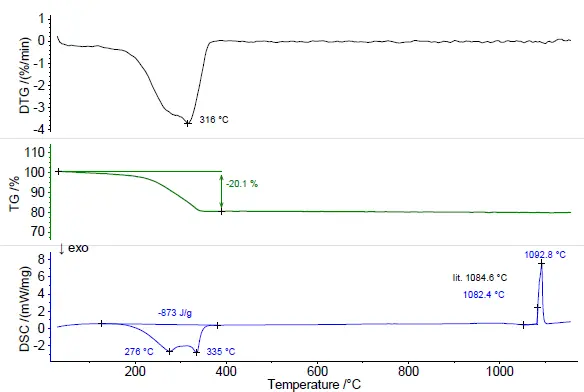
In figure 1, the TGA-DSC results of the copper reduction under hydrogen-containing atmosphere are shown. The TGA curve detected a mass loss of 20.1% between 150°C and 350°C with a peak in the mass-loss rate (DTG) at 316°C. The effect was accompanied by an ExothermicA sample transition or a reaction is exothermic if heat is generated.exothermic effect with peaks at 276°C and 334°C and a total enthalpy of 873 J/g. The mass loss precisely equalled the anticipated value derived from stoichiometric calculations:
CuO + H2 → Cu + H2O
79.5 g/mol 2 g/mol 63.5 g/mol 18 g/mol
Further heating led to a stable mass and an EndothermicA sample transition or a reaction is endothermic if heat is needed for the conversion.endothermic effect which – due to the low deviation – can be attributed to the melting of the Cu, with a Melting Temperatures and EnthalpiesThe enthalpy of fusion of a substance, also known as latent heat, is a measure of the energy input, typically heat, which is necessary to convert a substance from solid to liquid state. The melting point of a substance is the temperature at which it changes state from solid (crystalline) to liquid (isotropic melt).melting point known from literature to be 1084.6°C. The extrapolated onset temperature was found at 1082.3 °C. The sample optically changed from black powder to red agglomerates; see figure 2.

Summary
The robust STA Jupiter® series enables – in a single, well-controlled measurement under an H2-containing atmosphere – the precise capture of the full CuO → Cu transformation and, once metallic copper is formed, identification of the correct Melting Temperatures and EnthalpiesThe enthalpy of fusion of a substance, also known as latent heat, is a measure of the energy input, typically heat, which is necessary to convert a substance from solid to liquid state. The melting point of a substance is the temperature at which it changes state from solid (crystalline) to liquid (isotropic melt).melting point at about 1084°C in the same experiment. For powder-metallurgy research, these capabilities translate directly into practical advantages: rapid screening of oxide powders and additives, optimization of reduction schedules, and furnace set points with the need for only small sample quantities in the mg scale.