Introduction
Only flash systems featuring high sensitivity, an appropriate pulse width, and advanced data evaluation can accurately measure thin, highly conductive materials. The biggest challenge when measuring such material is the extremely short measurement time. This requires both a high data acquisition rate and a very low pulse width.
Copper is a perfect example for this. With a thickness of 0.3 mm up to several millimeters, it is often used as a heat spreader, substrate layer or as a structured cooling plate, where both lateral heat distribution and reliable mechanical integration are required. Typical applications can be found in power electronics, battery technology and assemblies under high thermal StressStress is defined as a level of force applied on a sample with a well-defined cross section. (Stress = force/area). Samples having a circular or rectangular cross section can be compressed or stretched. Elastic materials like rubber can be stretched up to 5 to 10 times their original length.stress, where compact design and efficient heat dissipation are crucial.
Method and Measurements Conditions
The LFA 707 StratoFlash® Classic is equipped with a laser that achieves high-energy DensityThe mass density is defined as the ratio between mass and volume. density, which is particularly necessary at high temperatures. However, when measuring thin materials, low energy input is essential to prevent damage and overheating.
Thanks to its adjustable pulse width and voltage, the LFA 707 StratoFlash® Classic can adapt the energy input to the measurement requirements. The detector features a 2 MHz-data acquisition rate, ensuring a sufficient number of data points even at the shortest measurement times.
The measurement conditions are detailed in table 1.
Table 1: Measurement conditions
| Material | Pure copper |
| Thickness | 0.32 mm to 4 mm |
| Sample holder | Ø 12.7 mm |
| Temperature | Room temperature |
| Pulse width | 100 to 600 μs |
| Model | Standard Model, based on Cape Lehmann with Pulse Correction |
Measurement Results and Discussion
Figure 1 depicts the Thermal DiffusivityThermal diffusivity (a with the unit mm2/s) is a material-specific property for characterizing unsteady heat conduction. This value describes how quickly a material reacts to a change in temperature.thermal diffusivity of copper of different thicknesses, ranging from 0.32 mm up to 4 mm. All results are within ±2.5 % compared to the literature value of approx.117 mm²/s at room temperature [1].
The pulse length was adjusted according to the thickness and measurement time, ranging from 100 μs to 600 μs. The half time (t1/2) varied over two orders of magnitudes from approx. 210 μs for the 0.32 mm sample to 24 ms for the thickest sample with 4 mm.
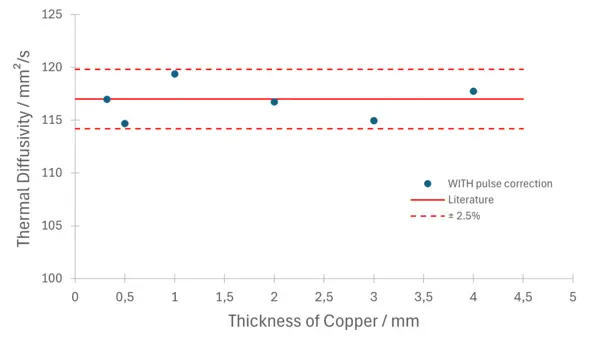
Figure 2 shows the signals for the samples of minimum and maximum thickness. The signal-to-noise ratio of both measurements is not ideal. This is due to the low energy input used to prevent overheating and the measurements being performed at room temperature. Nevertheless, the mathematical model fits the data perfectly, which is critical for achieving highly accurate results. In laser flash analysis, the mathematical models used to determine the Thermal DiffusivityThermal diffusivity (a with the unit mm2/s) is a material-specific property for characterizing unsteady heat conduction. This value describes how quickly a material reacts to a change in temperature.thermal diffusivity are based on the analytical solution of the heat conduction equation, assuming an instantaneous energy input (Dirac pulse). In reality, however, the laser pulse always has a finite duration. For samples with a relatively long measurement time, the pulse duration is typically much shorter than the characteristic measurement time, making deviations from the ideal assumption negligible (figure 2: 4 mm copper).
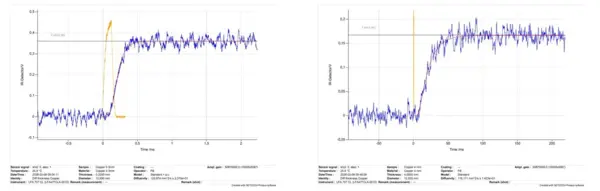
For highly conductive materials such as copper, especially when measuring thin samples, the thermal response occurs within a very short time. In such cases, the pulse duration is of the same order of magnitude as the characteristic diffusion time of the sample (figure 2: 0.32 mm copper). This leads to an overlap between the heating phase and the thermal response of the sample, which can distort the temperature curve and consequently, the calculated Thermal DiffusivityThermal diffusivity (a with the unit mm2/s) is a material-specific property for characterizing unsteady heat conduction. This value describes how quickly a material reacts to a change in temperature.thermal diffusivity.
Pulse Correction
To account for this effect, the NETZSCH LFA Proteus® analysis software automatically applies the exponential pulse correction [2]. Instead of assuming an instantaneous energy input, the real signal of the laser pulse is considered during the evaluation. This is achieved by incorporating the pulse signal through convolution, allowing the time-dependent heat input to be taken into account in the calculation of the temperature response. This way, the evaluated Thermal DiffusivityThermal diffusivity (a with the unit mm2/s) is a material-specific property for characterizing unsteady heat conduction. This value describes how quickly a material reacts to a change in temperature.thermal diffusivity reflects the actual experimental conditions rather than an idealized instantaneous pulse.
By considering the actual pulse shape during evaluation, the pulse correction significantly improves the accuracy of the Thermal DiffusivityThermal diffusivity (a with the unit mm2/s) is a material-specific property for characterizing unsteady heat conduction. This value describes how quickly a material reacts to a change in temperature.thermal diffusivity determination for thin and highly conductive samples. This becomes increasingly important as the sample thickness decreases and the thermal diffusivity increases.
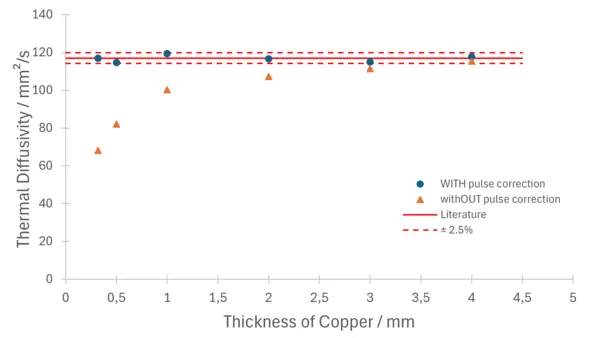
For extremely short measurement times and thus also extremely short t1/2, a robust and precise pulse correction is the most important analyzing feature. This is demonstrated in figure 3. As in figure 1, the blue dots represent the thermal diffusivity of copper with different thicknesses. In this case, the pulse correction was used for evaluation. The orange triangles represent the same measurements, but the evaluation was performed without pulse correction. Decreasing the sample thickness – resulting in shorter measurement times – leads to increased errors caused by pulse overlapping.
Conclusion
The results demonstrate that even thin, highly conductive copper samples with extremely short thermal response times can be accurately measured using the LFA 707 StratoFlash® Classic. The combination of adjustable pulse control, high-speed data acquisition and advanced pulse correction ensures reliable thermal diffusivity results even under demanding measurement conditions. This makes the LFA 707 StratoFlash® Classic a powerful solution for the characterization of materials with very high thermal diffusivity