Introduction
Graphite foils are used in many technical applications where efficient heat dissipation is required despite the material's thinness, such as in electronics, energy technology and mechanical engineering. In addition to their high thermal and chemical resistance, they are distinguished by their pronounced anisotropic thermal conducticity.
While their Thermal ConductivityThermal conductivity (λ with the unit W/(m•K)) describes the transport of energy – in the form of heat – through a body of mass as the result of a temperature gradient (see fig. 1). According to the second law of thermodynamics, heat always flows in the direction of the lower temperature.thermal conductivity perpendicular to the foil plane (through-plane) is comparatively low, they exhibit very high Thermal ConductivityThermal conductivity (λ with the unit W/(m•K)) describes the transport of energy – in the form of heat – through a body of mass as the result of a temperature gradient (see fig. 1). According to the second law of thermodynamics, heat always flows in the direction of the lower temperature.thermal conductivity in the plane (in-plane). These properties are largely production-related, e.g., due to rolling. The in-plane Thermal ConductivityThermal conductivity (λ with the unit W/(m•K)) describes the transport of energy – in the form of heat – through a body of mass as the result of a temperature gradient (see fig. 1). According to the second law of thermodynamics, heat always flows in the direction of the lower temperature.thermal conductivity enables rapid lateral heat distribution across the foil surface. This is particularly important for reducing local hotspots, as it allows localized heat sources to be efficiently dissipated. Thus, graphite foils act as heat spreaders, significantly contributing to the Thermal StabilityA material is thermally stable if it does not decompose under the influence of temperature. One way to determine the thermal stability of a substance is to use a TGA (thermogravimetric analyzer). thermal stability and reliability of modern technical systems.
Through-Plane vs. In-Plane
Accurately determining the through-plane and in-plane Thermal ConductivityThermal conductivity (λ with the unit W/(m•K)) describes the transport of energy – in the form of heat – through a body of mass as the result of a temperature gradient (see fig. 1). According to the second law of thermodynamics, heat always flows in the direction of the lower temperature.thermal conductivity is of central importance for designing many technical applications. LFA (Laser Flash Analysis) can easily and user-friendly handle this task with suitable sample holders and models. Through-plane measurements are performed using the foil sample holder, which is optimized for measuring thin samples (see figure 1, left). In-plane measurements, however, are performed using the in-plane sample holder (heat flow inward); see figure 1, right.
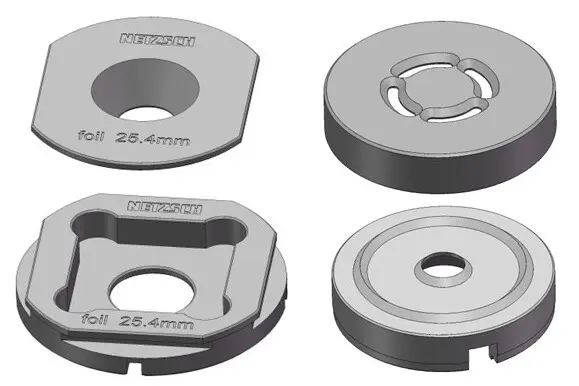
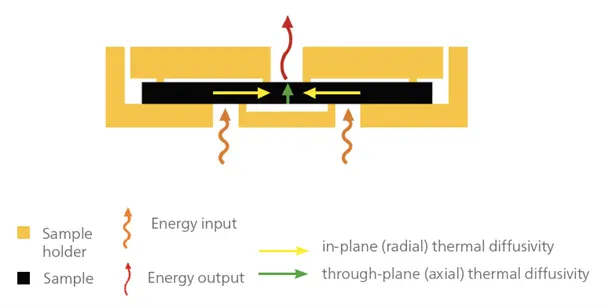
Through-plane measurements are performed perpendicular to the sample surface. In-plane measurements use ring-shaped illumination of the sample, while the temperature rise is detected at the sample center. This makes the measurement signal characteristic of heat conduction in the plane. Figure 2 shows a sketch illustrating this.
Measurement Conditions
The measurement conditions are detailed in table 1.
Table 1: Measurement conditions
| LFA system | LFA 717 HyperFlash® |
|---|---|
| Sample | Grapite foil |
| Sample thickness | 500 μm |
| DensityThe mass density is defined as the ratio between mass and volume. Density | ~ 1 g/cm³ from datasheet |
| Specific Heat Capacity (cp)Heat capacity is a material-specific physical quantity, determined by the amount of heat supplied to specimen, divided by the resulting temperature increase. The specific heat capacity is related to a unit mass of the specimen.Specific heat capacity | Literature values from POCO graphite [2] |
| Temperature program | 25 to 500°C |
| Atmosphere | nitrogen |
| Measurement direction | through-plane and in-plane |
| Sample holder | through-plane → sample holder for foils in-plane → in-plane sample holder (heat flow inward) |
| Evaluation models | through-plane → standard model based on Cape Lehman in-plane → orthotropic model |
Orthotropic Model
In order to account for the pronounced anisotropy of graphite foils during evaluation, the orthotropic model describes the Thermal DiffusivityThermal diffusivity (a with the unit mm2/s) is a material-specific property for characterizing unsteady heat conduction. This value describes how quickly a material reacts to a change in temperature.thermal diffusivity as a quantity that depends on direction, with two independent components: one that is perpendicular to the sample plane (α ), and one that is in the plane (α||). This is reflected directly in the underlying heat conduction equation.
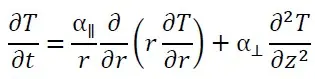
Here, z denotes the direction perpendicular to the sample surface (through-plane) und r the radial direction in the plane (in-plane). Rather than assuming uniform diffusivity in all directions, the model incorporates independent parameter values for α|| and α , enabling it to account for the actual heat propagation in anisotropic materials. When evaluating an in-plane measurement, the through-plane diffusivity, α , which was previously determined in a separate measurement, is incorporated into the calculation as a known input parameter. This allows α|| to be precisely determined.
Many commercial LFA systems exclusively use one-dimensional models to evaluate in-plane measurements. Since these models only describe the heat propagation along a single spatial direction, it is impossible to distinguish between the in-plane and through-plane diffusivity from the outset. For materials with pronounced anisotropy, such as graphite foils, this inevitably leads to underestimating the Thermal DiffusivityThermal diffusivity (a with the unit mm2/s) is a material-specific property for characterizing unsteady heat conduction. This value describes how quickly a material reacts to a change in temperature.thermal diffusivity.
Impact of the Chosen Model on the Measurement Result
Figure 3 shows the Thermal DiffusivityThermal diffusivity (a with the unit mm2/s) is a material-specific property for characterizing unsteady heat conduction. This value describes how quickly a material reacts to a change in temperature.thermal diffusivity of the graphite foil at room temperature in the through-plane and in-plane directions. The Thermal DiffusivityThermal diffusivity (a with the unit mm2/s) is a material-specific property for characterizing unsteady heat conduction. This value describes how quickly a material reacts to a change in temperature.thermal diffusivity perpendicular to the surface (through-plane) is evaluated with the standard model, based on Cape Lehman [1]. This is two orders of magnitude lower than the in-plane Thermal DiffusivityThermal diffusivity (a with the unit mm2/s) is a material-specific property for characterizing unsteady heat conduction. This value describes how quickly a material reacts to a change in temperature.thermal diffusivity. The orthotropic model is therefore used to evaluate the in-plane measurement. Upon closer examination, the distinction between isotropic and anisotropic behavior in in-plane measurements is significant.
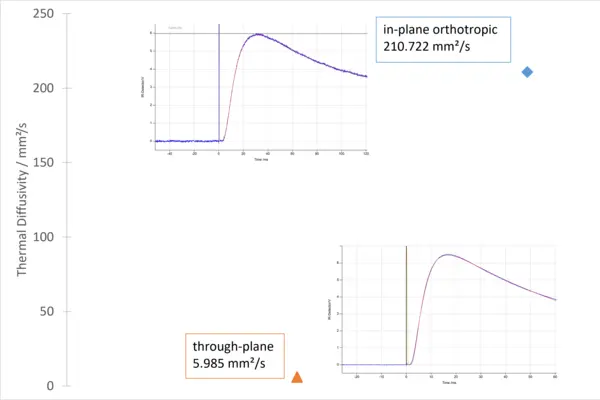
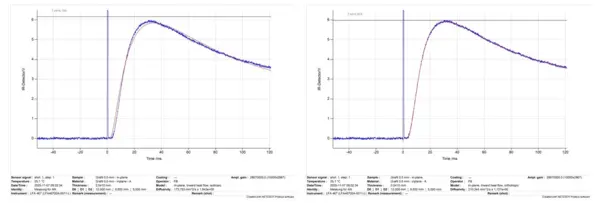
Figure 4 illustrates this clearly. Here, the measurement on the graphite foil evaluated using both the isotropic and orthotropic model. The isotropic evaluation yields significantly lower values (approx. -18%) and also shows a significantly poorer curve fit.
Thermal Conductivity as a Funtion of Temperature and Measurement Direction
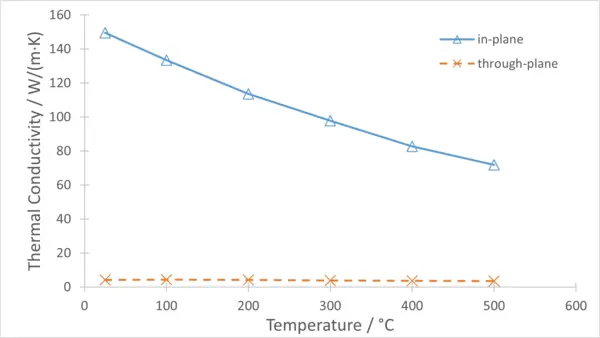
Figure 5 shows the Thermal ConductivityThermal conductivity (λ with the unit W/(m•K)) describes the transport of energy – in the form of heat – through a body of mass as the result of a temperature gradient (see fig. 1). According to the second law of thermodynamics, heat always flows in the direction of the lower temperature.thermal conductivity of the graphite foil in the through-plane and in-plane direction from room temperature to 500°C. The thermal conductivity was calculated using the Specific Heat Capacity (cp)Heat capacity is a material-specific physical quantity, determined by the amount of heat supplied to specimen, divided by the resulting temperature increase. The specific heat capacity is related to a unit mass of the specimen.specific heat capacity of POCO Graphite [2] and the DensityThe mass density is defined as the ratio between mass and volume. density at room temperature. The thermal conductivity decreases with increasing temperature in both directions. The in-plane thermal conductivity is significantly higher than the through-plane thermal conductivity.
Summary
When combined with suitable sample holders, laser flash analysis enables the reliable determination of the highly anisotropic thermal conductivity of graphite foils in both the through-plane and in-plane direction. This reveals an in-plane thermal conductivity that is orders of magnitude higher, which is crucial for the efficient distribution of heat and reduction of hotspots. To ensure an accurate evaluation, it is essential to use a model that accounts for anisotropy, as isotropic approaches significantly underestimate the properties.