Introduction
In the field of high-temperature engineering, there is an increasing demand for materials that can perform reliably even under extreme thermal conditions. Materials that can withstand high temperatures and strong temperature gradients over the long term are of particular importance. Ceramic fiber composites have established themselves as a high-performance solution in this context. They are primarily used to protect sensitive and heavily loaded components from heat. Typical applications include combustion chamber linings and structural components in the process industry.
Due to their layered structure, these materials feature pronounced direction-dependent properties. Consequently, their thermal properties can vary significantly depending on the fiber orientation. For the precise design of high-temperature components, precise understanding of the heat transport as a function of fiber alignment is therefore essential.
Method and Measurement Conditions
Laser flash analysis (LFA, measurement principle in figure 1) is used to determine the Thermal DiffusivityThermal diffusivity (a with the unit mm2/s) is a material-specific property for characterizing unsteady heat conduction. This value describes how quickly a material reacts to a change in temperature.thermal diffusivity, α, of a material. Combined with the DensityThe mass density is defined as the ratio between mass and volume. density, ρ, and the known Specific Heat Capacity (cp)Heat capacity is a material-specific physical quantity, determined by the amount of heat supplied to specimen, divided by the resulting temperature increase. The specific heat capacity is related to a unit mass of the specimen.specific heat capacity, cp, the Thermal ConductivityThermal conductivity (λ with the unit W/(m•K)) describes the transport of energy – in the form of heat – through a body of mass as the result of a temperature gradient (see fig. 1). According to the second law of thermodynamics, heat always flows in the direction of the lower temperature.thermal conductivity, λ, can be calculated (λ = α · cp · ρ).
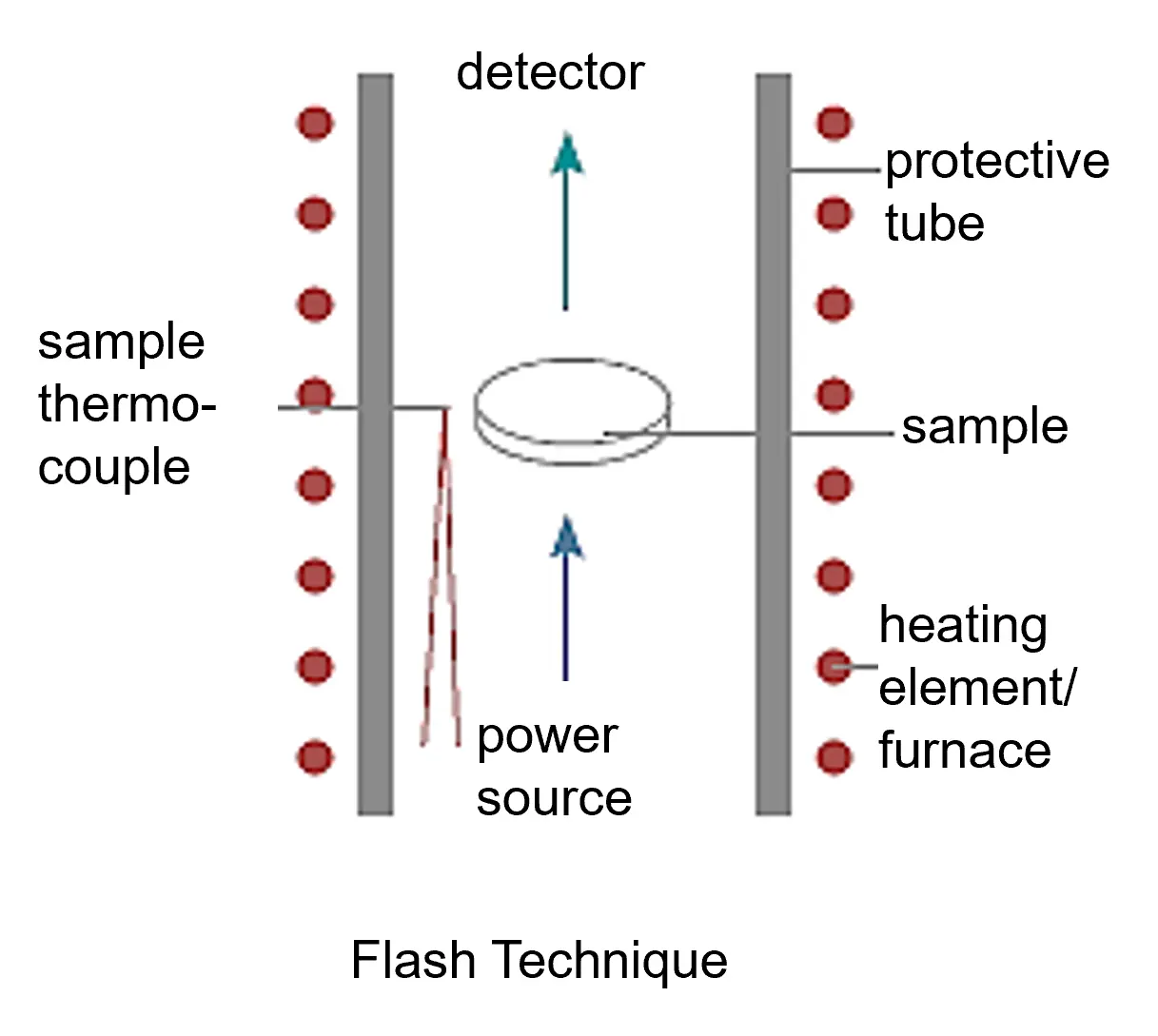
During the measurement, the bottom of the sample is heated by a short laser pulse, and the temperature increase on the opposite side is recorded by an infrared detector. The Thermal DiffusivityThermal diffusivity (a with the unit mm2/s) is a material-specific property for characterizing unsteady heat conduction. This value describes how quickly a material reacts to a change in temperature.thermal diffusivity can then be determined from the temperature curve over time using the appropriate mathematical model.
Measurements were performed on a ceramic fiber composite using the LFA 707 StratoFlash® Classic in the temperature range from room temperature to 1100°C, thus reflecting the materials‘ actual operating conditions.
Two different sample holders were used: a standard holder (figure 2) to determine the thermal properties in the through-plane direction and a lamellar sample holder to analyze the in-plane properties.
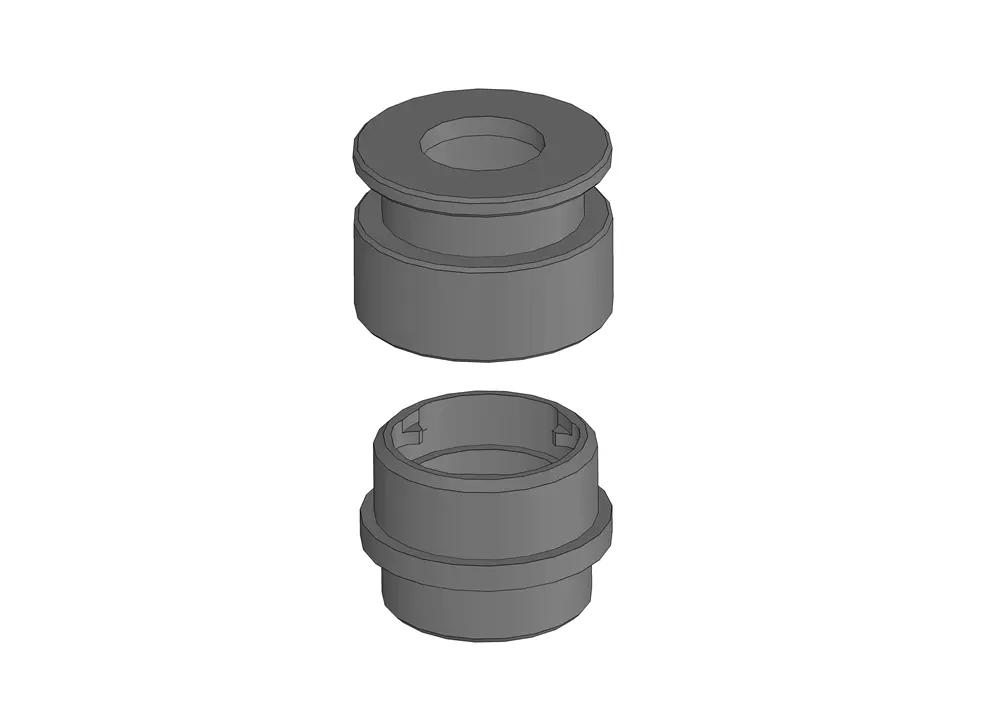
Figure 3 shows the schematics for sample preparation when using the lamellar sample holder.
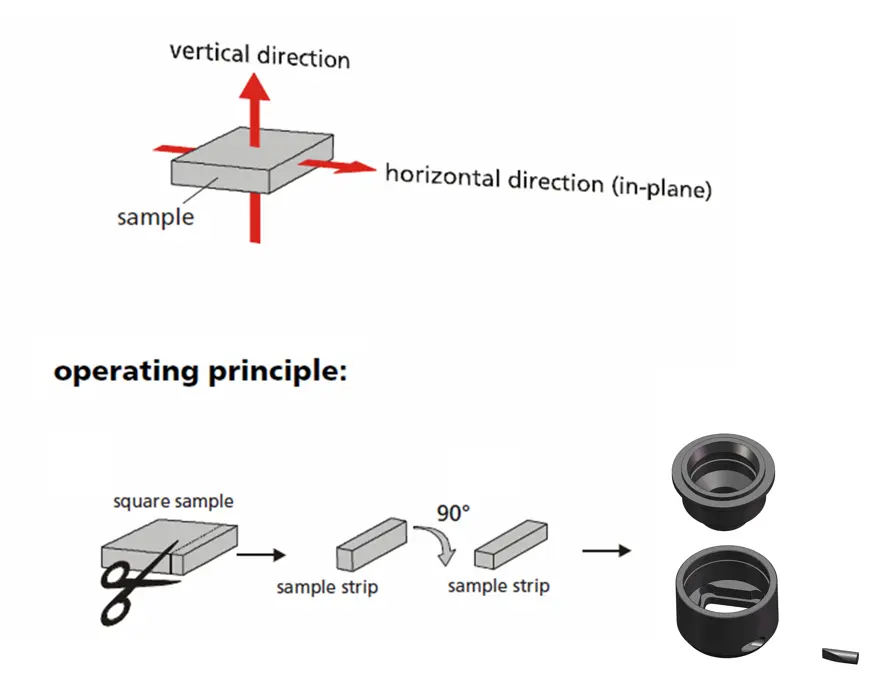
The specimen used for the through-plane measurement had a diameter of 12.64 mm and a thickness of around 2.03 mm, while the in-plane specimens were cut into strips and placed onto a lamellar sample holder with an edge length of 10 mm and a thickness of approximately 2.30 mm. The measurement parameters are detailed in table 1.
Table 1: LFA measurement conditions
| Temperature range | RT to 1100°C |
|---|---|
| Sample holder |
|
| Sample size |
|
| Coating | Graphite |
| Atmosphere | Argon |
| Heating rate | Variable up to 10 to 20 K/min |
| Energy | 650 V; 600 μs |
Results and Discussion
Figure 4 shows that the investigated fiber-reinforced composite exhibits a clearly pronounced anisotropic Thermal ConductivityThermal conductivity (λ with the unit W/(m•K)) describes the transport of energy – in the form of heat – through a body of mass as the result of a temperature gradient (see fig. 1). According to the second law of thermodynamics, heat always flows in the direction of the lower temperature.thermal conductivity profile. Even at room temperature, it is evident that the Thermal DiffusivityThermal diffusivity (a with the unit mm2/s) is a material-specific property for characterizing unsteady heat conduction. This value describes how quickly a material reacts to a change in temperature.thermal diffusivity along the fiber direction is notably higher than that perpendicular to the fiber. The difference is approximately 16%, which can be attributed to the preferential direction of the heat conduction along the fiber structure. In this direction, continuous fiber paths enable a more efficient energy transport; however, across the fiber, interfaces and structural inhomogeneities hinder heat transport more significantly.
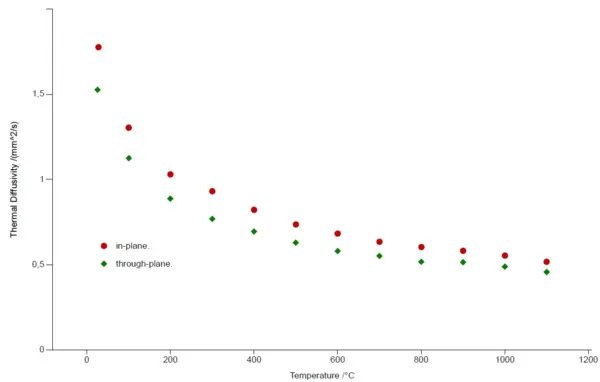
As the temperature rises, this anisotropic effect decreases slightly, with the difference between the two directions decreasing to around 13%. This suggests that additional mechanisms, such as enhanced phonon-phonon interactions, relatively weaken the influence of fiber orientation as the temperature increases.
Overall, the measurement results demonstrate that the fiber orientation significantly influences the thermal transport behavior. However, this influence becomes less pronounced at higher temperatures. The Thermal DiffusivityThermal diffusivity (a with the unit mm2/s) is a material-specific property for characterizing unsteady heat conduction. This value describes how quickly a material reacts to a change in temperature.thermal diffusivity data obtained therefore provide an essential basis for thermo-mechanical simulations. They enable a realistic representation of the behavior of these anisotropic materials and contribute significantly to the safe and efficient design and implementation of high-performance materials in industrial applications.
Summary
Laser flash analysis (LFA) enables precise determination of the Thermal DiffusivityThermal diffusivity (a with the unit mm2/s) is a material-specific property for characterizing unsteady heat conduction. This value describes how quickly a material reacts to a change in temperature.thermal diffusivity over a wide temperature range, including high operating temperatures. Using special sample holders allows for determination of the anistropy of materials.
Notably, the lamellar sample holder facilitates the investigation of the thermal diffusivity in the in-plane direction, complementing the traditional through-plane measurement. This makes it possible to measure anisotropic thermal properties experimentally, even at elevated temperatures. This is essential for understanding direction-dependent heat conduction mechanisms and for the realistic design of high-performance materials.