Introduction
Refractories are essential for high-temperature processes as they protect equipment used in steel, glass, ceramics, cement, chemical and energy engineering from extreme temperatures, aggressive substances and mechanical StressStress is defined as a level of force applied on a sample with a well-defined cross section. (Stress = force/area). Samples having a circular or rectangular cross section can be compressed or stretched. Elastic materials like rubber can be stretched up to 5 to 10 times their original length.stress. They are used, for example, as linings in furnaces, reactors and melting tanks. A key material property in this context is the Thermal ConductivityThermal conductivity (λ with the unit W/(m•K)) describes the transport of energy – in the form of heat – through a body of mass as the result of a temperature gradient (see fig. 1). According to the second law of thermodynamics, heat always flows in the direction of the lower temperature.thermal conductivity. It significantly determines how much heat is transferred to the surroundings, directly influencing the energy efficiency of the process. Furthermore, the Thermal ConductivityThermal conductivity (λ with the unit W/(m•K)) describes the transport of energy – in the form of heat – through a body of mass as the result of a temperature gradient (see fig. 1). According to the second law of thermodynamics, heat always flows in the direction of the lower temperature.thermal conductivity has a significant effect on thermal stresses and consequently on the service life of the materials.
Refractories are inhomogeneous materials consisting of a matrix with embedded particles. When determining thermophysical properties such as the Thermal ConductivityThermal conductivity (λ with the unit W/(m•K)) describes the transport of energy – in the form of heat – through a body of mass as the result of a temperature gradient (see fig. 1). According to the second law of thermodynamics, heat always flows in the direction of the lower temperature.thermal conductivity, the following applies: The larger the sample, the more representative it is.
Determining the Thermal ConductivityThermal conductivity (λ with the unit W/(m•K)) describes the transport of energy – in the form of heat – through a body of mass as the result of a temperature gradient (see fig. 1). According to the second law of thermodynamics, heat always flows in the direction of the lower temperature.thermal conductivity of refractory materials presents a challenge to many measurement systems. This is due to two factors: the relatively high temperatures, typically exceeding 1000°C, and the inhomogeneity of the materials.
Method and Measurements Conditions
The LFA 707 StratoFlash® Classic can analyze samples with a diameter of up to 25.4 mm, even at high temperatures. The LFA method primarily determines the Thermal DiffusivityThermal diffusivity (a with the unit mm2/s) is a material-specific property for characterizing unsteady heat conduction. This value describes how quickly a material reacts to a change in temperature.thermal diffusivity (α), and along with the DensityThe mass density is defined as the ratio between mass and volume. density (ρ) and the Specific Heat Capacity (cp)Heat capacity is a material-specific physical quantity, determined by the amount of heat supplied to specimen, divided by the resulting temperature increase. The specific heat capacity is related to a unit mass of the specimen.specific heat capacity (cp), the Thermal ConductivityThermal conductivity (λ with the unit W/(m•K)) describes the transport of energy – in the form of heat – through a body of mass as the result of a temperature gradient (see fig. 1). According to the second law of thermodynamics, heat always flows in the direction of the lower temperature.thermal conductivity (λ) is calculated using the following formula:
λ = α · cp · ρ
In the LFA method, the front surface of a sample is heated using a short energy pulse from a laser. The temperature increase on the back of the sample is then detected by an infrared (IR) detector. Mathematical models are then used to calculate the thermal conductivity based on this temperature increase.
The Specific Heat Capacity (cp)Heat capacity is a material-specific physical quantity, determined by the amount of heat supplied to specimen, divided by the resulting temperature increase. The specific heat capacity is related to a unit mass of the specimen.specific heat capacity can also be determined when the sample is analyzed alongside a reference sample. The most common method for determining the Specific Heat Capacity (cp)Heat capacity is a material-specific physical quantity, determined by the amount of heat supplied to specimen, divided by the resulting temperature increase. The specific heat capacity is related to a unit mass of the specimen.specific heat capacity at high temperatures is differential scanning calorimetry (DSC). However, typical sample sizes, with a diameter of 5 mm and a thickness of 1 mm, are not representative of refractories.
Using the large samples of the LFA 707 StratoFlash® Classic, with diameters of 25.4 mm, it is not only possible to determine the Thermal DiffusivityThermal diffusivity (a with the unit mm2/s) is a material-specific property for characterizing unsteady heat conduction. This value describes how quickly a material reacts to a change in temperature.thermal diffusivity, but also the Specific Heat Capacity (cp)Heat capacity is a material-specific physical quantity, determined by the amount of heat supplied to specimen, divided by the resulting temperature increase. The specific heat capacity is related to a unit mass of the specimen.specific heat capacity on a representative sample using the comparative method in accordance with ASTM E 1461.
The measurement conditions are detailed in table 1.
Table 1: Measurement conditions
| Material | 2 refractory materials on an MgO- and Al2O2- basis (thickness: approx. 3 mm) |
| Sample holder | Ø 25.4 mm, graphite |
| Temperature program | RT - 1400°C with 2 heatings |
| Sample size | Corresponding to material, one sample with Ø 25.4 mm and a thickness of ~3 mm, planparallel faces |
| Coating | Graphite |
| Reference for cp | POCO graphite |
| Atmosphere | Ar |
| Heating rate | variable up to 20 K/min |
| Energy | 600 V; 600 μs |
Results and Discussion
Figure 1 shows the Specific Heat Capacity (cp)Heat capacity is a material-specific physical quantity, determined by the amount of heat supplied to specimen, divided by the resulting temperature increase. The specific heat capacity is related to a unit mass of the specimen.specific heat capacity of two refractory materials (MgO- and Al2O3-based) at temperatures ranging from room temperature to 1400°C. As expected, the specific heat capacity increases with rising temperatures. There is no significant difference apparent between the first and second heating cycles (within ±5%). This highlights the chemical stability of the sample (no Decomposition reactionA decomposition reaction is a thermally induced reaction of a chemical compound forming solid and/or gaseous products. decomposition and/or outgassing across the temperature range).
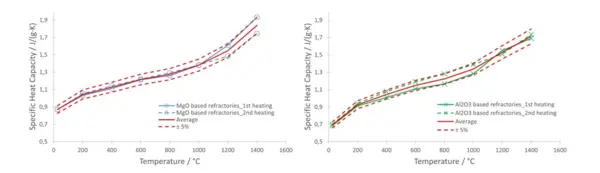
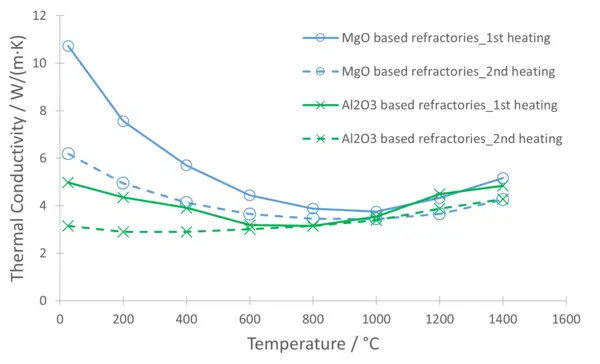
Figure 2 shows the thermal conductivity of the two materials, calculated using the aforementioned formula. In contrast to the specific heat capacity, clear differences are evident between the first and second heating cycles. These differences are likely due to structural changes within the sample (e.g., solid-solid Phase TransitionsThe term phase transition (or phase change) is most commonly used to describe transitions between the solid, liquid and gaseous states.phase transitions and/or formation of microcracks).
Summary
The LFA 707 StratoFlash® Classic is ideal for determining the thermal conductivity of inhomogeneous materials such as refractory materials due to its temperature range of up to 1600 °C and its capacity to accommodate large samples with a diameter of up to 25.4 mm. The device can also representatively determine the specific heat capacity. The resulting thermal conductivity is essential for designing and sizing equipment for high-temperature processes.