Introduction
Thermogravimetric analysis (TGA) is widely used to study reduction/OxidationOxidation can describe different processes in the context of thermal analysis.oxidation cycles of metal oxides/metals for carbon-neutral energy applications. Studies [Chen et al., 2024; Cerciello et al., 2024] have shown that repeated reduction/OxidationOxidation can describe different processes in the context of thermal analysis.oxidation cycles with hydrogen in controlled atmospheres can lead to structural changes of the metals and metal oxides that affect reactivity. The results of these papers provide insights into structural changes under non-IsothermalTests at controlled and constant temperature are called isothermal.isothermal and IsothermalTests at controlled and constant temperature are called isothermal.isothermal conditions, revealing the effect of temperature and gas composition on reaction kinetics. Moreover, hydrogen’s role in advanced metallurgical processes has been explored, particularly in the direct reduction of iron ore [Abanades & Rodat, 2024]. The experiments utilized a NETZSCH STA 449 F3 Jupiter®® system for IsothermalTests at controlled and constant temperature are called isothermal.isothermal and non-IsothermalTests at controlled and constant temperature are called isothermal.isothermal TGA measurements at temperatures from 400°C to 1000°C with different concentrations of H2 (up to 50%) in a mixture with Ar. The study successfully demonstrates that hydrogen is a highly effective reductant for Fe₂O₃, achieving complete conversion to metallic iron under controlled experimental conditions. The reduction process begins at 370°C to 400°C and accelerates significantly above 800°C, confirming that hydrogen reduction can operate at relatively moderate temperatures compared to traditional carbon-based processes.
As we have already discussed in the previous part [Rosenschon et. al. – Application Note 388], the reduction of iron(III) oxide (Fe₂O₃) in a hydrogen-containing atmosphere proceeds through a series of well-defined steps strongly influenced by temperature. Thermodynamic predictions indicate the following sequence: Fe₂O₃ → Fe₃O₄ (magnetite) → FeO (wüstite) → Fe, with a total theoretical mass loss of about 30%. The formation of intermediate phases is temperature-dependent; in particular, wüstite (FeO) is only stable above approximately 570°C. At lower temperatures, the reduction bypasses this phase, leading to a direct conversion from magnetite to metallic iron.
In this application note, we demonstrate how the hydrogen concentration affects the reduction kinetics of iron oxide (Fe₂O₃, hematite) at 1000°C. By mixing hydrogen with argon, three distinct concentrations were established (10%, 50%, and 100%).
Instrumentation
The measurements were carried out using the STA 4491 equipped with an SiC furnace, a TGA sample holder (type P), and an open Al₂O₃ crucible. Safe operation under hydrogen-containing atmospheres, including up to 100% H₂, was ensured by the H₂Secure box. This system features a centralized control unit for gas regulation, continuous H₂ and O₂ monitoring, and a fail-safe mechanism that automatically purges hydrogen with inert gas in the event of malfunction.
All four samples were heated from room temperature to 1000°C under a 100% argon atmosphere, followed by a 10-minute IsothermalTests at controlled and constant temperature are called isothermal.isothermal step. The corresponding hydrogen concentration (10%, 50%, and 100%) was then introduced for an additional IsothermalTests at controlled and constant temperature are called isothermal.isothermal stage of sufficient duration to ensure the complete reduction of Fe₂O₃ to metallic iron.
1Experiments were conducted using the previous version (STA 449) of the STA 509 instrument series which is fully compatible with the current version and provides comparable accuracy and result quality.
Experimental Results and Discussion
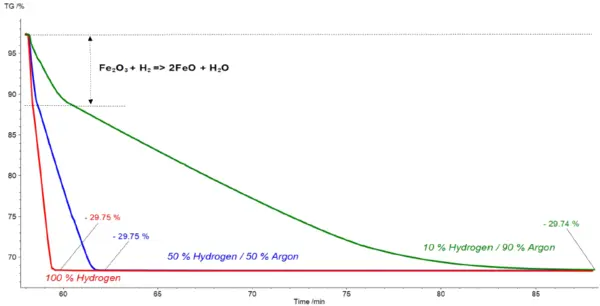
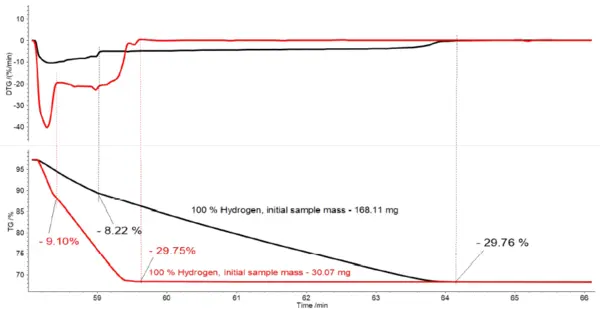
Two main stages of reduction reaction can be observed based on the TGA curves (figures 1 and 2), which can be summarized as follows:
Fe2O3 + H2 => 2FeO + H2O – the theoretical mass loss of O2 is 10.02%, calculated from stoichiometry.
FeO + H2 => Fe + H2O – the theoretical mass loss of O2 22.27%, calculated from stoichiometry.
The total mass loss related to the initial mass of Fe2O3 should be 30.06%.
As shown in table 1, the total mass loss for all four samples is 29.75 ± 0.01%, deviating by only 0.31% from the theoretical value. This deviation can be attributed to minor impurities in the initial Fe₂O₃. It should be noted that during the first heating of all four samples from room temperature to 1000°C under 100% of argon, the mass loss was around 2.75% ± 0.07% (table 1), which can be related to absorbed water and formed iron hydroxide. Therefore, all values were recalculated based on the mass of purified Fe2O3 (table 1).
Table 1: Thermogravimetric results of the reduction reaction of iron oxide (Fe2O3) to pure iron (Fe) with varying hydrogen concentrations of 10%, 50%, and 100% in a mixture with argon and different sample masses.
H2 [%] | Mass loss by 1st heating to 1000°C [%] | Mass loss of purified Fe2O3 [mg] | Mass loss related to the 1st stage of reduction reaction [%] | Mass loss at 1000°C [%] | Time at 25% of mass loss |
|---|---|---|---|---|---|
| 10 | 2.68 | 29.28 | 8.71 | 29.74 | 16 min 0 sec |
| 50 | 2.72 | 29.28 | 8.88 | 29.75 | 2 min 49 sec |
| 100 | 2.75 | 29.24 | 9.10 | 29.75 | 1 min 9 sec |
| 100 | 2.82 | 163.36 | 8.22 | 29.76 | 4 min 36 sec |
Reduction Kinetics
- At 100% hydrogen, the reduction process is significantly faster, as evidenced by steeper slopes in the measurement curves. This indicates a rapid and efficient conversion rate of iron oxide to metallic iron at this temperature. It should be noted that by increasing the initial mass from 30 mg to 168 mg, the reduction tie changes from 1 min to 4.5 min (figure 2, table 1).
- With lower hydrogen concentrations (50% and 10%), the reduction rate slows noticeably, reflected by more gradual slopes in the curves.
- All four TGA curves (figures 1 and 2) show a change in the mass-loss rate at around 8% – 9%, corresponding to the formation of FeO or the solid solution phase between Fe3O4 and FeO, according to the existing phase diagram for this system [Zhang, 2023]. This value slightly deviates from the theoretical mass change for this stage (10.02%), possibly due to overlapping with the next stage of the reduction reaction.
- The change in slope during the second stage of the reduction reaction indicates a slower, more energy-consuming process than the first stage.
Summary
The reduction of Fe₂O₃ is governed by several critical parameters, including temperature, hydrogen concentration, surface area, and sample mass. Under IsothermalTests at controlled and constant temperature are called isothermal.isothermal conditions at 1000°C in a hydrogen atmosphere, two dominant reduction stages are observed in the TGA curves. This observation is consistent with previous findings [Rosenschon et al., Application Note 388], where similar behavior was reported at 1000°C under a 4% H₂/N₂ mixture.
Reaction efficiency increases significantly with hydrogen concentration and decreases with larger sample mass. At 100% H₂, the reduction proceeds extremely rapidly, making it difficult to resolve intermediate steps due to the high reaction rate. Nevertheless, the transient formation of FeO and its subsequent reduction to metallic Fe emphasize the complexity of the underlying kinetics. These insights are essential for optimizing hydrogen-based reduction processes in metallurgical applications, balancing reaction speed with control over intermediate phases.
The NETZSCH STA 509/449 series, combined with the H₂Secure system, provides a robust platform for such investigations. It enables precise thermogravimetric and calorimetric measurements under controlled hydrogen-rich and mixed-gas atmospheres while ensuring maximum operational safety. This advanced setup supports a wide range of applications, including redox cycle studies, catalyst optimization, and the development of hydrogen-based technologies for metallurgy and energy storage.