Introduction
Iron and its alloys are the most economically important group of metallic materials [1]. After processing or purifying iron ore, the resulting iron oxide is reduced to pig iron in blast furnaces at temperatures of up to 2000°C [2]. This process is a major source of CO₂ emissions, significantly contributing to greenhouse gas output. However, compared to conventional reduction with coke, hydrogen-based reduction produces water or water vapor as a by-product, rather than CO2. A growing number of research and development initiatives are focusing on transitioning from conventional, carbon-based iron reduction in blast furnaces to hydrogen-based alternatives. While the use of natural gas in direct reduction processes is often considered an interim solution, green hydrogen offers a more sustainable long-term approach with significantly greater potential for reducing CO₂ emissions [3–5].
Another reason for the growing interest is the emergence of new fields of research related to iron oxide reduction, such as using iron as an oxygen and/or energy storage medium. Numerous innovative application studies are focusing on the thermochemical reduction and reoxidation of iron and iron oxide. [6].
As a result, the number of applications for thermal analysis in a hydrogen atmosphere has increased significantly in recent years. In this application note, we demonstrate the potential of qualitative and quantitative thermogravimetric analysis.
Reduction of Iron Oxide in a Hydrogen Atmosphere
The starting material for producing pig iron is iron ore, which consists mainly of iron oxides, as well as rock material and iron carbonates. Starting with iron(III) oxide (Fe₂O₃), also known as hematite, reduction with hydrogen (H₂) takes place in several temperature-dependent steps. Table 1 provides an overview of these steps, as described by Spreitzer and Schenk [3] and Fradet et al. [4], alongside the respective percentage mass losses relative to Fe₂O₃. These steps were calculated based on phase diagrams (under equilibrium conditions) of FeO from the FTOxid database in FactSage software [3]. According to this phase diagram, the wüstite phase (Fe(1-x)O) is only stable at temperatures above 570°C. Therefore, the reduction of Fe₂O₃ below this temperature can be represented by two stages (reactions 1 and 1a in Table 1). First, magnetite (Fe₃O₄) forms from hematite (reaction 1), and then Fe₃O₄ reduces directly to Fe (reaction 1a). At temperatures above 570°C, wüstite (FeO) can form, which would ultimately be reduced to pure iron (Fe) (reactions 2b and 3). Water (H₂O) is produced as a by-product in each reaction step, resulting in a characteristic mass loss. Theoretically, the mass loss when starting with pure Fe₂O₃ can be around 30%.
Table 1: Reduction steps of Fe2O3 to pure iron in a hydrogen atmsophere according to Spreitzer and Schenk [3]
| Steps and temperature range | Reaction | Theoretical mass loss referring to Fe2O3 |
|---|---|---|
| 1 | 3Fe2O3 + H2 → 2Fe3O4 + H2O | 3.3% |
| 2a (>570°C) | Fe3O4 + H2 → 3FeO + H2O | 6.7% |
| 2b (<570°C) | Fa3O4 + 4H2 → 3Fe + 4H2O | 26.7% |
| 3 (>570°C) | FeO + H2 → Fe + H2O | 20.0% |
Methodology
This Application Note examines the reduction of Fe₂O₃ powder in a simultaneous thermal analyzer (NETZSCH STA) under a hydrogen-containing atmosphere at different constant temperatures. Thermogravimetric analysis is performed using a sample holder and aluminum oxide crucibles with a volume of 85 μl. The sample mass is 30 ± 0.5 mg in each case. To remove any possible impurities, the samples are initially heated to 600°C in a nitrogen atmosphere. The Fe₂O₃ powder is then held at various isotherms (390°C, 700°C and 1000°C) in a 4-% hydrogen (H₂) and 96-% nitrogen (N₂) atmosphere until the reduction process is complete.
H2Secure System
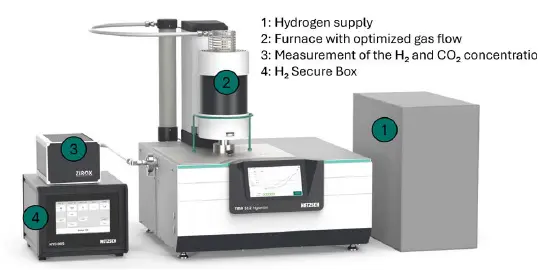
The NETZSCH H2Secure system (figure 1), which is available for the STA, ensures safe operation even in hydrogen atmospheres of up to 100% during the measurement. The system includes a central control unit for the precise, real-time monitoring of H₂ and O₂ concentrations. In the event of malfunction, a safety mechanism is automatically activated to displace the hydrogen with inert gas. An optimized gas flow ensures an even distribution of the gas atmosphere over the sample. Additionally, an internal pressure sensor monitors overpressure limits in the furnace and measuring chamber, enabling early leak detection and enhancing safety and system integrity.
Experimental Results
Figure 2 shows the measurement results for Fe₂O₃ powder in a 4-% hydrogen atmosphere at an IsothermalTests at controlled and constant temperature are called isothermal.isothermal temperature of 390°C. The upper part of the diagram shows the percentage mass loss, while the lower part shows the DTG signal, which reflects the mass loss rate.
The initial mass signal value of 97.6% indicates that approximately 2.4% of the sample's mass was lost during previous heating under an inert atmosphere (not shown here). This mass loss is due to the thermal Decomposition reactionA decomposition reaction is a thermally induced reaction of a chemical compound forming solid and/or gaseous products. decomposition of iron carbonates, hydroxides and other impurities, such as adsorbed water. A comparable mass loss was observed in all examined samples. In the following diagrams, the mass losses have been corrected accordingly.
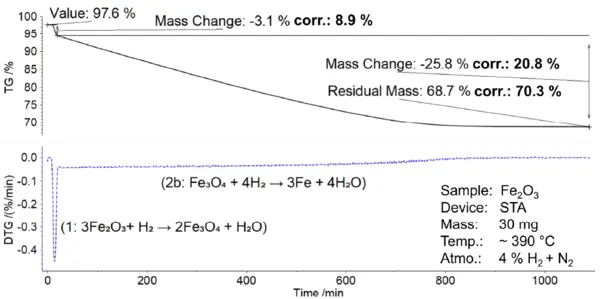
At a temperature of 390°C, the thermogram shows two distinct mass-loss steps, corresponding to the reduction steps listed in table 1. In the first step, Fe₂O₃ is converted to Fe₃O₄ (magnetite) 1. The experimentally determined mass loss is 3.2%, which is in good agreement with the theoretical value of 3.3%. Since the intermediate phase, FeO (wüstite), is thermodynamically unstable below 570°C, reduction to pure iron occurs directly in the subsequent step (table 1, reaction 2a). The mass loss of 26.4% observed in this process also corresponds well with the calculated theoretical value of 26.7%. Minor deviations can be attributed, among other things, to a starting sample that is not completely pure.
Complete reduction of the Fe₂O₃ powder takes approximately 800 minutes, as confirmed by the absence of further mass changes during the IsothermalTests at controlled and constant temperature are called isothermal.isothermal holding period. It should be noted that the times given refer to the specific measurement conditions of the example shown, which are influenced by various factors, including general test parameters such as the initial weight and sample-specific properties such as the particle size of the powder.
Subsequent comparisons are therefore based on consistent measurement parameters.
Increasing the IsothermalTests at controlled and constant temperature are called isothermal.isothermal temperature to 700°C causes the reduction of Fe₂O₃ to proceed via an intermediate step involving the formation of the FeO (wüstite) phase. As can be seen in figures 3 and 4, three distinct steps can be observed in both the TGA and DTG signals. Similarly to the measurement at 390°C, magnetite (Fe₃O₄) is initially formed, accompanied by a measured mass loss of 3.2% (theoretical value: 3.3%). Then, FeO (wüstite) forms, accompanied by an additional mass loss of 6.2% (theoretical value: 6.7%). Finally, FeO is reduced to pure iron, resulting in a mass loss of approximately 20.5% (theoretical value: 20.0%). These deviations from the theoretically expected values are due not only to the fact that the starting material is not completely pure, but also to overlapping reaction steps, which make it difficult to precisely separate the individual effects. Compared to the measurement at 390°C, which took around 800 minutes to completely reduce, the process at 700°C is complete in approximately 80 minutes.

As shown in figure 4, if the reduction is carried out at 1000°C, the process is even faster and is already complete after around 50 minutes, as in the example shown.

Unlike the results at 700°C, there is a pronounced overlap of the first two reaction stages at 1000°C: the conversion of hematite to magnetite, followed by the formation of wüstite. Overall, an approximate mass loss of 8.9% is measured (theoretical value: 10.0%). It is not possible to separate the two steps under these measurement conditions. In the final step, the wüstite formed is reduced to pure iron, accompanied by a mass loss of 20.8% (theoretical value: 20.0%). It should be noted that the remaining residual mass is consistently in the range of 70.3% to 70.4% for all measurements. This indicates the homogeneity of the powder under investigation and corresponds very well to the theoretically expected complete mass loss of 30%.
Summary
The hydrogen reduction of iron oxide is considered a promising alternative to the CO₂-intensive blast furnace process used in steel production. This application note analyzes the reduction of iron(III) oxide (Fe₂O₃) in a hydrogen-containing atmosphere using thermogravimetry, evaluating the influence of different IsothermalTests at controlled and constant temperature are called isothermal.isothermal temperatures on the reaction process. This method enables the synthesis and analysis of compounds with different OxidationOxidation can describe different processes in the context of thermal analysis.oxidation states. By varying the IsothermalTests at controlled and constant temperature are called isothermal.isothermal reaction temperature specifically, different reduction processes can be initiated and the individual phases separated. Other factors that can be investigated include the:
- H2 concentration
- Temperature profile
- Structure and composition
- Geometry and particle size of a sample
The NETZSCH H2Secure system, which is available for STA, ensures safe operation during the measurement, even in hydrogen atmospheres of up to 100%. This method enables detailed observation of the mass loss during the reaction. The results demonstrate that temperature significantly influences the individual conversion steps, the speed of the overall reduction and the underlying reaction mechanisms — providing an important basis for a better understanding of, and more specific optimization of, industrial processes.