
27.02.2026 by Aileen Sammler
How to Detect Plasticizers in Toys and Sporting Goods with TGA-FT-IR
Beyond Peaks and Curves: Application Insights by NETZSCH and Bruker
The Monthly Blog Series with Bruker Optics – Part 2:
Detection of plasticizers in sporting goods and toys using TGA-FT-IR: Learn how evolved gas analysis enables reliable identification of polymer additives during thermal Decomposition reactionA decomposition reaction is a thermally induced reaction of a chemical compound forming solid and/or gaseous products. decomposition.
How Combined Thermal Analysis and Infrared Spectroscopy Reveal Hidden Additives
Plasticizers play a critical role in polymer-based consumer products such as sporting goods, toys, and flexible plastic components. They improve flexibility, processability, and durability. However, they can also pose regulatory, safety, and quality challenges if their type or concentration is unknown or uncontrolled.
In the second part of our blog series “Beyond Peaks and Curves: Application Insights by NETZSCH und Bruker”, we focus on how thermogravimetric analysis coupled with FT-IR spectroscopy (TGA-FT-IR) allows for reliable detection and identification of plasticizers in complex polymer matrices.
Why Plasticizer Identification Matters
Sporting goods and toys are often subject to strict regulations regarding material composition, especially when products are intended for children or frequent skin contact. Plasticizers may migrate over time or evaporate during processing or under thermal StressStress is defined as a level of force applied on a sample with a well-defined cross section. (Stress = force/area). Samples having a circular or rectangular cross section can be compressed or stretched. Elastic materials like rubber can be stretched up to 5 to 10 times their original length.stress, potentially affecting both product performance and safety.
Traditional thermal analysis methods such as thermogravimetric analysis (TGA) can precisely measure the mass loss during heating. However, TGA alone cannot identify, which substances are released. This is where evolved gas analysis (EGA) becomes essential.
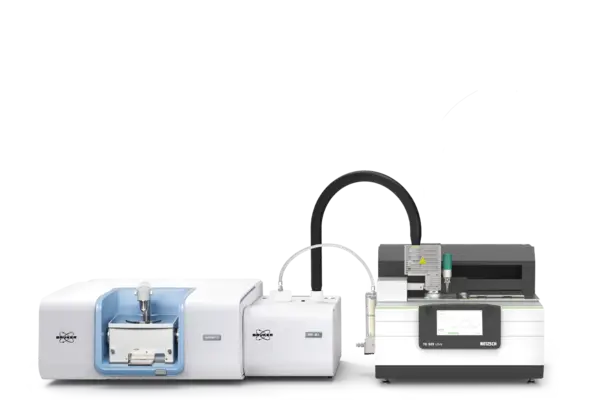
TGA-FT-IR: Understanding Not Only When, but also Why
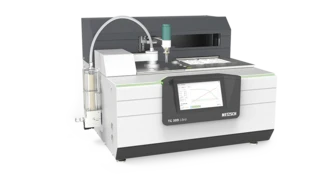
By coupling a NETZSCH thermogravimetric analyzer with a BrukerFourier Transform Infrared Spectrometer (FT-IR), mass loss events can be directly correlated with the chemical nature of the gases evolved.
In a study, NETZSCH and Bruker demonstrate how TGA-FT-IR enables:
- Differentiation between polymer Decomposition reactionA decomposition reaction is a thermally induced reaction of a chemical compound forming solid and/or gaseous products. decomposition and plasticizer evaporation
- Identification of specific plasticizer types based on characteristic IR absorption bands
- Clear assignment of mass-loss steps to chemical components
This combined approach transforms thermal analysis from a purely descriptive method into a chemically informative technique.
Practical Insights from an Application Study
This application example investigates polymer samples commonly used in sporting goods and toys. During controlled heating, distinct mass-loss steps are observed in the TGA curve. Simultaneously recorded FT-IR spectra reveal the molecular fingerprints of the released compounds.
Characteristic absorption bands in the infrared spectra allow unambiguous identification of plasticizers, even when present in complex material systems. This provides critical information for:
- Quality control and material verification,
- Regulatory compliance and product safety assessment,
- Failure analysis and material optimization.
Learn More in the Full Application Note
This blog highlights the key findings and analytical concepts.
For experimental details, and complete results, read the full application note:
NETZSCH and Bruker: A Proven Partnership in Evolved Gas Analysis
The ability to seamlessly combine thermal analysis with FT-IR spectroscopy is the result of a long-standing collaboration between NETZSCH and Bruker Optics, dating back to 1993.
By integrating NETZSCH thermogravimetric analyzers with Bruker FT-IR spectrometers, users benefit from:
- Stable and reproducible gas transfer leading to high sensitivity
- Synchronized thermal and spectroscopic data
- Reliable identification of evolved gases across polymer, chemical, and pharmaceutical applications
This article is part of our TGA-FT-IR blog series “Beyond Peaks and Curves: Application Insights by NETZSCH and Bruker” in collaboration with Bruker Optics. In Part 1, we demonstrated how separator materials for battery applications can be identified using TGA-FT-IR.
In the next article, we will explore how moisture influences the thermal Decomposition reactionA decomposition reaction is a thermally induced reaction of a chemical compound forming solid and/or gaseous products. decomposition of pharmaceutical compounds.


Become an Expert with our Free E-Learning Courses
All NETZSCH E-Learning Basic Courses are free of charge! The content is created by our laboratory method experts, who share their personal experiences with you. Take advantage of flexible online learning, fully adapted to your training needs!