25.06.2026 by Aileen Sammler
Tracking Down the Chemistry of PUR Powder Coatings with TGA-FT-IR and DSC
Beyond Peaks and Curves: Application Insights by NETZSCH and Bruker
The Monthly Blog Series with Bruker Optics – Part 6: How TGA-FT-IR and DSC reveal the Curing (Crosslinking Reactions)Literally translated, the term “crosslinking“ means “cross networking”. In the chemical context, it is used for reactions in which molecules are linked together by introducing covalent bonds and forming three-dimensional networks.curing behavior and Decomposition reactionA decomposition reaction is a thermally induced reaction of a chemical compound forming solid and/or gaseous products. decomposition chemistry of PUR-based powder coatings
Combined Thermal Analysis and Evolved Gas Analysis for Automotive Powder Coatings: How DSC and TGA-FT-IR Provide a Complete Picture of Curing and Decomposition reactionA decomposition reaction is a thermally induced reaction of a chemical compound forming solid and/or gaseous products. Decomposition
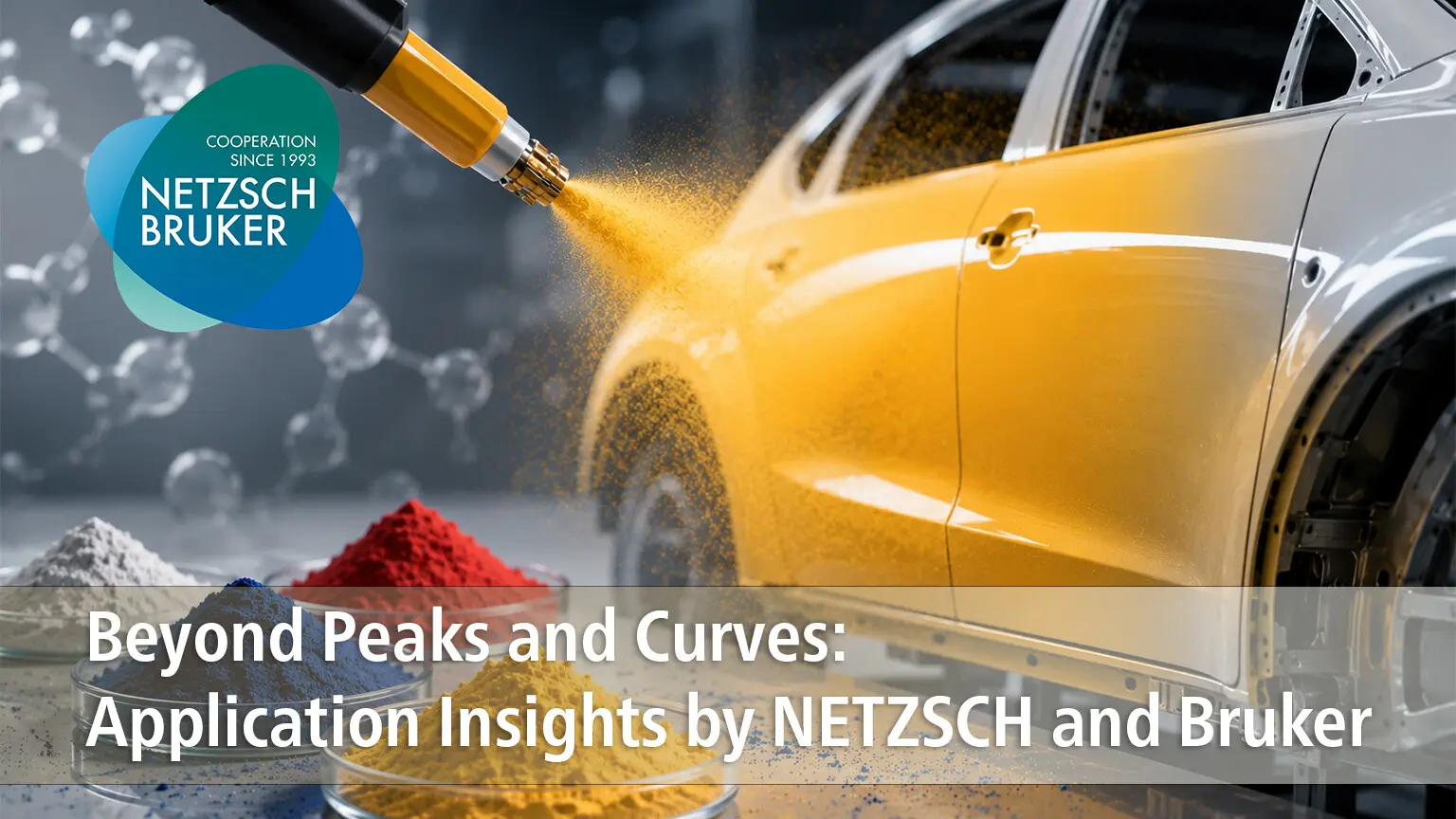
Powder coatings are gaining ground in the automotive industry — and for good reasons. They meet strict environmental standards by minimizing emissions during the Curing (Crosslinking Reactions)Literally translated, the term “crosslinking“ means “cross networking”. In the chemical context, it is used for reactions in which molecules are linked together by introducing covalent bonds and forming three-dimensional networks.curing process and delivering high-quality, durable surface finishes. However, achieving flawless results requires understanding of the coating’s chemistry in detail: its Curing (Crosslinking Reactions)Literally translated, the term “crosslinking“ means “cross networking”. In the chemical context, it is used for reactions in which molecules are linked together by introducing covalent bonds and forming three-dimensional networks.curing behavior, Thermal StabilityA material is thermally stable if it does not decompose under the influence of temperature. One way to determine the thermal stability of a substance is to use a TGA (thermogravimetric analyzer). thermal stability, and the nature of any gases released during processing.
In this article from our blog series “Beyond Peaks and Curves: Application Insights by NETZSCH and Bruker”, we demonstrate how two complementary analytical techniques — Differential Scanning Calorimetry (DSC) and Thermogravimetric Analysis coupled with FT-IR spectroscopy (TGA-FT-IR) — combine to provide a comprehensive characterization of a polyurethane (PUR)-based powder coating.
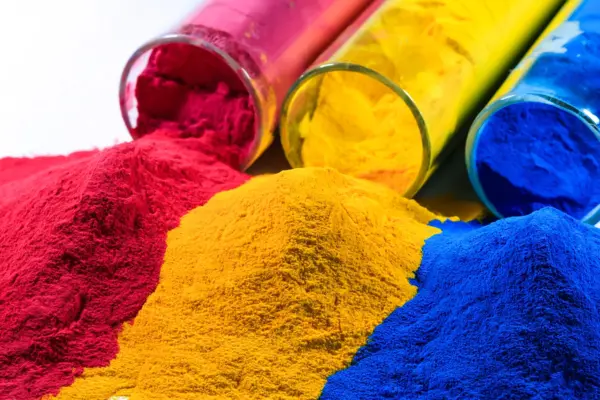
Why Understanding Powder Coating Chemistry Matters
In automotive manufacturing, powder coatings must meet demanding requirements for surface quality, mechanical performance, and long-term durability. Even minor variations in formulation or Curing (Crosslinking Reactions)Literally translated, the term “crosslinking“ means “cross networking”. In the chemical context, it is used for reactions in which molecules are linked together by introducing covalent bonds and forming three-dimensional networks.curing conditions can lead to defects such as uneven gloss, poor adhesion, or unexpected outgassing.
For process engineers, quality control laboratories, and coating developers, a reliable analytical approach to characterize both Curing (Crosslinking Reactions)Literally translated, the term “crosslinking“ means “cross networking”. In the chemical context, it is used for reactions in which molecules are linked together by introducing covalent bonds and forming three-dimensional networks.curing behavior and Decomposition reactionA decomposition reaction is a thermally induced reaction of a chemical compound forming solid and/or gaseous products. decomposition chemistry is essential. This is particularly relevant when:
- Qualifying new powder coating formulations
- Optimizing curing parameters for production
- Investigating defects or batch-to-batch variations
- Understanding the chemical nature of emissions during curing
DSC: Characterizing the Curing Reaction
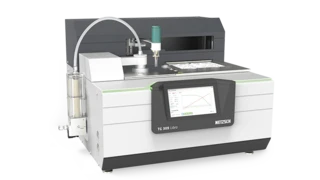
Differential Scanning Calorimetry (DSC) provides a fast and precise description of the curing reaction. By measuring the ExothermicA sample transition or a reaction is exothermic if heat is generated.exothermic heat flow at different heating rates, DSC captures:
- The Glass Transition TemperatureThe glass transition is one of the most important properties of amorphous and semi-crystalline materials, e.g., inorganic glasses, amorphous metals, polymers, pharmaceuticals and food ingredients, etc., and describes the temperature region where the mechanical properties of the materials change from hard and brittle to more soft, deformable or rubbery.glass transition temperature of the uncured powder
- The ExothermicA sample transition or a reaction is exothermic if heat is generated.exothermic curing reaction and its temperature range
- The degree of cross-linking achieved
When combined with reaction kinetic evaluation using software such as NETZSCH Kinetics Neo, DSC data from multiple heating rates can be fitted to determine the reaction model. In the case of the PUR powder coating studied here, the curing reaction follows a three-step mechanism of nth-order — information that enables reliable predictions of IsothermalTests at controlled and constant temperature are called isothermal.isothermal curing behavior at different process temperatures.
These engineering predictions are invaluable for defining optimal curing schedules in production.
TGA-FT-IR: Identifying What Is Released and When
While DSC describes the energetics of curing, it does not reveal which chemical species are released during the process. This is where TGA-FT-IR provides essential complementary insight.
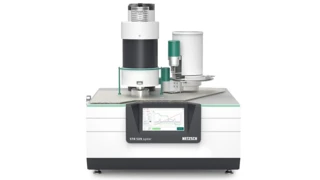
By coupling a NETZSCH thermobalance with a Bruker FT-IR spectrometer (e.g., the INVENIO platform), mass-loss events are directly correlated with the chemical identity of evolved gases through their characteristic infrared absorption spectra.
The measurement of the PUR powder coating from room temperature to 500°C revealed a detailed chemical picture:
- At 85°C: Small emissions of methacrylic acid — even before the main curing reaction begins, corresponding to only 0.2% mass loss
- At 203°C: Clear identification of carbon dioxide and isocyanic acid, coinciding with the ExothermicA sample transition or a reaction is exothermic if heat is generated.exothermic curing reaction observed by DSC
- At 315°C: Continued evolution of methacrylic acid with subordinate isocyanic acid
- At 353°C: Main Decomposition reactionA decomposition reaction is a thermally induced reaction of a chemical compound forming solid and/or gaseous products. decomposition step — dominated by methacrylic acid with a maximum emission of methanol
- Two-step Decomposition reactionA decomposition reaction is a thermally induced reaction of a chemical compound forming solid and/or gaseous products. decomposition at 353°C and 411°C, accompanied by the release of CO₂ and methanol
Connecting the Dots: DSC Meets TGA-FT-IR
The real strength of this approach lies in combining both techniques. The results correlate directly:
The release of isocyanic acid during the curing reaction indicates the presence of encapsulated or sterically hindered isocyanate groups that cannot fully participate in the polyaddition reaction — a critical insight for formulation optimization.
The early emission of methacrylic acid at 85°C is not visible in the DSC curve at all, demonstrating that TGA-FT-IR detects chemical events that thermal analysis alone would miss.
Together, DSC and TGA-FT-IR deliver:
- Complete characterization of the curing reaction (kinetics, mechanism, degree of cross-linking)
- Identification of all evolved gas species at each temperature
- Direct correlation between mass loss and chemical identity
- Actionable insights for curing optimization and emission control
👉 Learn More in the Full Application Note
This blog highlights the key findings and analytical concepts. For detailed experimental conditions, measurement curves, spectra, and full data interpretation, read the complete application note:
From Automotive Coatings to Broader Applications
TGA-FT-IR coupled with DSC is not limited to powder coatings. This combined approach supports a wide range of applications, including:
- Analysis of the outgassing materials
- Detection of residues and additives
- Characterization of aging processes
- Analysis of Decomposition reactionA decomposition reaction is a thermally induced reaction of a chemical compound forming solid and/or gaseous products. decomposition and synthesis reactions
- Competitive analysis and incoming material inspection
By combining thermal information with the chemical identification of evolved gases, laboratories gain the deep understanding needed to develop better materials and optimize manufacturing processes.
A Long-Standing Partnership: NETZSCH and Bruker
The seamless integration of thermal analysis and FT-IR spectroscopy is the result of a collaboration between NETZSCH and Bruker Optics that dates back to 1993. This long-standing partnership allows for:
- Optimized gas transfer interfaces between thermobalance and spectrometer
- Reliable synchronization of thermal and spectroscopic data
- Application-ready solutions backed by decades of joint expertise


Become an Expert with our Free E-Learning Courses
All NETZSCH E-Learning Basic Courses are free of charge! The content is created by our laboratory method experts, who share their personal experiences with you. Take advantage of flexible online learning, fully adapted to your training needs!